Organisational Design (Edexcel A Level Business): Revision Note
Exam code: 9BS0

Understanding organisational structure terminology
Organisational structure outlines the reporting relationships, roles and responsibilities of employees in the organisation
Businesses must determine what the best structure is for them to effectively implement their ideas and achieve their objectives
They should consider how the structure may affect the management and effectiveness of operations and communications
A well-designed organisational structure helps to promote clarity, efficiency and accountability
Terminology used in organisational design
Term | Definition | Explanation |
|---|---|---|
Hierarchy |
|
|
Chain of command |
|
|
Span of control |
|
|
Centralised structure |
|
|
Decentralised structure |
|
|
Different types of organisational structure
Businesses typically structure their organisation in one of three ways:
Tall organisational structures
Flat organisational structure
Matrix organisational structure
Tall organisational structures
Tall structures are characterised by multiple levels of management and a more centralised decision-making process
A long chain of command
Common in large organisations with complex operations, e.g. government agencies and universities
A tall organisational structure

A narrow span of control in a tall structure allows managers to closely supervise and support each employee, which can improve decision quality
However, the many layers of management can slow communication and reduce efficiency
Clear, narrow job roles and a defined promotion path can improve motivation, though limited autonomy at lower levels can reduce it
Evaluation of tall structures
Advantages |
|
|---|---|
Disadvantages |
|
Flat organisational structures
Flat structures are characterised by fewer levels of management and a more decentralised decision-making process
A short chain of command
Common in small organisations or start-ups
E.g. technology start-ups and small businesses
A flat organisational structure

A wide span of control in a flat structure gives employees greater autonomy and responsibility, which tends to improve motivation
However, managers may struggle to closely supervise a large number of staff, reducing efficiency if standards slip
Fewer layers of management mean decisions and communication travel faster, improving efficiency
Evaluation of flat structures
Advantages |
|
|---|---|
Disadvantages |
|
Matrix organisational structures
Matrix structures are usually built around specific products or projects
E.g. KitKat has its own team within Nestlé
They combine the functional areas of a business (human resources, finance, marketing, sales) with a specialist team that operates inside the business
A matrix organisational structure
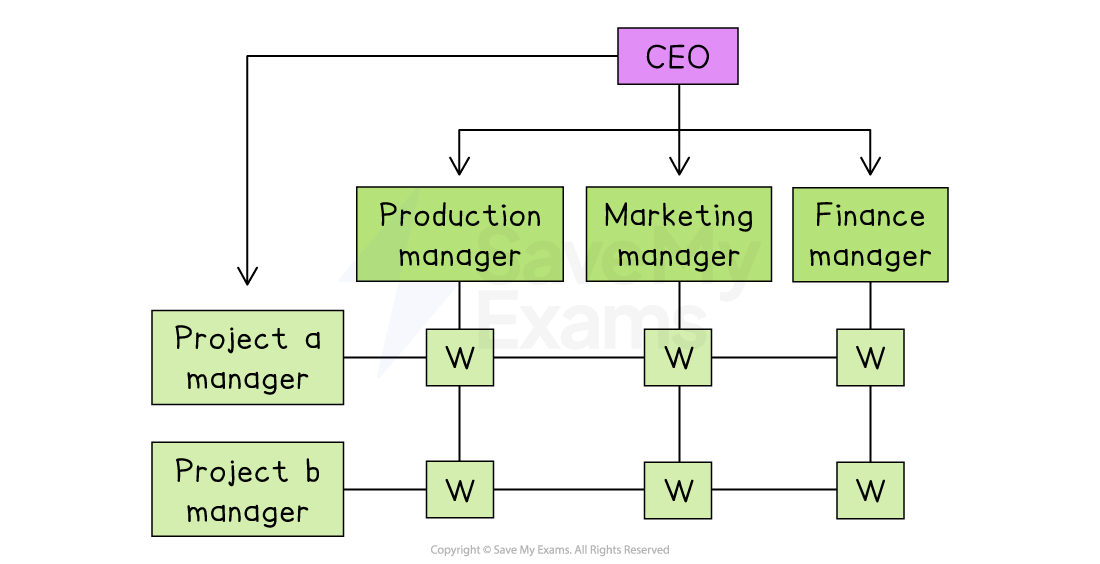
Employees in a matrix structure often report to more than one manager, which can improve motivation by exposing staff to varied projects and skills
However, conflicting instructions from different managers can reduce efficiency and cause confusion over priorities
Evaluation of matrix structures
Advantages |
|
|---|---|
Disadvantages |
|

Unlock more, it's free!
Join the 100,000+ Students that ❤️ Save My Exams
the (exam) results speak for themselves:

Was this revision note helpful?
Build on this topic