Analysing Newspaper Articles (DP IB English A: Language and Literature: SL): Revision Note

Analysing Newspaper Articles
Paper 1 asks you to analyse unseen non-literary texts. A non-literary text broadly means a text that is not a novel, poetry, drama or literary non-fiction (such as a memoir). While you cannot predict what type of text will come up in the exam, it is a good idea to practise analysing common text types so that you are familiar with typical features and conventions of a variety of texts.
One type of text you may be asked to analyse is newspaper articles.
Here, we will cover these aspects of analysing newspaper articles:
Overview of newspaper articles
Newspaper articles: genre norms
How to analyse newspaper articles
Newspaper articles: Paper 1 model answer
Overview of newspaper articles
A newspaper article is a written text that informs readers of a current event or topic.
The style and structure of the article will vary according to the newspaper it appears in, its context and the audience. Generally, articles are either tabloid, broadsheet or online.
To convincingly analyse a newspaper article, you need to be able to make detailed, specific claims about what it is trying to do and why (see more in Approaching Unseen Non-Literary Texts: Purpose, Audience, Context).
Purpose
Usually, newspaper articles have the same purpose: to inform the reader.
They may also have secondary purposes. Other possible purposes to consider include:
Raising topic awareness
Following up on a news story
Providing an overview or summary of a topic
Prompting discussion
Audience
The intended audience of a newspaper article is who it is targeted at and who it was made for. To effectively identify the intended audience of the article, ask yourself:
Who is the newspaper article aimed at?
What type of person would notice/pay attention to/be interested in/be impacted by the article?
Consider age, gender, demographics, interests, lifestyle, values, and concerns
Newspaper articles appear in print newspapers or online news sites:
These papers and sites often have loyal readers or subscribers
The article may align with broader audience expectations of that newspaper or site
Context
The context is the facts of time and place that influence how and why an article was written in the way that it was. To effectively identify the context of the newspaper article, ask yourself:
When was the text made?
Where was the text made?
What economic/political/cultural/social factors influence how the text was made and how it might be received (i.e., the context of production and the context of reception)?
Examiner Tips and Tricks
Honing the skill of identifying specific purposes, audiences and contexts can help you score well on multiple criteria: Criterion D: Language, because you are using effective, accurate and precise vocabulary for textual analysis; Criterion A, because you are showing understanding of the text; and Criterion B, because you can make convincing analytical claims by evaluating how a specific textual feature allows the writer to achieve their specific purpose on a specific audience in a specific context.
Newspaper articles: genre norms
Criterion B in Paper 1 assesses your ability to analyse how a text achieves a purpose or has an impact on the audience. While many textual features can be found across text types, some are specific to certain text types.
Here, we will examine some genre norms and techniques that are frequently found in newspaper articles.
Examiner Tips and Tricks
Criterion D assesses your use of effective and appropriate language. One good way to do well in this is to use subject-specific vocabulary when naming textual features. However, overly using technical language without fully understanding its meaning is not effective. Use the list below to examine newspaper articles and understand how they are constructed. Ensure you understand the terms and build a dictionary with definitions that make sense to you.
While newspaper articles are primarily written texts, some visuals may be relevant in terms of how we read them. You need to be able to interpret how these elements impact the reader.
Not all of these stylistic features are found in all newspaper articles, but it is a good idea to look out for them as you begin to annotate and analyse.
Stylistic feature | What to look out for |
Masthead |
|
Headline and lead |
|
Photographs |
|
Copy |
|
Diction |
|
Quotes and statistics |
|
How to analyse newspaper articles
Before you write an answer to any Paper 1 question, it is important that you select the best evidence from your source text. A great way to do this is to identify the focus of the guiding question, and then annotate your text with this focus in mind.
Here is an example of how you might annotate a newspaper article in the exam:
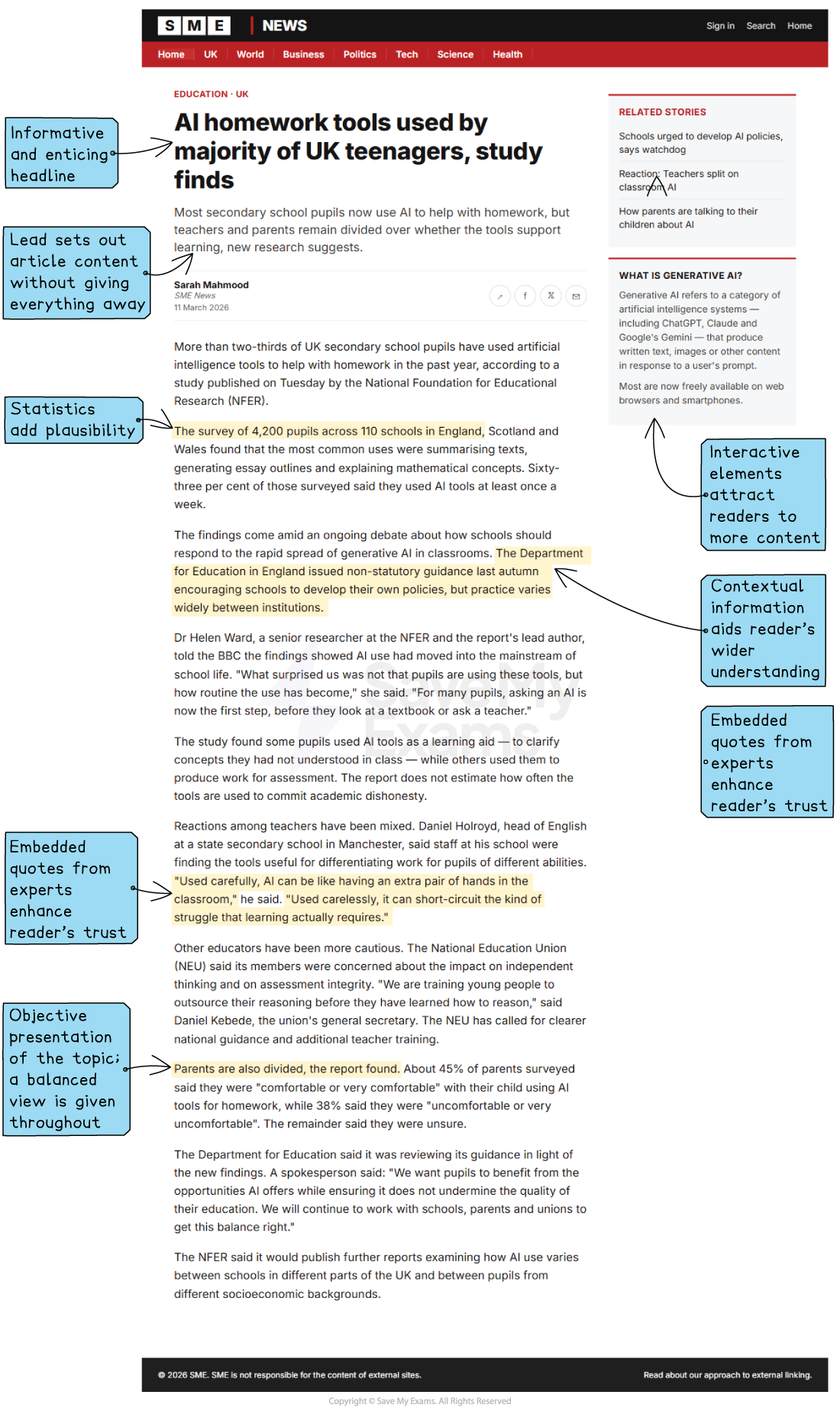
Newspaper articles: Paper 1 model answer
Below is a top-mark answer to the following Paper 1 question on a magazine cover. We’ve included where the answer has hit the assessment criteria to show you exactly why it would achieve full marks.
Source: Sarah Mahmood SME newspaper article, March 2026 Question: How and to what effect does the writer present a balanced perspective on a contested topic? |
The 2026 SME newspaper article by Sarah Mahmood provides an informative and objective take on the use of AI as a tool for secondary school students.
The headline sets out the context and topic clearly, with the reference to the “majority of UK teenagers” likely to catch the eye of the target audience: working British adults and families. The lead provides additional information on the reason for the use of AI as a “help with homework” and the important difference in experts’ opinions on the topic, with “teachers and parents remaining divided” encouraging further reading.
Mahmood then clearly and concisely presents statistics from cited reliable sources. These details provide additional detail on when, where and how AI is being used by students, so the reader is adequately informed on the scale of the issue. This is followed by contextual information on the broader topic of AI in education and the “ongoing debate”. The juxtaposition of the Department for Education's “guidance” with the “widely” varying practice highlights the lack of certainty on the topic and implicitly justifies the importance of the article.
The article then provides a summary of the study with embedded quotes from a senior researcher from the National Foundation for Educational Research. She details the reasons students use it, with familiar everyday examples such as “to clarify concepts”. This is informative and perceived as trustworthy and well-researched information.
This summary is followed by a well-ordered and balanced presentation of two sides of an argument around the pros and cons of AI for students. The topic sentence “Reactions among teachers have been mixed” hints at this objective summary and will likely appeal to the reader trying to understand the topic, especially if they are teachers or parents themselves. Again, the embedded quotes from experts in the field (both teachers and parents) are presented without emotion or sensationalism, in keeping with a non-tabloid newspaper article. Statistics show the divide in simple, data-based facts before the article concludes with a brief summary of the next steps: that is, a review of guidance, continued work and further reports.

Unlock more, it's free!
Join the 100,000+ Students that ❤️ Save My Exams
the (exam) results speak for themselves:

Was this revision note helpful?