Analysing Cartoons (DP IB English A: Language and Literature: SL): Revision Note

Analysing Cartoons
Paper 1 asks you to analyse unseen non-literary texts. A non-literary text broadly means a text that is not a novel, poetry, drama or literary non-fiction (such as a memoir). While you cannot predict what type of text will come up in the exam, it is a good idea to practise analysing common text types so that you are familiar with typical features and conventions of a variety of texts.
One type of text you may be asked to analyse is a cartoon or comic strip.
Here, we will cover these aspects of analysing cartoons:
Overview of cartoons
Cartoons: genre norms
How to analyse cartoons
Cartoons: Paper 1 model answer
Overview of cartoons
A cartoon or comic strip is a multi-modal text that combines visuals and text to comment on an issue or explore a theme.
The style and structure of the cartoon will vary according to the artist, purpose, context and audience. In order to convincingly analyse a cartoon, you need to be able to make detailed, specific claims about what it is trying to do and why (see more in Approaching Unseen Non-Literary Texts: Purpose, Audience, Context).
Purpose
Although there are many types of comic or cartoons, a popular subcategory that may feature in your Paper 1 exam is political cartoons. Usually, political cartoons have the same purpose: to comment on a political issue.
They may also have secondary purposes. Other possible purposes to consider include:
Raising topic awareness
Provoking debate
Persuading the audience to support, feel or think something
Audience
The intended audience of a cartoon is who the cartoon is targeted at and who it was made for. To effectively identify the intended audience of the cartoon, ask yourself:
Who is the cartoon aimed at?
What type of person would notice/pay attention to/be interested in/be impacted by the cartoon?
Consider age, gender, demographics, interests, lifestyle, values, and concerns
Political cartoons often appear in a newspaper, so the intended audience is the readership of that newspaper:
Sometimes, these newspapers may have a political leaning and, therefore, so would the readers of the newspaper
Context
The context is the facts of time and place that influence how and why a cartoon was made in the way that it was. To effectively identify the context of the cartoon, ask yourself:
When was the text made?
Where was the text made?
What economic/political/cultural/social factors influence how the text was made and how it might be received (i.e., the context of production and the context of reception)?
For political cartoons, you should also consider the bias and perspective of the cartoonist
Examiner Tips and Tricks
Honing the skill of identifying specific purposes, audiences and contexts can help you score well on multiple criteria: Criterion D: Language, because you are using effective, accurate and precise vocabulary for textual analysis; Criterion A, because you are showing understanding of the text; and Criterion B, because you can make convincing analytical claims by evaluating how a specific textual feature allows the writer to achieve their specific purpose on a specific audience in a specific context.
Cartoons: genre norms
Criterion B in Paper 1 assesses your ability to analyse how a text achieves a purpose or has an impact on the audience. While many textual features can be found across text types, some are specific to certain text types.
Here, we will examine some genre norms and techniques that are frequently found in cartoons or comic strips.
Examiner Tips and Tricks
Criterion D assesses your use of effective and appropriate language. One good way to do well in this is to use subject-specific vocabulary when naming textual features. However, overly using technical language without fully understanding its meaning is not effective. Use the list below to examine cartoons and comics and understand how they are constructed. Ensure you understand the terms and build a dictionary with definitions that make sense to you.
Cartoons are multi-modal texts, that is, they make use of both visual and textual elements. You need to be able to interpret how these elements work and how they work together.
Not all of these stylistic features are found in all cartoons, but it is a good idea to look out for them as you begin to annotate and analyse any political cartoon.
| |
Irony |
|
| |
Exaggeration/hyperbole |
|
Labelling |
|
Emanata |
|
Speech bubbles |
|
| |
Graphic weighting |
|
Gaze, gesture and body language |
|
Colour connotation |
|
Symbols |
|
How to analyse cartoons
Before you write an answer to any Paper 1 question, it is important that you select the best evidence from your source text. A great way to do this is to identify the focus of the guiding question, and then annotate your text with this focus in mind.
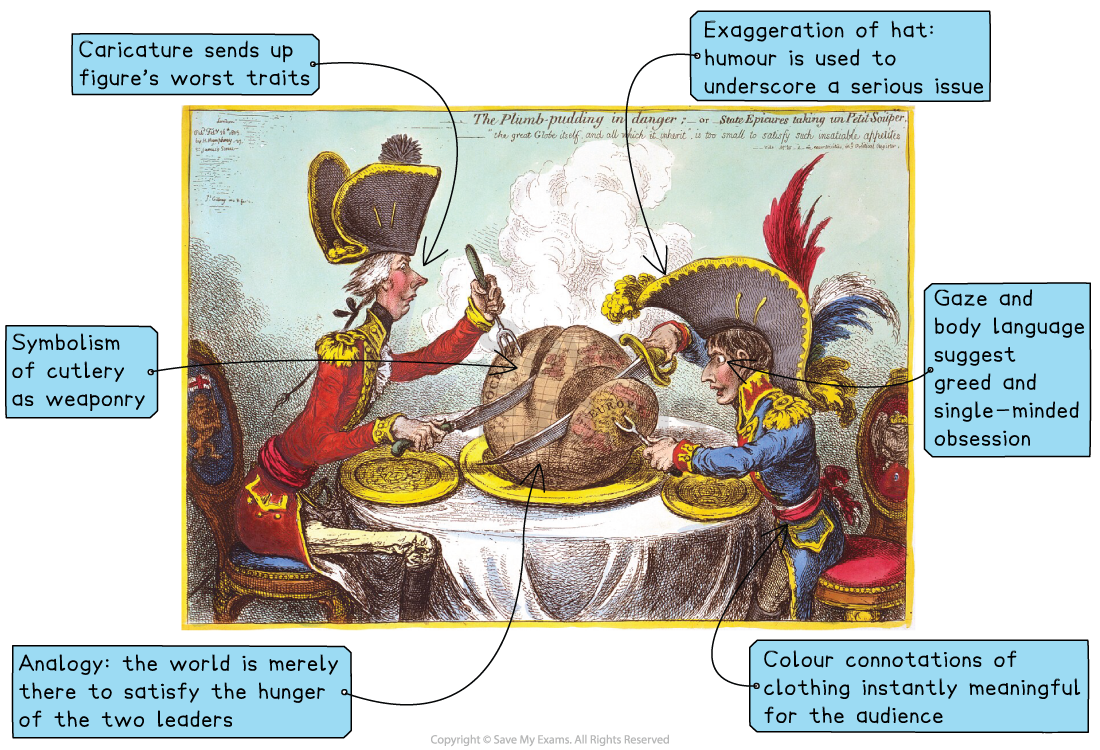
Here is an example of how you might annotate a political cartoon in the exam:
Cartoons: Paper 1 model answer
Below is a top-mark answer to the following Paper 1 question on a political cartoon. We’ve included where the answer has hit the assessment criteria to show you exactly why it would achieve full marks.
Source: James Gillray political cartoon, 1805 Question: Discuss how visual features are used in this cartoon to convey a political message. |
James Gillray’s 1805 political cartoon satirises European leaders’ rapacious desire for imperial power. Through analogy and caricature, he critiques the careless approach to other countries, cultures and civilisations as French and British leaders seek to metaphorically gobble up the world.
The focal point of the cartoon is the exaggerated eponymous endangered plum pudding at the centre of the text. Serving as an analogy for imperialism, the two leaders hungrily carve up the pudding marked with lines of longitude and latitude and labelled as a globe.
Gillray’s caricature of Napoleon Bonaparte and William Pitt sees the former depicted as short and the latter as tall and skinny. This visual reference helps the audience know who the figures are, as it plays on their most recognisable, and often mocked, physical characteristics. The symbolic colour of their clothing further emphasises this with the blue imperial coat of Napoleon and the red military coat of Pitt. The comically hyperbolic hats imbue the figures with pomp and satirise their supposed grandeur. Napoleon wields a gold-handled sword, while Pitt has a trident and knife symbolising their respective prowess in the army and navy. Pitt carves the Atlantic Ocean, suggesting Britain’s naval strength, while Napoleon takes a huge slice of Europe, alluding to his desire for power across the continent.
The body language and gaze of both men are a mirror of each other: they both stare at the pudding (Napoleon with almost demonic greed) and lift up their arms to carve enthusiastically. The gold plates are also mirrored on both sides of the pudding. Through these choices, we can conclude that Gillray is not embarking on pro-British, anti-French commentary here. Instead, he is critiquing both countries’ imperialistic drive.
Despite its humour and seemingly innocent setting of a dinner table, Gillray’s cartoon makes a sharp criticism of the carelessness and callousness with which both men embark on global dominance.
Sources
Gillray, J. (1805), The Plumb-pudding in Danger; or, State Epicures taking un Petit Souper [Etching]. Available at: https://commons.wikimedia.org/wiki/File:James_Gillray_-_The_Plum-Pudding_in_Danger_-_WGA08993.jpg (opens in a new tab) (Public domain).

Unlock more, it's free!
Join the 100,000+ Students that ❤️ Save My Exams
the (exam) results speak for themselves:

Was this revision note helpful?