Analysing Blogs (DP IB English A: Language and Literature: SL): Revision Note

Analysing Blogs
Paper 1 asks you to analyse unseen non-literary texts. A non-literary text broadly means a text that is not a novel, poetry, drama or literary non-fiction (such as a memoir). While you cannot predict what type of text will come up in the exam, it is a good idea to practise analysing common text types so that you are familiar with typical features and conventions of a variety of texts.
One type of text you may be asked to analyse is blogs.
Here, we will cover these aspects of analysing blogs:
Overview of blogs
Blogs: genre norms
How to analyse blogs
Blogs: Paper 1 model answer
Overview of blogs
Blogs are multi-modal (meaning they feature both textual and visual elements) online texts that have flexible purposes but are usually written by an individual working independently to appeal to regular readers and attract new readers.
In order to convincingly analyse a blog, you need to be able to make detailed, specific claims about what it is trying to do and why (see more in Approaching Unseen Non-Literary Texts: Purpose, Audience, Context).
Purpose
The purpose of a blog is the reason it was made. To effectively identify the purpose, ask yourself:
What is the writer trying to achieve?
What is the writer trying to make the audience feel/think/do?
While it seems logical to conclude that blogs aim to recount an individual’s experiences or opinions, this is not always the case.
Other possible purposes to consider include:
Exploring cultural/social/political issues
Prompting reflection
Inspiring action or change
Audience
The intended audience of the blog is who it is targeted at and who it was made for. To effectively identify the intended audience of the blog, ask yourself:
Who is the blog aimed at?
What type of person would notice/pay attention to/be interested in/be impacted by the text?
Consider age, gender, demographics, interests, lifestyle, values, concerns
Does the blog appeal only to existing fans/subscribers or also to new readers?
Context
The context is the facts of time and place that influence how and why a blog was made. To effectively identify the context of the text, ask yourself:
When was the text made?
Where was the text made?
What economic/political/cultural/social factors influence how the text was made and how it might be received (i.e., the context of production and the context of reception)?
Examiner Tips and Tricks
Honing the skill of identifying specific purposes, audiences and contexts can help you score well on multiple criteria: Criterion D: Language, because you are using effective, accurate and precise vocabulary for textual analysis; Criterion A, because you are showing understanding of the text; and Criterion B, because you can make convincing analytical claims by evaluating how a specific textual feature allows the writer to achieve their specific purpose on a specific audience in a specific context.
How to analyse blogs
Before you write an answer to any Paper 1 question, it is important that you select the best evidence from your source text. A great way to do this is to identify the focus of the guiding question, and then annotate your text with this focus in mind.
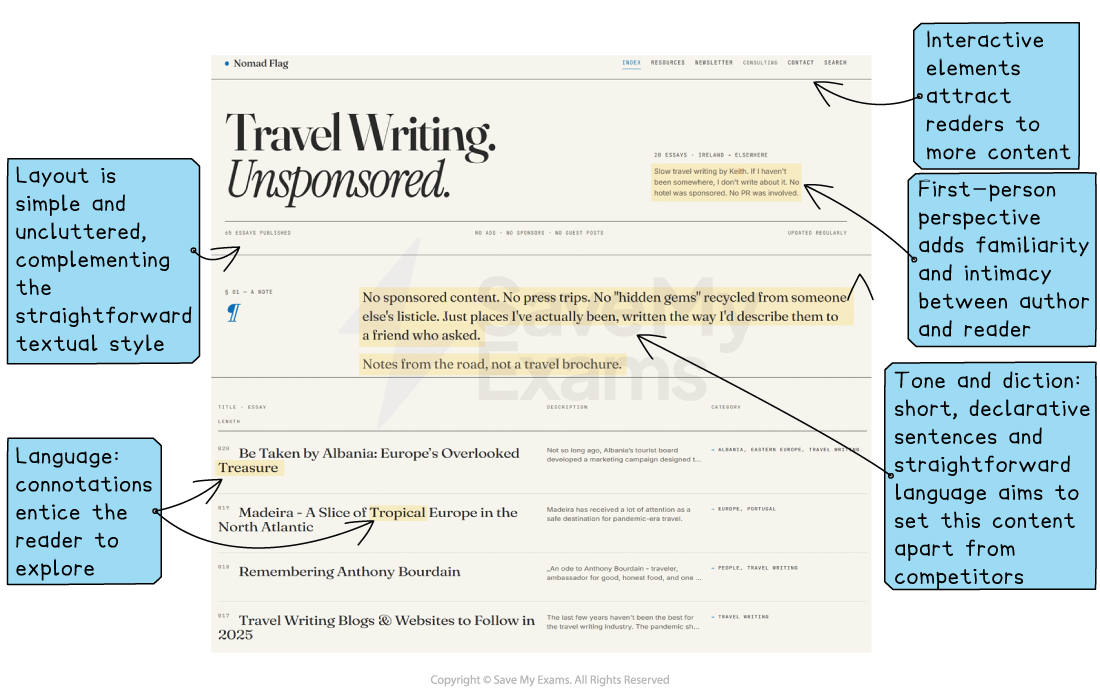
Here is an example of how you might annotate a blog in the exam:
Blogs: genre norms
Criterion B in Paper 1 assesses your ability to analyse how a text achieves a purpose or has an impact on the audience. While many textual features can be found across text types, some are specific to certain text types.
Here, we will examine some genre norms and techniques that are frequently found in blogs.
Examiner Tips and Tricks
Criterion D assesses your use of effective and appropriate language. One good way to do well in this is to use subject-specific vocabulary when naming textual features. However, overly using technical language without fully understanding its meaning is not effective. Use the list below to examine blogs and understand how they are constructed. Ensure you understand the terms and build a dictionary with definitions that make sense to you.
Blogs are multi-modal texts, that is, they make use of both visual and textual elements. You need to be able to interpret how these elements work and how they work together.
Not all of these stylistic features are found in all blogs, but it is a good idea to look out for them as you begin to annotate and analyse any blog.
First-person perspective |
|
| |
Information balanced with description |
|
Visuals |
|
Diction and tone |
|
Interactive elements |
|
Blogs: Paper 1 model answer
Below is a top-mark answer to the following Paper 1 question on a blog. We’ve included where the answer has hit the assessment criteria to show you exactly why it would achieve full marks.
Source: Nomadflag blog, Keith Lang, 2016–present Question: Examine how the writer uses language and design to present the blog as authentic and credible. |
Keith Lang’s blog, Nomadflag, invites readers to explore content on travel from the perspective of an independent writer. With effective layout and clever diction, Lang presents his blog as authentic and credible for both the armchair and real traveller interested in exploring the world.
The homepage of Nomadflag employs a layout that invites interaction without feeling overwhelming or chaotic. The pared-back colour scheme of pale coffee and black connotes the lack of showiness and artifice that Lang positions himself against. Clear and carefully selected tabs in the right-hand corner invite interaction with the content. The masthead and lead are dominant and eye-catching with typography and spacing that draw the eye without feeling cluttered. The note describing the style and content of the blog is bordered neatly before the reader scrolls to the blog entries. These are listed by number and in a table with headings on title, description and category, allowing the reader to scroll and choose content in a calm but informed way.
Lang’s use of language makes the blog seem informative and authentic. The large, italicised text reading “Unsponsored” in the masthead emphasises his independence as a writer, and this is further emphasised in the parallel “No ads, no sponsors, no guest posts”. His bio note uses his first name, connecting on a personal level with the reader, and uses the first person to state his stance on travel writing: “If I haven’t been somewhere, I don’t write about it”. This implicitly places Nomadflag in contrast to other online content that lacks authenticity, so the reader feels a sense of trust and is enticed to engage with the content. Before the links to the blog entries, the note introduces the reader to the style of content to expect. Again, parallelism in “No sponsored content. No press trips. No ‘hidden gems’” and the first-person voice in “places I’ve actually been, written the way I’d describe them to a friend who asked” differentiates the blog from artificial, for-profit online content for the reader who is looking for genuine travel writing. The titles of the blog entries balance information with description to entice the reader to click. For example, the connotation of “overlooked treasure” and “a slice of tropical Europe in the North Atlantic” make the reader feel that they will get information on real destinations that are not mere trends.
Overall, Lang uses online design and language to create an alluring text for the discerning traveller and reader. Distinguishing the blog from other, less authentic or unbiased travel writing, he promises detail, description and information from lived experiences, encouraging us to read and wander in our imaginations or read and be inspired to hop on a plane.
Sources
Lang, K. (2026), Nomadflag [Blog]. Available at: https://nomadflag.com (opens in a new tab).

Unlock more, it's free!
Join the 100,000+ Students that ❤️ Save My Exams
the (exam) results speak for themselves:

Was this revision note helpful?