Analysing Photography (DP IB English A: Language and Literature: SL): Revision Note

Analysing Photographs
Paper 1 asks you to analyse unseen non-literary texts. A non-literary text broadly means a text that is not a novel, poetry, drama or literary non-fiction (such as a memoir). While you cannot predict what type of text will come up in the exam, it is a good idea to practise analysing common text types so that you are familiar with typical features and conventions of a variety of texts.
One type of text you may be asked to analyse is photographs.
Here we will cover these aspects of analysing photographs:
Overview of photographs
Photographs: genre norms
How to analyse photographs
Photographs: Paper 1 model answer
Overview of photographs
Photographs are visual texts that aim to capture a moment or tell a story without words.
In order to convincingly analyse a photograph, you need to be able to make detailed, specific claims about what it is trying to do and why (see more in Approaching Unseen Non-Literary Texts: Purpose, Audience, Context).
Purpose
The purpose of a photograph is the reason it was made. To effectively identify the purpose of the photograph, ask yourself:
What is the photographer trying to achieve?
What is the photographer trying to make the audience feel/think/do?
What genre of photography is the photograph part of, and how does this determine the purpose?
While it seems logical to conclude that photographs are trying to capture a moment, other possible purposes to consider include:
Raising awareness of an issue
Prompting a reaction or emotion in the audience
Documenting and recording important events
Audience
The intended audience of a photograph is who the photograph is targeted at and who it was made for. To effectively identify the intended audience of the photograph, ask yourself:
Who is the photograph aimed at?
What type of person would notice/pay attention to/be interested in/be impacted by the photograph?
Consider age, gender, demographics, interests, lifestyle, values, concerns
Context
The context is the facts of time and place that influence how and why a photograph was taken. To effectively identify the context of the photograph, ask yourself:
When was the photograph taken?
Where was the photograph taken?
What economic/political/cultural/social factors influence why the photograph was taken and how it might be received (i.e., the context of production and the context of reception)?
Where was the photograph published/displayed?
Examiner Tips and Tricks
Honing the skill of identifying specific purposes, audiences and contexts can help you score well on multiple criteria: Criterion D: Language, because you are using effective, accurate and precise vocabulary for textual analysis; Criterion A, because you are showing understanding of the text; and Criterion B, because you can make convincing analytical claims by evaluating how a specific textual feature allows the writer to achieve their specific purpose on a specific audience in a specific context.
Photographs: genre norms
Criterion B in Paper 1 assesses your ability to analyse how a text achieves a purpose or has an impact on the audience. While many textual features can be found across text types, some are specific to certain text types.
Here, we will examine some genre norms and techniques that are frequently found in photographs.
Examiner Tips and Tricks
Criterion D assesses your use of effective and appropriate language. One good way to do well in this is to use subject-specific vocabulary when naming textual features. However, overly using technical language without fully understanding its meaning is not effective. Use the list below to examine photographs and understand how they are constructed. Ensure you understand the terms and build a dictionary with definitions that make sense to you.
Photographs are visual texts. In order to score high marks, you need to be able to interpret how visual elements work.
Not all of these stylistic features are found in all photographs, but it is a good idea to look out for them as you begin to annotate and analyse photographs.
Composition |
|
Symbols |
|
Figures |
|
Gaze |
|
Colour |
|
Lighting |
|
Setting |
|
Perspective, framing, angles |
|
How to analyse photographs
Before you write an answer to any Paper 1 question, it is important that you select the best evidence from your source text. A great way to do this is to identify the focus of the guiding question, and then annotate your text with this focus in mind.
Here is an example of how you might annotate a photograph in the exam:
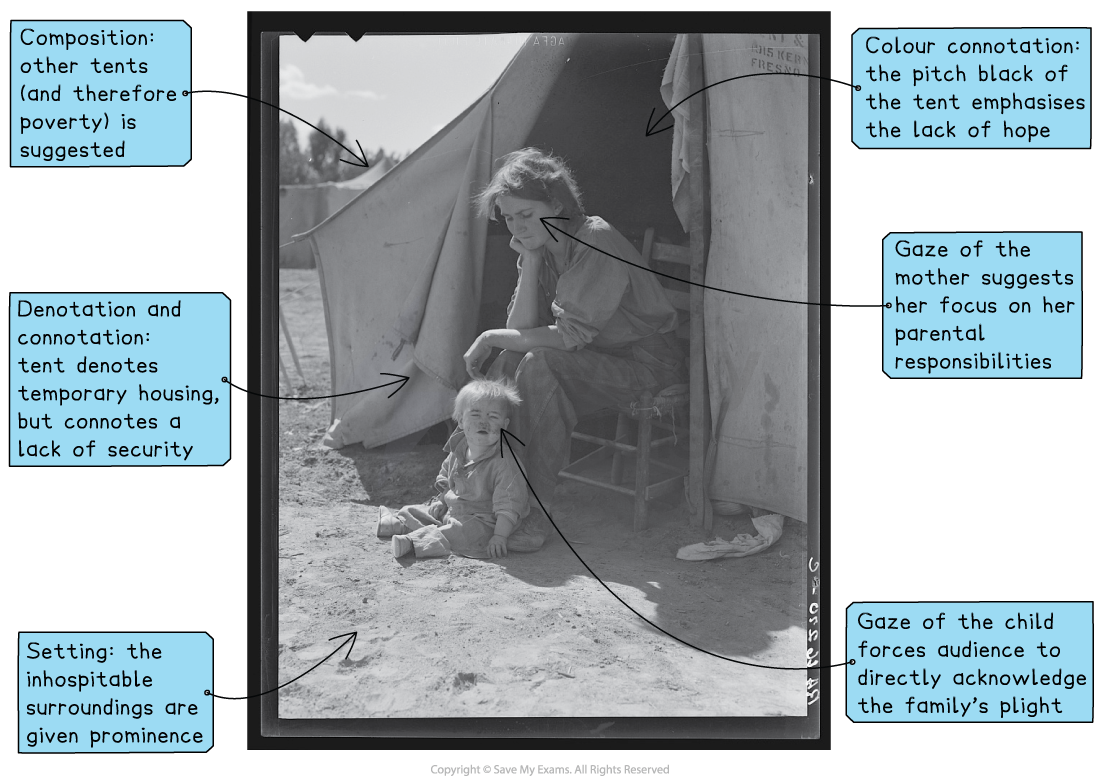
Photographs: Paper 1 model answer
Below is a top-mark answer to the following Paper 1 question on a photograph. We’ve included where the answer has hit the assessment criteria to show you exactly why it would achieve full marks.
Source: Dorothea Lange photograph, 1937 Question: Discuss how visual features are used in this photograph to convey the experience of its subjects. |
Dorothea Lange’s 1937 photograph of a young mother and child is part of Lange’s wider project on documenting the lives of migrant families in the Great Depression and Dust Bowl in 1930s America. Lange sought to highlight the realities of the economic crisis and remind the audience of comfortable Americans of the humanity and suffering of their compatriots.
The photograph reminds the viewer of the vulnerability of those without a reliable income in 1930s America. The composition of the photograph puts the family and their dwelling as the main focus point, with the background blurred but hinting at many other families facing the same challenges. The foreground emphasises the setting of the migrant’s camp with the light and shadows emphasising the dry, dusty dirt the child sits on. The viewer is left in no doubt that this is a harsh environment lacking fertility, hope or comfort.
The figures and objects convey the suffering experienced as a result of extreme poverty. The composition makes the tent dominate the frame, but lighting and shadow emphasise its fragility and unsuitability as a safe family home. Similarly, the only objects are the rickety wooden chair and the dirty blanket on the ground. These objects denote the real economic struggles, but also connote a lack of comfort or safety.
Framed by the flapping entrance to the tent, the eponymous young mother is the heart of the photo. The dark black of the tent behind her seems to symbolise the destitution she faces. Her thin body in overly big workclothes emphasises her youth and fragility, and her body language suggests self-protection or exhaustion. She gazes at her child, drawing our eye to his tiny body sitting in the dust. Again, he is dressed in oversized clothes, and his face is smeared with dirt. In the context, these signs evoke his vulnerability and lack of access to basic needs. The light glints off his messy blond hair, reminding us of his innocence as he gazes directly at the audience, demanding we do not look away.
Lange’s photographs captured a moment in American society and shone a light on economic hardships and inequalities. The women and children in her photographs embody resilience and survival in the face of immense hardship and suffering.
Sources
Lange, D. (1937), Eighteen year-old mother from Oklahoma, now a California migrant [Photograph], Library of Congress, Farm Security Administration / Office of War Information Collection. Available at: https://www.loc.gov/item/2017769788/ (opens in a new tab).

Unlock more, it's free!
Join the 100,000+ Students that ❤️ Save My Exams
the (exam) results speak for themselves:

Was this revision note helpful?