Approaching Unseen Non-Literary Texts: Purpose, Audience & Context (DP IB English A: Language and Literature: HL): Revision Note

Before writing a full Paper 1 response, you need to have identified key details of the text you are going to analyse. Identifying the purpose, audience and context will help you write a more fine-tuned and effective thesis statement, and it will allow you to make convincing analytical claims.
The purpose, audience and context of a text may influence the following authorial choices:
Tone and register
Diction
Stylistic and structural elements
References/allusion
Perspective
This section focuses on:
Understanding purpose, audience and context
Identifying purpose, audience and context
Looking at purpose, audience and context in sample texts
Understanding purpose, audience and context
Understanding purpose
The purpose of a text is the reason it was made. To effectively identify the purpose of the text, ask yourself:
What is the writer trying to achieve?
What is the writer trying to make the reader feel/think/do?
Why was the text made?
Understanding audience
The intended audience of a text is who the text is targeted at and who it was made for. To effectively identify the intended audience of the text, ask yourself
Who is the text aimed at?
What type of person would be interested in/impacted by the text?
Consider age, gender, demographics, interests, lifestyle, values, concerns
Understanding context
The context is the facts of time and place that influence how and why a text was made. To effectively identify the context of the text, ask yourself:
When was the text made?
Where was the text made?
What economic/political/cultural/social factors influence how the text was made?
How might it be received? Here, consider:
The context of production
The context of reception
Identifying purpose, audience and context
Identifying purpose
To identify the purpose of a text, we need to understand what the writer’s intention is. It is not enough to say an advertisement wants you to buy something, or a travel writer wants you to travel to the destination.
You need to be more nuanced and specific by considering the sub-purposes: how is the writer making you feel to make you want to buy the product? What emotion about the destination is the writer trying to evoke? The tone and mood of the text will help you narrow down the purpose.
Examiner Tips and Tricks
Honing the skill of identifying specific purposes can help you score well on multiple criteria:
Criterion D Language, because you are using effective, accurate and precise vocabulary for textual analysis
Criterion A, because you are showing understanding of the text
Criterion B, because you can make convincing analytical claims by evaluating how a specific textual feature allows the writer to achieve their specific purpose
It is a good idea to build a vocabulary bank in advance of the exam. Here is a list of possible purposes. Practise linking some of these to sample Paper 1 texts to hone your skills at identifying specific purposes.
Persuading
Describing
Informing
Narrating
Endorsing
Reflecting
Protesting
Calling to action
Mocking
Praising
Giving an opinion
Polemicizing
Criticising
Raising awareness
Entertaining
Clarifying
Highlighting logical relationships, trends, patterns
Identifying audience
To identify the intended audience, we need to use inductive and deductive reasoning. That is, first come to a general idea by looking at the text as a whole (e.g., teenagers), and then look for clues in the context, purpose and style and come to a logical conclusion about who specifically these details would most appeal to (e.g., sporty female teenagers interested in watching and/or playing basketball).
Examiner Tips and Tricks
Avoid vague statements on the intended audience, such as “all adults” or “people in Australia”. Statements like this are too broad and do not demonstrate a strong understanding of the text (Criterion A).
Instead, show how the writer’s specific stylistic choices appeal to a specific demographic. For example, “the use of the famous breakout basketball star appeals to young sports fans inspired by her athleticism and style”.
It is a good idea to brainstorm possible audience types against a checklist like this:
Ethnicity
Nationality
Class
Gender
Age
Level of education
Heritage/language/cultural identity
Field of interest/hobbies
Beliefs and values
Level of engagement with a topic or skill
Examiner Tips and Tricks
Remember, you might not be the demographic of the intended audience. Just because the text does not appeal to you or you do not find the authorial choices effective or impactful, that does not mean that the intended audience will not.
You need to put yourself in the intended audience’s shoes to make convincing and insightful analytical claims.
Combine your understanding of context (see below) with your understanding of the audience to imagine how the audience might feel or react to the text.
For example, an advertisement for cigarettes in the 1960s that has young, working men as its target audience will likely use textual features that would not appeal to a non-smoking, health-conscious 17-year-old girl in 2026. That does not mean the ad is not successful, since the latter is not its intended audience.
Identifying context
In order to identify context, you need to look for clues that help you identify the time and place of the text. Often, the exam paper will state clearly the year and location of publication. Other clues may be in references to well-known events or people. Broadly, you are trying to identify what was happening in the writer’s and the audience’s worlds when the text was made.
Examiner Tips and Tricks
Avoid making sweeping generalisations about a time and place. For example, it is not appropriate or accurate to make a claim like “All men were sexists in 1950s America, so this ad appeals to them”.
Instead, use the language of hedging and, crucially, support your claims with evidence from the text under analysis. For example, “The patriarchal norms in 1950s America celebrated the clearly defined gender roles we see depicted in this domestic scene; thus, the ad appeals to those wishing to conform to and emulate these roles”.
To use contextual details to inform your analysis, it is a good idea to consider these questions:
Where in the world was the text produced?
Does this influence the perspective?
When in the world was the text produced?
Does this influence stylistic choices?
Does this influence the message?
Does this influence the mood?
What platform/media/format was the text produced in?
Does this influence how we read it (e.g., a satirical political cartoon vs. a speech at the United Nations might be on the same topic but use very different styles)
What issues/trends were already happening?
How/why does the text engage with or respond to these?
Purpose, audience and context in sample texts
Here, we will look at some sample texts and how we can identify the purpose, audience and context to show good understanding of the texts (Criterion A) and use this understanding to build up to insightful analytical claims (Criterion B).
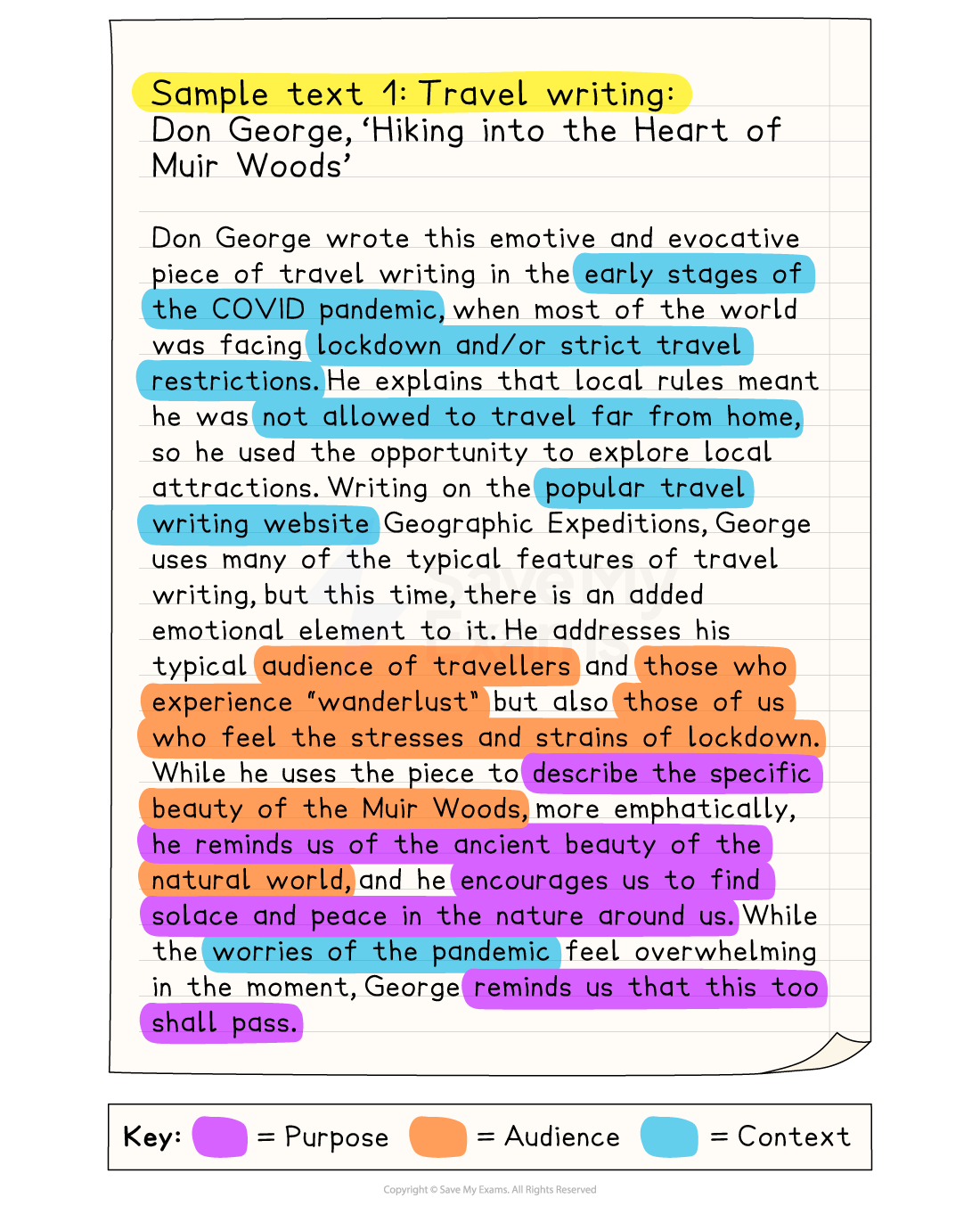
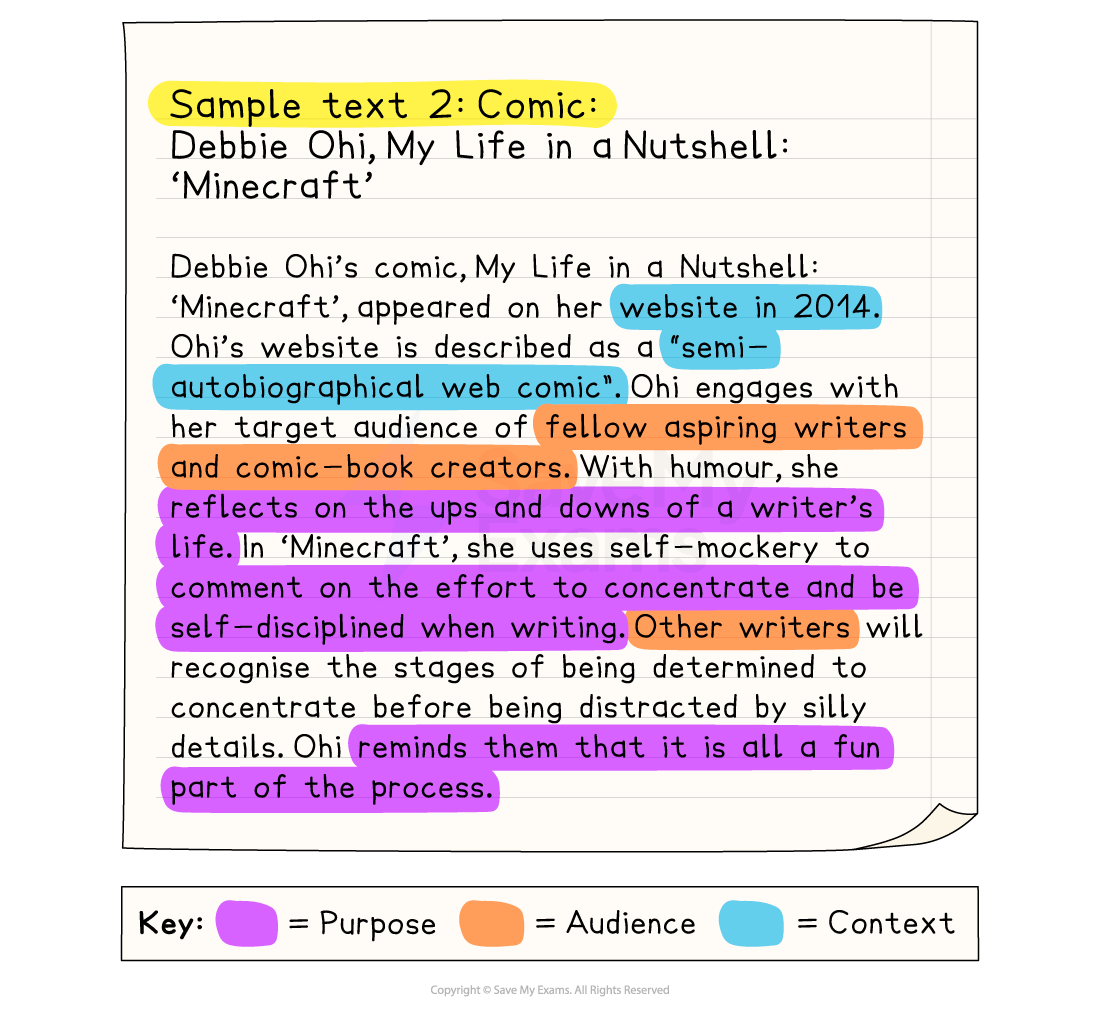
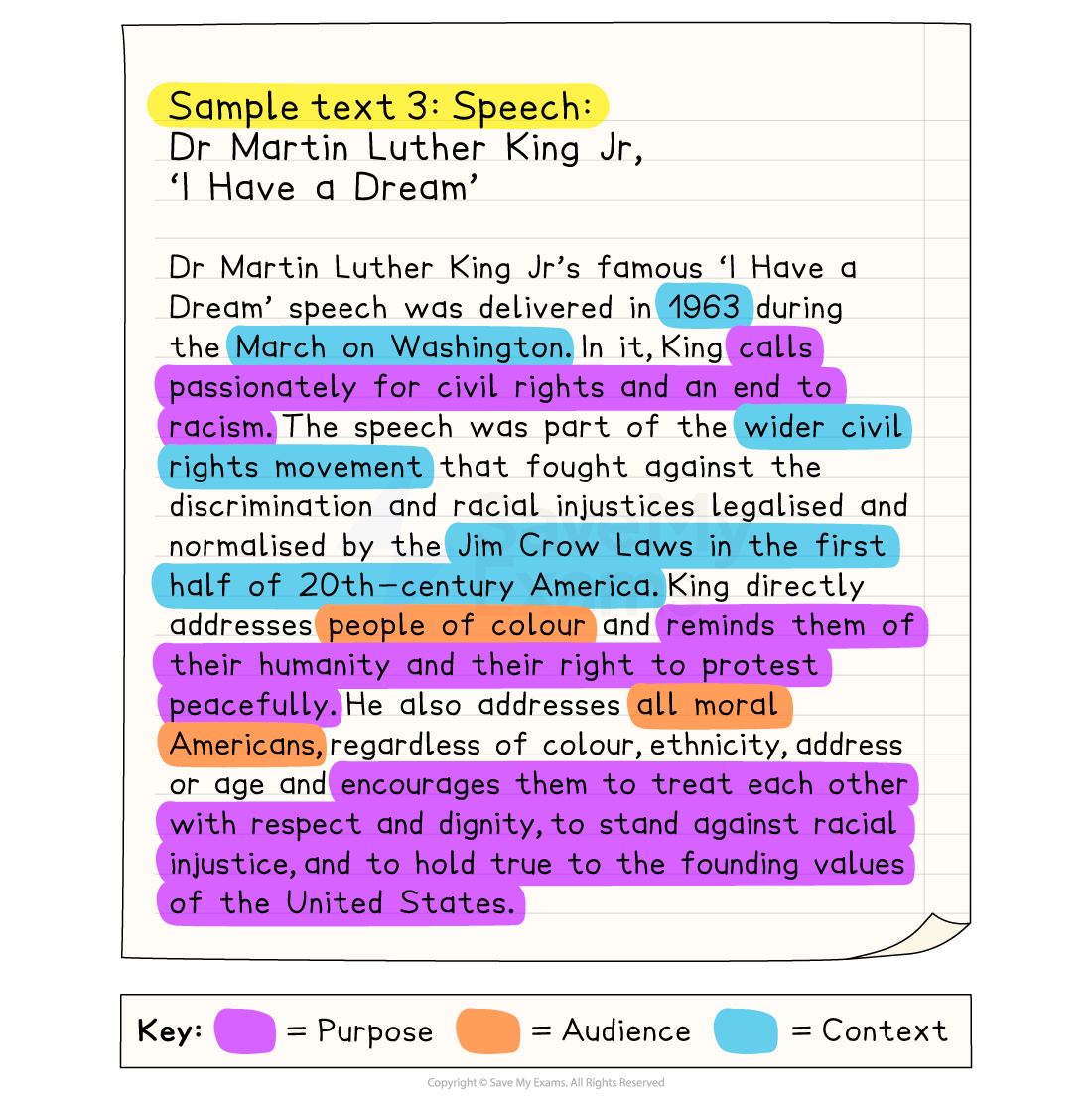
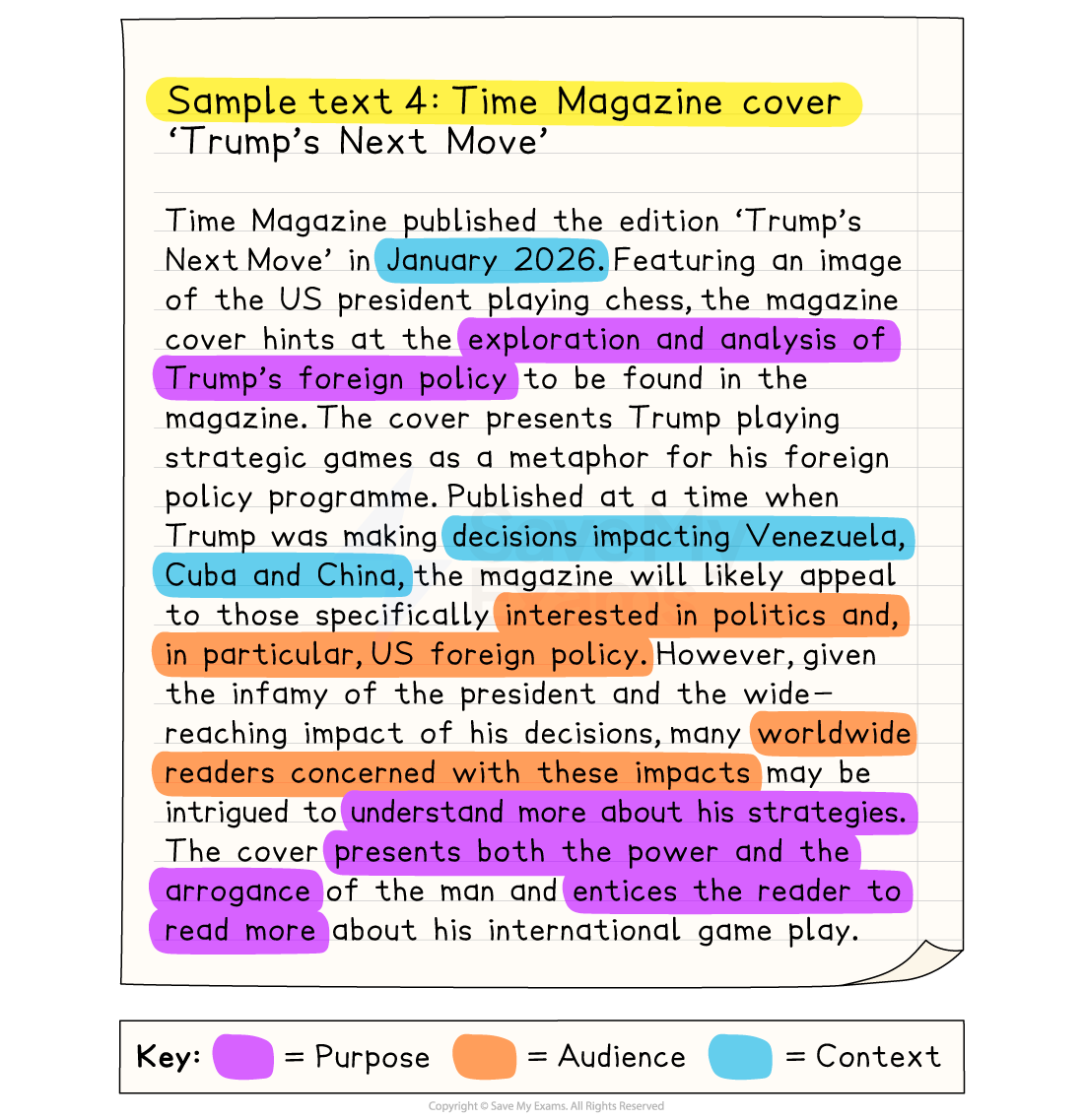
Examiner Tips and Tricks
The introduction of your Paper 1 response is the ideal place to identify the purpose, audience and context of the text under discussion. When linked to textual features, these facts can be used to formulate a highly effective thesis statement that gives you scope to write a comprehensive and convincing analysis that shows understanding of the text.
Sources
King Jr., M. L. (1963), ‘I Have a Dream’, American Rhetoric, https://www.americanrhetoric.com/speeches/mlkihaveadream.htm (opens in a new tab)
George, D. (2020), ‘Old Growth: A Day Trip Hiking into the Heart of Muir Woods’, GeoEx, https://www.geoex.com/blog/old-growth-hiking-into-the-heart-of-muir-woods (opens in a new tab)
Ohi, D. R. (2014), ‘Minecraft’, My Life in a Nutshell, https://debbieohi.com/webcomic-series/my-life-in-a-nutshell/ (opens in a new tab)

Unlock more, it's free!
Join the 100,000+ Students that ❤️ Save My Exams
the (exam) results speak for themselves:

Was this revision note helpful?