Building a Comparative Argument (DP IB English A: Language and Literature: HL): Revision Note

For your Paper 2 Comparative Essay on the IB Diploma English A: Language and Literature (HL) exam, examiners expect you to develop a coherent argument that analyses how and why two writers engage with related ideas in similar and/or different ways.
This section includes:
Comparing texts
Writing a strong comparative thesis
Structural approaches to comparison
What examiners reward in a top-band response
Comparing texts
Effective comparison requires more than placing your two texts side by side. It involves analysing how writers engage with related ideas, how their methods shape meaning and why their similarities or differences are significant.
Throughout your essay, your comparison should be conceptual. This means moving beyond surface-level observations and analysing:
How shared ideas are constructed differently
How authorial choices shape meaning
Why these similarities or differences are significant
A high-level comparison is conceptual, meaning you are thinking about big ideas and not just features. You should avoid:
“In Text A… In Text B…” with no link
Listing quotes without comparison
Spotting techniques without explaining meaning
You should focus on how shared ideas are constructed similarly or differently. Writers may explore the same idea but present it in different contexts, use different narrative voices and shape different attitudes or meanings.
Examiner Tips and Tricks
It is important to remember that examiners reward:
Balanced discussion of both texts
Sustained comparison throughout
Clear conceptual focus
Integrated references to both texts
Writing a strong comparative thesis
Paper 2 is the only assessment where comparison is expected. A strong thesis should be comparative from the outset.
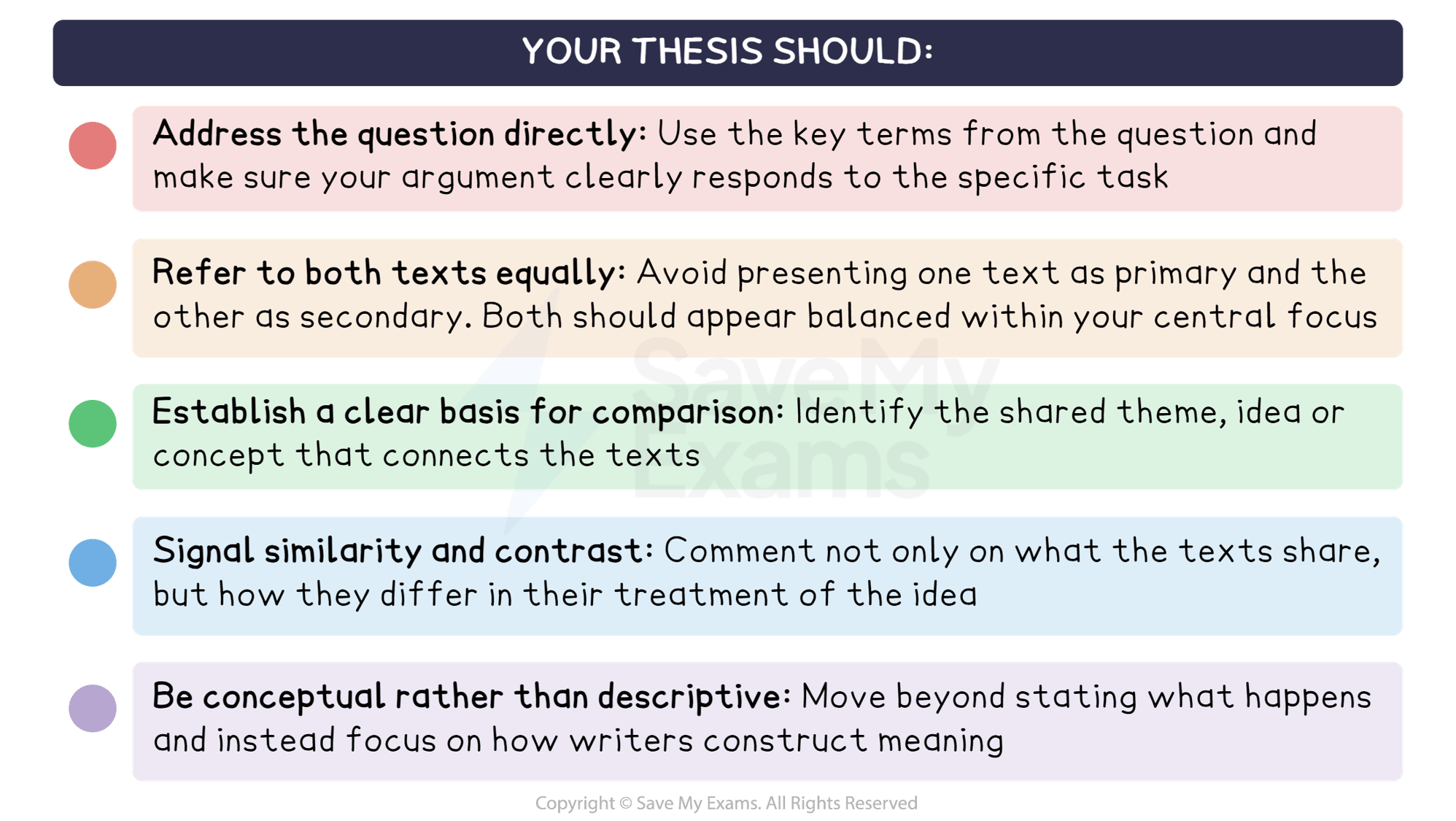
Let’s look at a Paper 2 question and how you might structure a clear thesis statement in response to it.
Question |
Discuss how the writers of two works you have studied present women’s responses to patriarchal constraints. |
Weak thesis | Strong thesis |
|---|---|
Both texts explore the role of women in society | While both Ibsen and Williams depict women constrained by patriarchal structures, Ibsen presents self-awareness as a means of achieving autonomy and challenging societal norms, whereas Williams portrays resistance as destructive and inescapable. |
This thesis statement focuses on all three parts of the question: “women’s responses”, “patriarchal constraints” and “two works/writers”.
You have a lot of flexibility in how you choose to compare the texts you have studied in response to your chosen question. Remember, you are not limited to comparing texts of the same literary form.
Examiner Tips and Tricks
Avoid trying to create an academic tone simply by using complex vocabulary that you are not fully confident with. If you use literary terms such as bildungsroman or existentialism make sure you fully understand their meaning and can use them accurately within your response. Clear and precise analysis is always much more effective than misused technical language.
Structural approaches to comparison
Examiners are not looking for a particular type of essay structure (a three-part thesis, organisation by idea versus organisation by text, a particular type of conclusion) but are looking for a clear, focused argument with a beginning, a middle and an end. Any form of structure in your response will be rewarded if it is effective and logical.
There are two main structural approaches you could choose to use when writing your essay and each one offers a different way of organising your ideas.
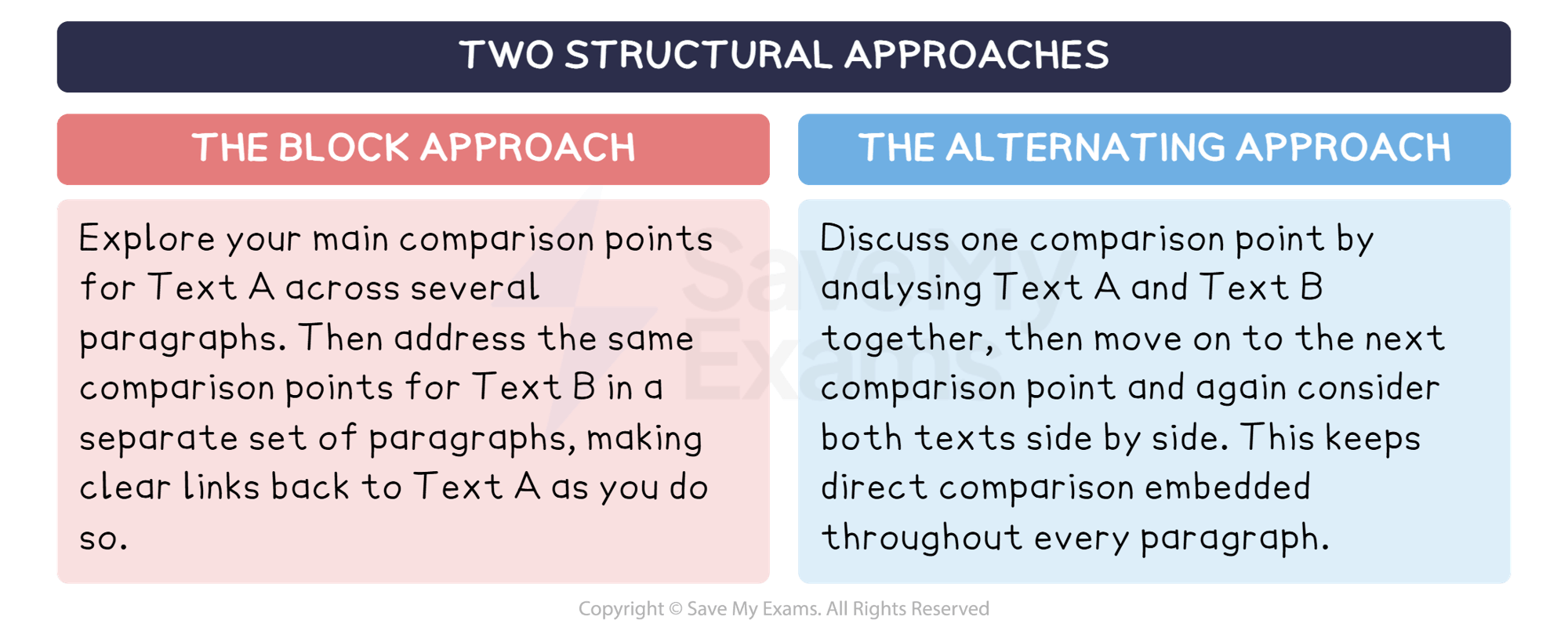
The structure you choose should support your ability to compare both texts consistently, rather than treating them as separate discussions.
Let’s explore two literary texts and how you might use either of these two structural approaches.
A Streetcar Named Desire (Williams) | Both | A Doll’s House (Ibsen) |
|---|---|---|
Set in 1940s New Orleans in a cramped urban apartment | Both are domestic dramas focused on strained relationships | Set in 19th-century Norway within a middle-class domestic home |
Explores sexual politics and power struggles between men and women | Both explore gender roles and power within intimate relationships | Focuses on marriage and the restrictive roles imposed on women |
Blanche’s conflict stems from illusion, trauma and denial | Both protagonists construct versions of reality to survive | Nora’s conflict stems from secrecy and societal expectations |
The climax results in Blanche’s removal and psychological collapse | Both conclude with a fundamental rupture within the family unit | The climax results in Nora choosing independence and leaving |
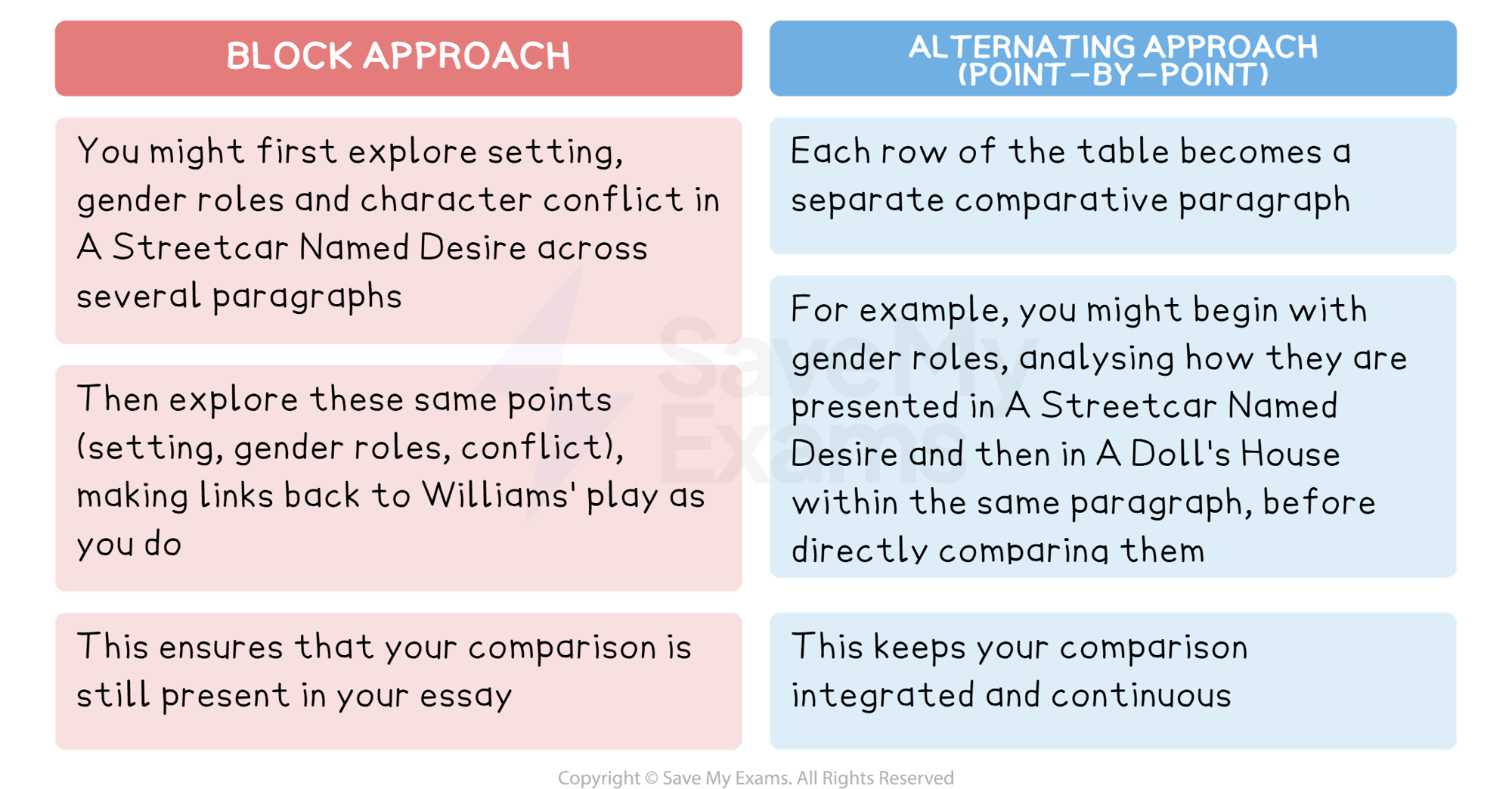
Once you have selected your structure, you need to ensure each paragraph moves beyond description and becomes analytical. The framework below can help you to build your analysis within each comparison point.
Williams presents gender tensions as violent and destructive, while Ibsen pr
Here is an example of how you might plan a paragraph using this structure.
Why | What | How | So what? |
|---|---|---|---|
|
|
|
|
There should be a strong link to the question embedded in the structure of your essay and it should be evident in each paragraph.
What examiners reward in a top-band response
Examiners reward essays that demonstrate perceptive knowledge of both texts, sustained and integrated comparison, insightful analysis of authorial choices and clear, precise expression.
A top-band response presents a strong comparative thesis from the outset, responds directly to the question and maintains a balanced discussion throughout
It moves beyond thematic similarity to analyse how writers use language, structure, perspective and genre to shape meaning
It evaluates why similarities and differences are significant
The strongest essays are conceptually focused, well organised and written in a confident academic register
Examiner Tips and Tricks
You can achieve high marks in Criterion B by focusing on either similarities or differences; addressing both is not required.
Marks are also not dependent on balance between similarities and differences if both are discussed. If you do analyse both, stronger essays usually consider similarities and differences alongside each other. However, it is important to remember that there is no prescribed structure; your focus should always be on the depth and quality of your analysis.

Unlock more, it's free!
Join the 100,000+ Students that ❤️ Save My Exams
the (exam) results speak for themselves:

Was this revision note helpful?