Guided Textual Analysis Model Answers (DP IB English A: Language and Literature: HL): Revision Note

For your Paper 1 Analytical Essay on the IB Diploma Language A: Language and Literature (HL) exam, it is important to understand how your essay is assessed and what a high-level response looks like in practice.
This section includes:
Overview
Marking criteria
Model answers
Top tips
Overview
Paper 1 is marked out of 20 and is assessed using four criteria. Each criterion focuses on a different aspect of your analytical essay.
There are four assessment criteria.
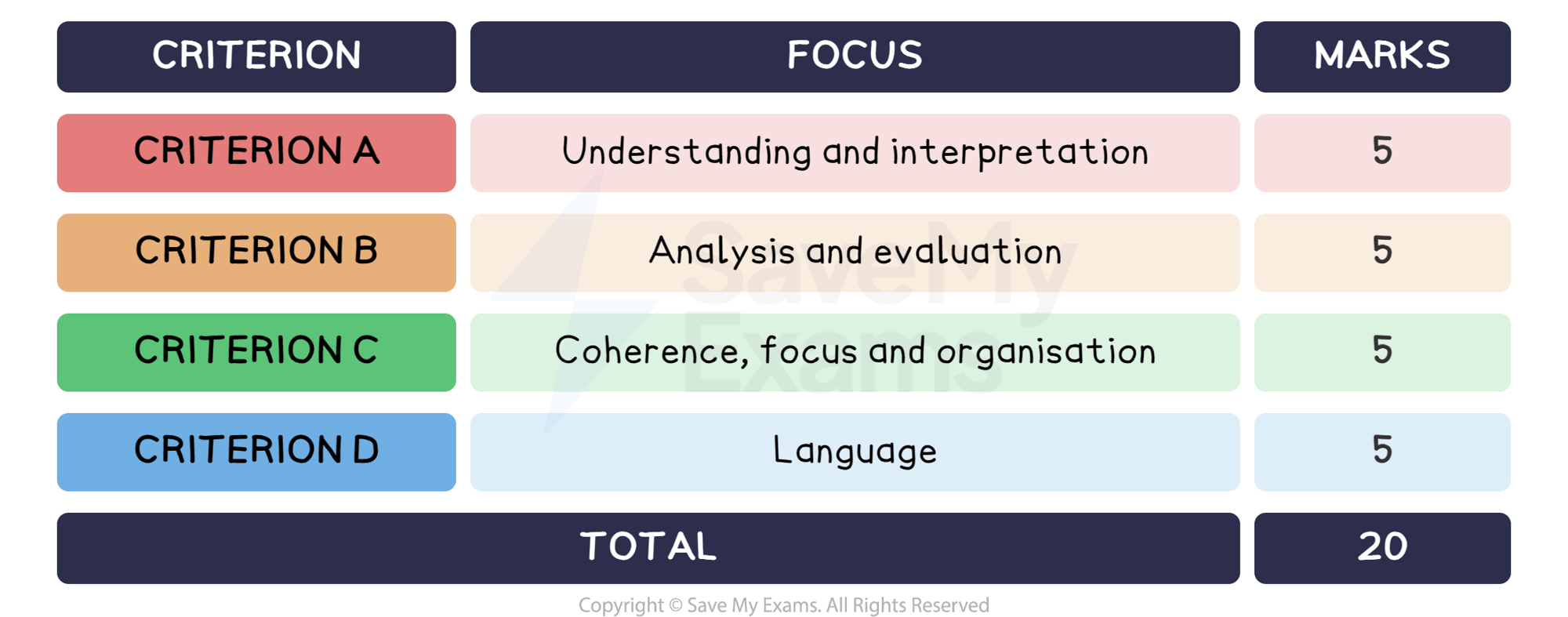
Understanding how these criteria work will help you structure your essay clearly and develop a focused argument. It is important to know the meaning of each of the terms so that you are confident that you know what the differences are between “knowing”, “understanding”, “interpreting”, “analysing” and “evaluating”. Examiners consider all elements of the descriptors when determining your mark for each criterion.
Marking criteria
Criterion A: Understanding and interpretation
To do well in Criterion A, you need to demonstrate an accurate and relevant understanding of the unseen texts in terms of their text type, genre norms, context, purpose and intended audience. “Interpretation” means using your understanding to recognise methods used in creating the text and draw implications connected to the audience, purpose and/or context.
Criterion A also assesses if you have supported your claims with references from the text.
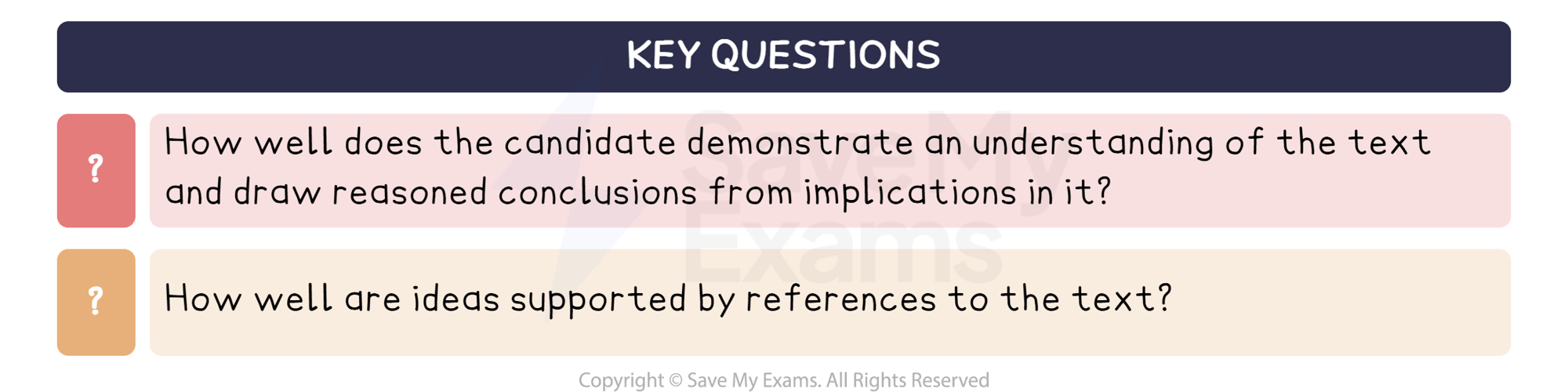
To gain top marks, you need to meet the following descriptor. The keywords are highlighted in bold.
Marks | Descriptor |
5 |
|
Here are some common mistakes to avoid based on IB examiner feedback on Criterion A:
Common mistakes to avoid | |
Misunderstanding the text |
|
Making general comments without evidence |
|
Describing or summarising instead of interpreting and analysing |
|
Focusing on understanding instead of interpretation |
|
Overusing quotations |
|
Examiner Tips and Tricks
For the highest marks, you need to push past the literal and consider deeper meanings of your texts. For example, a literal understanding of an ad is that it wants its brand to look desirable; an interpretation of the same advert could be that the ad aligns the brand with a current trend to connect the brand with the ethics or vibes of that trend.
This shows understanding of the text type, and its purpose and context.
Criterion B: Analysis and evaluation
To do well in Criterion B, you need to analyse how the writers construct meaning and evaluate why those choices are significant in terms of impacting the audience and/or achieving a purpose.

To gain top marks, you need to meet the following descriptor. The keywords are highlighted in bold.
Marks | Descriptor |
5 |
|
Marks are not awarded based on quantity. Therefore, simply listing textual features in your response, without any analysis, is likely to remain in the 1–2 mark bands for Criterion B. What matters most is the quality and depth of your analysis. Stronger responses go beyond summarising and provide an in-depth evaluation of how effectively the features have an effect on the audience and/or allow the writer to achieve their purpose.
Here are some common mistakes to avoid based on IB examiner feedback on Criterion B:
Common mistakes to avoid | |
Identifying techniques without analysing them |
|
Ignoring some important authorial choices |
|
Not including evaluation |
|
Examiner Tips and Tricks
Linking the analysis of specific textual features to a named purpose and audience and placing this in a specific context will help make your claims more convincing.
Criterion C: Focus and organisation
To do well in Criterion C, you need to present a focused and coherent argument that consistently remains focused on the question while also maintaining a balance between both texts. “Focus” and “coherence” are key.

To gain top marks, you need to meet the following descriptor. The keywords are highlighted in bold.
Marks | Descriptor |
5 |
|
Here are some common mistakes to avoid based on IB examiner feedback on Criterion C:
Common mistakes to avoid | |
Losing focus on the text and/or guiding question |
|
Lack of a clear argument |
|
Over-reliance on memorised formats |
|
Criterion D: Language
To do well in Criterion D, you need to use accurate and formal language to support your argument and communicate your ideas effectively.
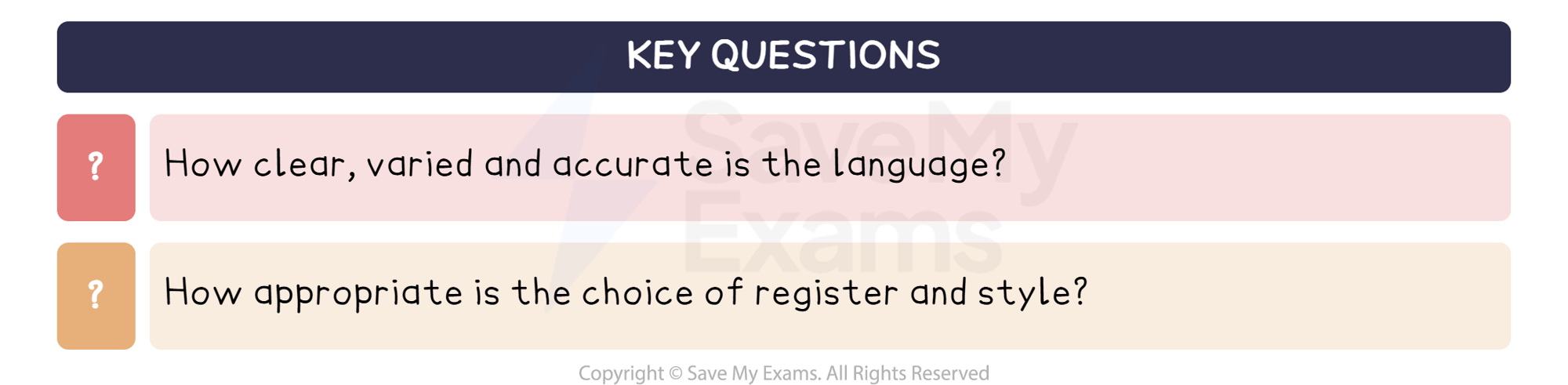
To gain top marks, you need to meet the following descriptor. The keywords are highlighted in bold.
Marks | Descriptor |
5 |
|
Here are some common mistakes to avoid based on IB examiner feedback on Criterion D:
Common mistakes to avoid | |
Using an informal or inappropriate register |
|
Unclear or awkward expression |
|
Frequent grammar and syntax errors |
|
Lack of sentence variety |
|
Model answers
We will now explore how you can create a convincing and insightful analysis using an example of a question from Paper 1. Read through the question below:
Exam question |
How does the writer use textual and visual elements to convey a message to the reader? |
Here is a model paragraph using a comic by Debbie Ohi.
Ohi uses facial expression, emanata and typography humorously to explore the reality of how easily writers are distracted. In Panel 1 and 2 the repetition of the figure’s fixed body language and gaze convey her concentration at the computer. Her eyes look at the screen and her hands are posed in a typing position over the keyboard, suggesting she is in the process of writing. Her slightly open mouth as she responds to the out-of-panel speaker further emphasises the concentration. The reader, likely another aspiring writer or creator like Ohi, recognises themselves in this familiar position and attitude. However, as we transition to Panel 3 the tiny differences in facial expression foreshadow the humorous close. The figure’s left eye now looks away from the computer, and her mouth is pursed in interest; her concentration is broken and we sense a pause in her work. The fourth and final panel is dramatically contrasted with the stillness of the previous three. The figure turns face-on to the viewer, completely breaking her gaze on the computer. Emanata of sweat or saliva drops hyperbolically convey her excitement, as does her facial expression of wide-open eyes and dishevelled hair. The graphic weighting achieved in shading her open mouth heavy black emphasises her emotion of surprised, gleeful excitement. The typography of “BUNNIES” in all caps, heavy, thick black font and the repeated question marks combines with the emanata of the jagged speech bubble to make the reader almost hear her shriek. The humour of such a minor event causing such an enormous reaction gently mocks the faux-seriousness of the writing process. Ohi shares in the frustrations of a writer’s daily distractions while reminding her readers that we are all human, and that we are all a little silly at times. |
We will now explore another question using a different text. Read through the question below:
Exam question |
How does the writer appeal to the audience’s ethics to persuade them to agree with him? |
Here is a model paragraph using the ‘I Have a Dream’ speech by Dr Martin Luther King Jr.
In the first section of the speech, Dr. King alludes to the founding principles of the United States of America in order to align the civil rights movement with these shared values. Echoing the famous president’s phrasing, King opens the speech with allusion to Abraham Lincoln and the Emancipation Proclamation. That momentous moment announced the end of slavery. King thereby emphasises how long it has been since that decision and yet how much remains to be done to achieve racial equality. Referring to the proclamation as “a great beacon light of hope” that ended “the long night” of captivity, King begins the use of an extended metaphor of light vs. dark to connect equality with good and racism with evil in the listener’s mind. He goes on to allude to another founding document, the Declaration of Independence, and its promise that all men would be guaranteed freedom and the pursuit of happiness, to reinforce the moral impetus of his argument. He then moves us with force to the present with his impactful anaphora in “One hundred years later” to highlight how long people of colour have been waiting for actual, meaningful freedom in their daily lives. Through connotative and emotive language, he demands the audience look fully into the reality of “the shameful condition” in which the Jim Crow laws have left people of colour. Thus, King speaks to all Americans and calls on their national pride, historic values and democratic values to recognise the hypocrisy of celebrating such moments of the past when the present reality is a horrific contrast to those lofty ideals. |
Examiner Tips and Tricks
Focus on developing your ability to think critically about a range of text types and contexts. You cannot predict what text type will come up in your exam, so instead of trying to learn formulaic responses and lists of features, practise, practise, practise by reading and analysing regularly.
In your everyday engagement with the world, as you watch media, read magazines, see ads, open your analytical eye and think about what the text:
Is trying to do
To whom is it doing it
Why is it doing it
Whether it is doing it well
Top tips
Maintain a clear focus on the text under analysis and the guiding question
Understand different text types and their norms
Refine your identification of purpose, audience and context
You are expected to interpret, analyse and evaluate:
Do not describe or summarise
Sources
Ohi, D. R. (2014), ‘Minecraft’, My Life in a Nutshell, https://debbieohi.com/webcomic-series/my-life-in-a-nutshell/ (opens in a new tab)
King Jr., M. L. (1963), ‘I Have a Dream’, American Rhetoric, https://www.americanrhetoric.com/speeches/mlkihaveadream.htm (opens in a new tab)

Unlock more, it's free!
Join the 100,000+ Students that ❤️ Save My Exams
the (exam) results speak for themselves:

Was this revision note helpful?