What to Include in your Learner Portfolio (DP IB English A: Language and Literature: HL): Revision Note

The IB is clear that the Learner Portfolio should contain a diversity of formal and informal responses to the texts you study, in a range of forms and media.
This can include the discussions that happen in the classroom, the connections you notice halfway through a reading or even questions that you think of along the way, even if you haven’t answered them yet.
To help organise and shape your portfolio, it is a good idea to include a tracking or summary sheet at the start which you add to as you progress through the course. Please see our guide on How to Structure your Learner Portfolio for more ideas about this.
The following sections include suggestions of what to include in your Learner Portfolio.
What should I include in my Learner Portfolio?
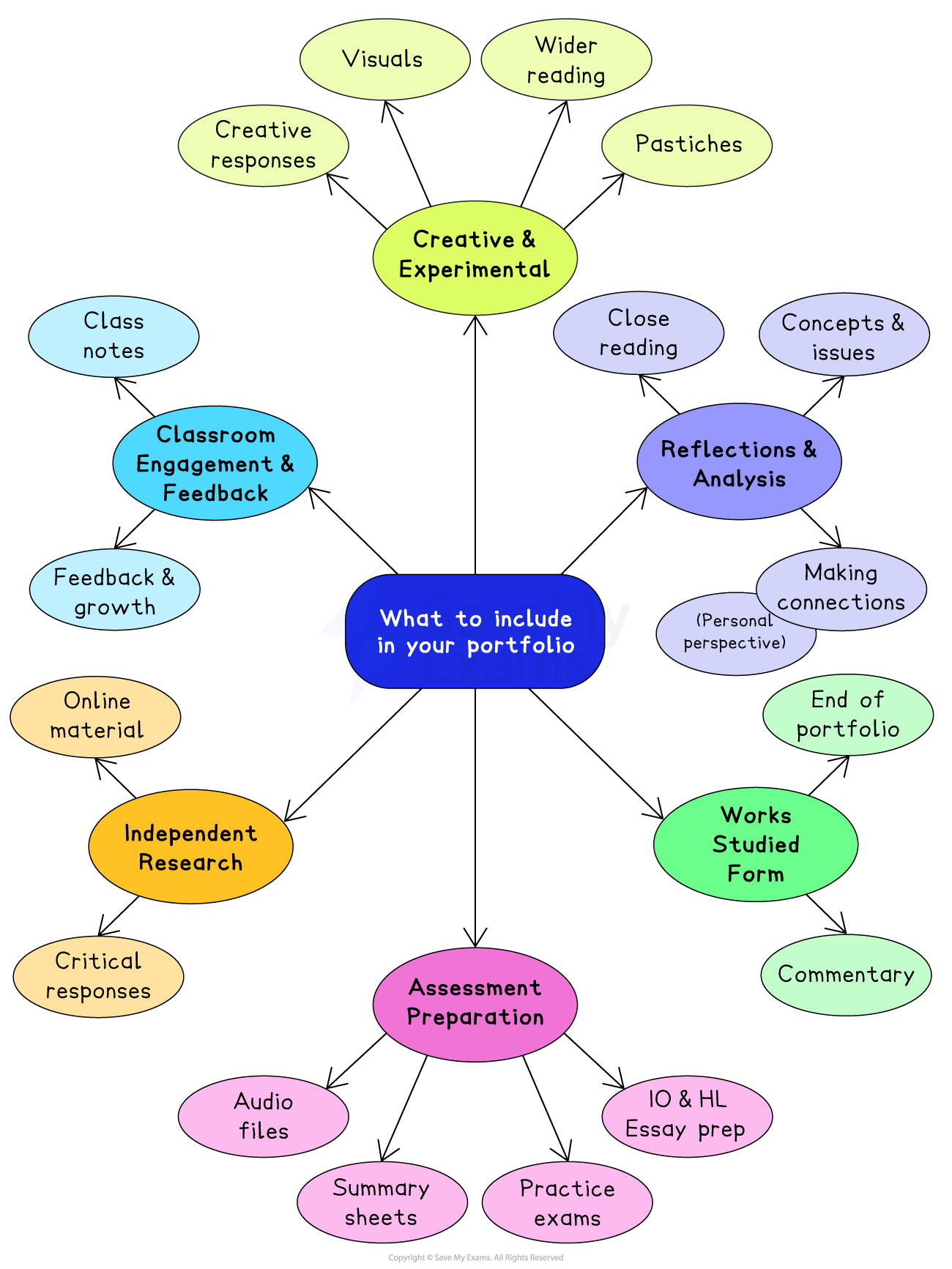
Classroom engagement and feedback
Class discussions, debates and group work are all great portfolio content. An entry reporting a class discussion does not need to be a transcript; it can just be a short reflection on what perspectives were raised and which of them changed the way you were thinking about a text. Suggestions include:
Class notes:
Digital or scanned notes from lessons, group activities or class discussions
Feedback and growth:
Records of valued feedback from your teacher or peers
Self-assessment notes evaluating your own progress
Reflections on the academic challenges you have faced
Reflections and analysis
Each Area of Exploration is framed by a set of central questions about language, literature, culture and identity. Your reflections on these questions do not need to be long or formal; the key is that you are engaging with the ideas of the course, not just the content of individual texts. You might also wish to reflect on your own assumptions, beliefs and values as a reader, and how the texts you study connect to the wider world. Suggestions include:
Close Reading |
|
|---|---|
Reflections on concepts and issues |
|
Making connections |
|
Personal perspective |
|
Creative and experimental entries
The portfolio is one of the few places in the course where you are explicitly encouraged to be creative and experimental. This might mean responding to a text through a different medium entirely, such as a short film or recording your thoughts digitally as voice-notes. These types of entries can develop your understanding of how form itself creates meaning, which is directly relevant to Paper 1. Suggestions include:
Creative experiments and writing:
Experiments with different literary forms, media and technology
Pastiches:
Writing in the style of an author to explore their techniques from "the inside"
Visuals:
Sketches or drawings that explore key aspects of the literature
Independent research
Wider reading is one of the most consistently rewarded habits in IB English, and the portfolio is where you record it. A brief entry summarising what you read, what it added to your understanding and how it connects to your course texts is enough. The habit of recording wider reading as you go means you have a genuine trail of secondary engagement to draw on when writing the HL Essay or preparing for the Individual Oral. Suggestions include:
Records of reading, research and inquiry you conduct beyond the classroom
Evaluations of different critical responses or reviews of the texts
Links to relevant online resources
Assessment preparation materials
As you move through the course and begin preparing for your assessed components, the portfolio is where that preparation should be recorded. Recording the decisions you make, and the thinking behind them, is itself a valuable reflective exercise and provides a clear paper trail of your preparation. Suggestions include:
Practice exams:
Chronologically ordered practice responses for Paper 1 and Paper 2, as well as practice written commentaries
Individual Oral (IO) and HL Essay prep:
Selections of suitable extracts, drafts and proposals that could form the basis of your IO or Higher Level Essay
Audio files:
Recordings of practice orals or simply audio recordings of your own thoughts
Summary sheets:
A running tracking table for each text logging its form, themes, authorial choices, links to the seven central concepts, and how that text might be used for future assessments
The mandatory component
The "Works Studied form" must be included at the very end of your portfolio. It details the works you selected throughout the course and explicitly shows how you used them for your assessment components.
Ultimately, your portfolio should grow naturally and contain whatever materials best help you document your discoveries and prepare for your final assessments.

Unlock more, it's free!
Join the 100,000+ Students that ❤️ Save My Exams
the (exam) results speak for themselves:

Was this revision note helpful?