Preparing for the Individual Oral (DP IB English A: Language and Literature: HL): Revision Note

Preparing for the Individual Oral (IO) requires careful planning and also working on a confident delivery. As well as developing your analysis, it is important to practise how you present your ideas clearly and effectively within the time limit. This section focuses on:
Individual Oral requirements
Presentation skills
Responding to your teacher’s questions
Individual Oral requirements
The Individual Oral assesses your ability to analyse how meaning is created in texts through authorial choices with a clear focus on a global issue. You are not being assessed on memorisation but on your ability to think, respond and develop ideas in real time.
The following points outline the requirements when preparing and delivering your Individual Oral.
You are allowed to bring an outline with no more than 10 bullet points into your Individual Oral:
These should be brief, concise prompts rather than full sentences
They must not include a detailed, scripted response
You must bring a clean unannotated copy of your extracts:
This ensures that your analysis is based on prior understanding rather than annotated notes
The extracts should be used only as a reference point
You must share your extracts with your teacher in advance:
This enables your teacher to become familiar with the context and content
Your teacher’s role is to support and guide you, not to rehearse or script your response
Presentation skills
Your IO is not just about what you say but also about how you say it.
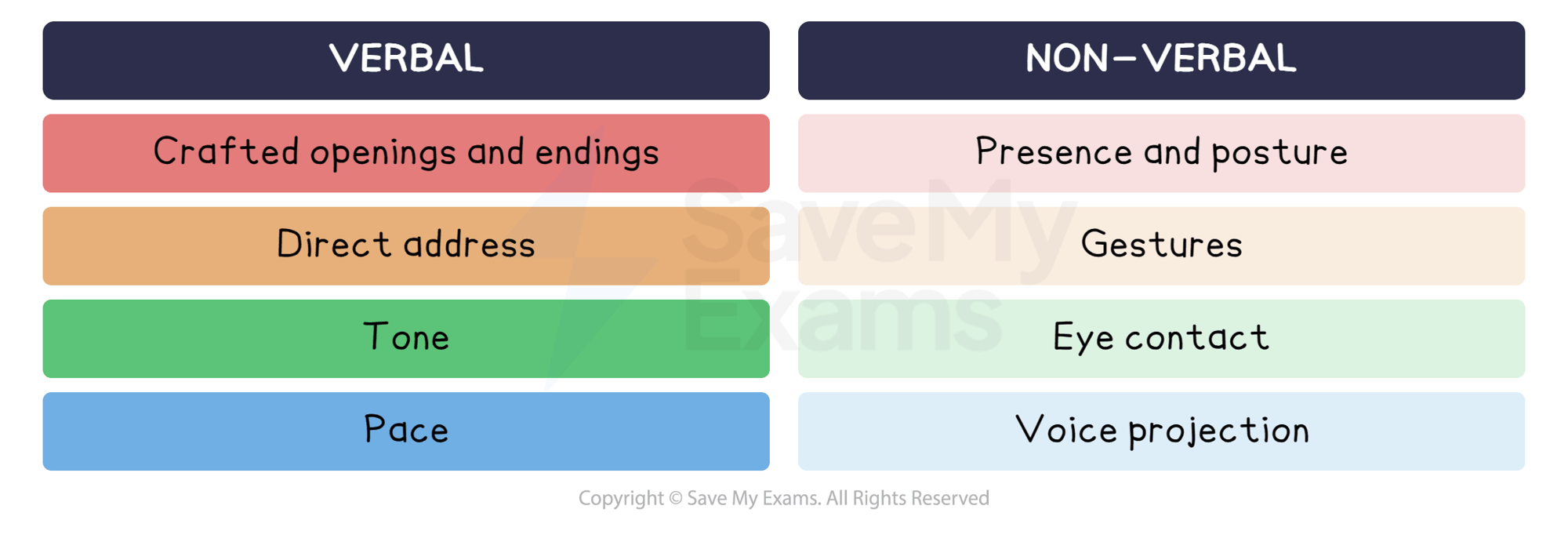
Verbal and non-verbal skills
To communicate clearly and confidently, you need to use both verbal (spoken) and non-verbal skills like body language, gestures and eye contact. These help you to engage the audience and make your presentation more interesting to listen to. Here are some verbal and non-verbal techniques you could include:
Language and vocabulary
One of the key things your teacher will focus on is your use of language and vocabulary during your presentation. Your word choices demonstrate how well you understand how to use language to engage and influence your audience.
To do this successfully you should:
Vary your vocabulary:
Avoid repeating the same words or phrases and consider different ways to express your ideas
Choose specific words and phrases:
Use vocabulary that helps to convey your message and ideas
Match your language to your purpose and audience:
If you are giving a formal talk, use sophisticated language
If your presentation is more personal or creative, you could use humour or emotion to connect to your audience
Use rhetorical techniques:
Devices such as rhetorical questions, direct address, repetition, can make your presentation and discussion more persuasive
Vary your sentence structure:
Use a range of sentence structures to change the pace and rhythm of what you are saying
Discussion and questions
After you have delivered your 10-minute presentation, your teacher will have a 5-minute discussion with you. This discussion gives you the opportunity to develop or clarify ideas from your presentation. Your teacher may ask questions to help you expand on points that were unclear or not fully developed during your oral. For example, you might be asked to:
Comment further on parts of the extracts that relate to your chosen global issue and explain how meaning is created in those parts
Expand on how the global issue appears in the whole work or body of work and why it is important within the text
Compare how the global issue is presented in the two texts and comment on any similarities and differences in the way the writers explore it
Reflect on how your learner portfolio helped you prepare for the Individual Oral, including how it supported you in choosing your global issue, texts and extracts
This discussion is an opportunity for you to demonstrate your deeper understanding of your extracts and discuss your thinking in more depth.
Responding to your teacher’s questions
After your presentation, your teacher will ask you a series of questions. These are designed to enable you to show your understanding of the extracts and your chosen works further and to give you the opportunity to develop ideas that you explored in your presentation.
Here are some follow up questions which your teacher may ask.
Could you expand on this point that you made…? | What authorial choices do you think most effectively illustrate your chosen global issue? | Why do you think the creators chose to present this global issue in this way? | Can you give an example of…? |
How does context influence the presentation of the global issue? | Why did you choose this global issue for these works? | What would you add if you had more time? | Do you think the creators achieved their overall purpose? |

Unlock more, it's free!
Join the 100,000+ Students that ❤️ Save My Exams
the (exam) results speak for themselves:

Was this revision note helpful?