Plot Summary (DP IB English A: Language and Literature: HL): Revision Note
Examiners always reward students who know the text thoroughly, as this underpins all analysis. Below you will find:
Below you will find:
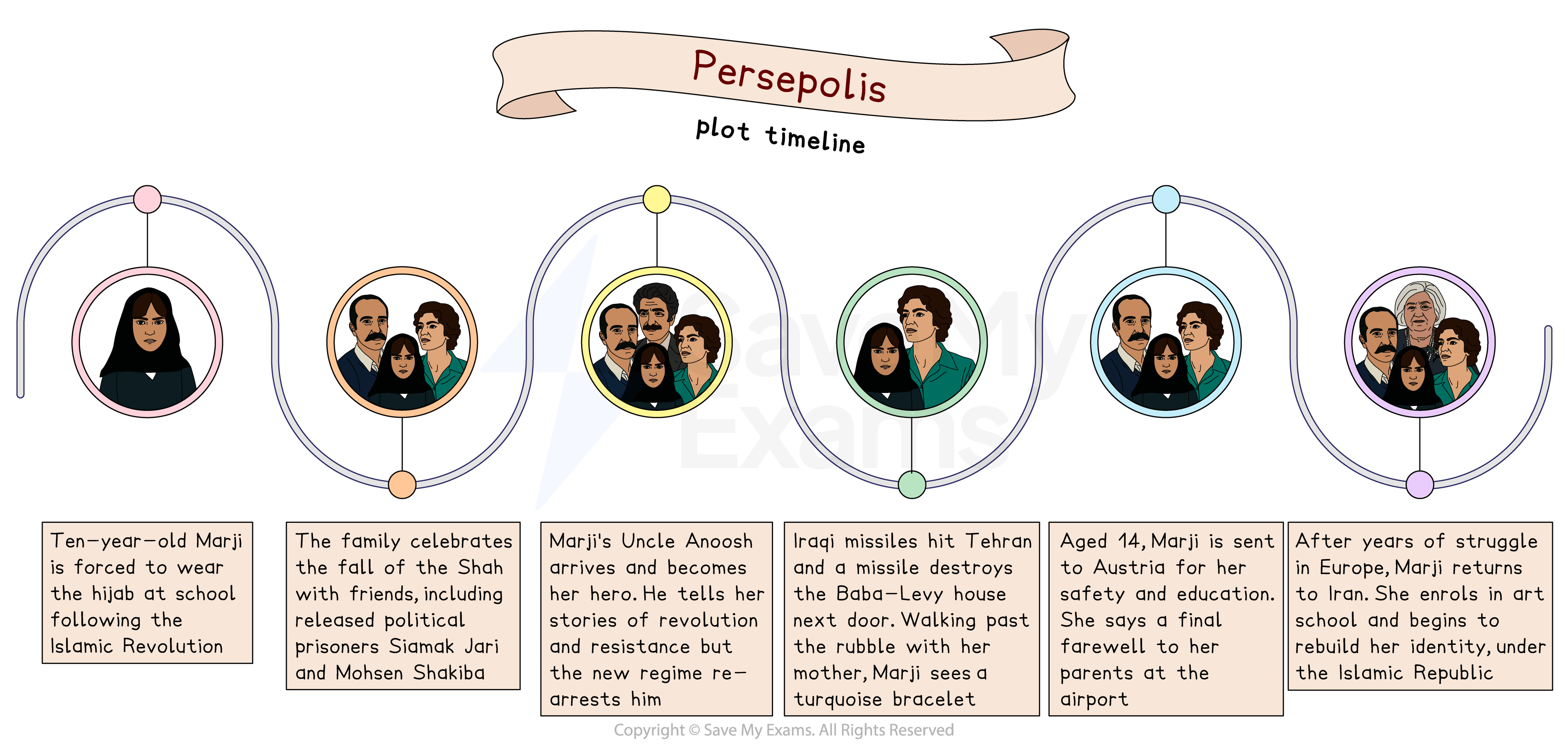
A visual timeline of the plot
An overview of the graphic memoir
An overview of the narrative’s three phases
A chapter-by-chapter plot summary
Persepolis: Plot timeline
Overview of Persepolis
Persepolis: The Story of a Childhood is an autobiographical graphic novel (also described as a graphic memoir) written and illustrated by Marjane Satrapi. First published in French in 2000, it was translated into English in 2003.
The narrative covers the period from 1980, when Marji is ten years old and the veil becomes compulsory in Iranian schools following the Islamic Revolution, through to approximately 1984, when her parents send her to Vienna for her own safety.
The text is narrated in the first person by the adult Satrapi looking back at her younger self, whom she calls Marji. This retrospective dual perspective is central to the text's irony and emotional force: the knowing adult narrator frames the experiences of a child.
The title refers to Persepolis, the ancient capital of the Persian Empire — evoking the tension between Iran’s rich pre-Islamic history and the restrictions of the post-revolutionary regime.
In her introduction, Satrapi states her purpose directly: to show that Iran is “far from” the image of “fundamentalism, fanaticism and terrorism” presented in the West and to honour those who suffered under repressive regimes.
Examiner Tips and Tricks
When writing about Persepolis, avoid summarising the plot as a simple sequence of events. The most perceptive responses identify how each chapter title — always an object, place, or concept — carries symbolic weight beyond its literal meaning. Ask yourself: what does this object or idea represent about power, identity, or resistance in this chapter?
Narrative structure: three phases
Although Persepolis does not divide into formal acts, the narrative moves through three broadly identifiable phases, each defined by a shift in Marji's political and personal consciousness.
Phase one: Revolution and awakening (Chapters 1–7)
The graphic memoir opens in 1980 when Marji is ten years old. This phase establishes the central tension of the text: the collision between Marji's secular, educated, politically aware family and the increasingly theocratic state. Key events include:
The imposition of the compulsory veil and gender segregation in schools
Marji's prophetic and political ambitions as a child
Her father explaining the Shah's rise to power and Iran's long history of foreign domination
The Black Friday massacre and the Shah's departure
The arrival of Uncle Anoosh and his stories of communist activism and imprisonment
Phase two: War and loss (Chapters 8–16)
The Iran–Iraq War, which begins in September 1980, dominates this phase. Marji watches her country bombed, her peers lose family members and the regime tightens its grip through the war. Key events include:
Anoosh's arrest and execution as a ‘Russian spy’ — Marji's first direct experience of state-sanctioned killing
Marji's rejection of God and turn towards secular, rebellious values
Escalating violence: missiles, martyrdom, the ‘key to paradise’ given to child soldiers
The family's private resistance: parties, wine, contraband Western music
Deaths of family friends, including the Baba-Levy family in a missile strike
Phase three: Rebellion and departure (Chapters 17–19)
By 1984, Marji is fourteen and increasingly rebellious. The regime has intensified its control of public and private life. Key events include:
Marji buying contraband Western cassette tapes and wearing a Michael Jackson badge
Confrontations with the Guardians of the Revolution and school authorities
Her expulsion after striking her school principal
Her parents’ decision to send her to Vienna for her safety
The farewell at the airport, where her father faints and her mother refuses to look back
Examiner Tips and Tricks
For Paper 2, consider how the three-phase structure of Persepolis compares to the structure of Born a Crime by Trevor Noah. Both texts use a coming-of-age structure shaped by political violence, but where Satrapi's phases are defined by revolution and war, Noah's are defined by Apartheid's legal categories and their dismantling. How do both authors use structural progression to show the impact of political systems on individual identity?
Persepolis: chapter-by-chapter plot summary
The table below summarises each of the 19 chapters. Every chapter is named after an object, place, or concept that carries symbolic significance beyond its literal meaning.
Chapter 1: The Veil
Set in 1980, Marji is ten years old
The Islamic Revolution has made the veil compulsory in schools; boys and girls are now segregated:
Marji and her classmates resist and play with their veils, unaware of their full significance
Marji’s mother is photographed demonstrating against the veil and must dye her hair to avoid recognition
Chapter 2: The Bicycle
Marji simultaneously aspires to be a prophet and a revolutionary, playing at Fidel, Che Guevara and Trotsky in the family garden
Her father explains that revolution is “like a bicycle. When the wheels don’t turn, it falls”
The regime’s Cultural Revolution closes bilingual schools
Chapter 3: The Water Cell
Marji’s parents join daily street demonstrations against the Shah
Her father explains Iran’s long history of foreign domination and tyranny
Marji wants to join the demonstrations but is forbidden:
That night she prays: “God, where are you?” — but God does not come
Chapter 4: Persepolis
Grandmother visits and tells Marji of the family’s poverty under the Shah’s father
Marji learns her grandfather was imprisoned for his communist beliefs
The chapter establishes the Satrapi family’s tradition of political resistance and Marji’s pride in her heritage
Chapter 5: The Letter
Marji’s maid Mehri falls in love with a neighbour, Hossein, and exchanges letters written by Marji on her behalf
When Hossein discovers Mehri is a servant, he ends the relationship
Marji’s father explains: “In this country you must stay within your own social class”
Father and Marji join the demonstration on Black Friday
Chapter 6: The Party
Following the Black Friday massacre, the Shah makes a televised address claiming to understand the people’s revolt
Political prisoners are freed; the chapter presents two of the family’s friends in dossier format
The end of the Shah’s reign is clearly near
Chapter 7: The Heroes
Three thousand political prisoners are freed; the Shah flees on 16 January 1979
Schools reopen under new ideological control:
Pupils are told to tear the Shah’s photograph from their textbooks
Marji repeats her father’s political views in class and is sent to stand in the corner
Chapter 8: Moscow
Uncle Anoosh arrives — a beloved uncle Marji has never met, having spent nine years in prison
He tells Marji his life story: exile in the USSR, marriage, imprisonment, escape
He gives her a swan made of bread; Marji adores him immediately
Chapter 9: The Sheep
Anoosh stays with the family; Marji absorbs high-level political debates
She is humiliated at school for repeating her father’s critique of the Islamic Republic
The family believe the election result — 99.99% in favour of the Islamic Republic — is rigged
Chapter 10: The Trip
The US Embassy is seized; American hostages are taken
Marji’s dream of visiting her friend Kaveh in the United States is shattered
Anoosh is arrested; he is permitted one visitor and chooses Marji:
Their meeting at Evin Prison is the last time she sees him
Chapter 11: The F-14s
The Iran–Iraq War begins in September 1980; Iraqi jets bomb Tehran
Marji and her father witness the first air raid from his office
The family confirm from the radio that the jets are Iraqi MiGs, not Iranian F-14s — the war is real
Chapter 12: The Jewels
The outbreak of war triggers panic-buying and shortages
The regime intensifies dress restrictions, dividing women into ‘fundamentalist’ and ‘modern’ categories
Clothing becomes an ideological sign of political allegiance
Chapter 13: The Key
The Iraqi army takes Khorramshahr; the regime sends teenage boys to the front
Boys are given plastic ‘keys to paradise’ to wear around their necks as they clear minefields
The government refuses a proposed peace settlement
Chapter 14: The Wine
Tehran becomes a primary bombing target; neighbours convert the basement into a shelter
The family hosts secret parties with wine and dancing, defying the regime’s prohibition above ground
The chapter shows private resistance to public repression as a form of survival
Chapter 15: The Cigarette
Two years into the war, Marji is growing up and making older friends who break school rules
She skips class, eats burgers, and smokes her first cigarette
She is stopped by the Guardians of the Revolution for wearing a Michael Jackson badge and she lies her way out of detention
Chapter 16: The Passport
July 1982: Uncle Taher, who has had heart attacks, cannot obtain a passport to travel abroad for medical treatment
He dies before he can leave, never having seen his son again
Marji’s friend Neda Baba-Levy is killed when a missile strikes her apartment building
Chapter 17: Kim Wilde
The borders reopen; Marji’s parents travel to Turkey and return with contraband:
A denim jacket and posters of Kim Wilde and Iron Maiden
Marji is stopped by the Guardians of the Revolution for her Western dress but lies her way free
She dances to Kim Wilde alone in her room
Chapter 18: The Shabbat
Iraq uses ballistic missiles against Tehran; a missile strikes a building in Marji’s neighbourhood
The Baba-Levy family — Jewish friends of the Satrapis — are killed
Marji sees Neda’s bracelet in the rubble:
She is physically sick; her parents cannot comfort her
Chapter 19: The Dowry
1984: Marji is fourteen and increasingly rebellious
She wears forbidden jewellery and confronts teachers
A school guardian threatens her with the value of a dowry — 500 tomans — as her worth; Marji strikes the principal and is expelled
Her parents decide she must leave Iran; she is sent to Vienna
At the airport she passes through passport control alone:
Her father faints; her mother cannot look back
“Nothing’s worse than saying goodbye. It’s a little like dying”
Examiner Tips and Tricks
When writing about the chapter titles, explain their symbolic function precisely. For example, in ‘The Key’, the plastic key to paradise given to child soldiers is both literally a key and a symbol of the regime’s manipulation of religious belief to justify sending children to their deaths. In ‘Kim Wilde’, the pop star’s name represents the Western cultural freedom that the regime forbids but cannot fully suppress. Examiners reward this kind of specific, analytical engagement with Satrapi’s authorial choices.
Sources
Satrapi, M. (2003). Persepolis: The Story of a Childhood. Translated by M. Ripa and B. Ferris. London: Jonathan Cape
Satrapi, M. (2002). Introduction to Persepolis. Paris, September 2002

Unlock more, it's free!
Join the 100,000+ Students that ❤️ Save My Exams
the (exam) results speak for themselves:

Was this revision note helpful?