Structuring the Individual Oral (DP IB English A: Language and Literature: HL): Revision Note

This section is designed to help you understand how to structure your Individual Oral as part of your IB Diploma English A: Language and Literature (HL) course. It consists of:
Structuring the Individual Oral: an overview
Introduction
Main body text: analysing your extracts
Conclusion
Structuring the Individual Oral: an overview
There are many ways to organise and structure your Individual Oral. It is helpful to structure your presentation in a similar way to an essay.
Introduction | Main body | Conclusion |
As you need to discuss two texts during your presentation, you have different ways that you can approach this. You may choose to:
Analyse each text separately
Compare and/or contrast the texts
Here are some possible approaches:
Approach 1 | Approach 2 |
|
|
Whichever structure you choose for your Individual Oral, make sure that you:
Spend an equal amount of time discussing each text or work
Balance your analysis by spending time exploring how the global issue is presented in each extract and how it appears more broadly across the whole work or body of work
Examiner Tips and Tricks
Remember, comparison is not a required part of your Individual Oral. You will not lose marks if you choose not to compare your texts and you will not gain extra marks simply for including a comparison.
A key part of the Individual Oral is showing the connection between the extract and the work or body of work as a whole that it comes from. This connection is important as it is assessed in Criteria A and B so it should be clearly explored in your presentation.
Literary extract | Non-literary extract |
|
|
Examiner Tips and Tricks
A key requirement of the assessment criteria is that you must make a clear connection between the extract and the larger work or body of work. If you cannot clearly establish a connection, you should choose a different text for your Individual Oral.
Zoom in (extract) | Zoom out (whole text) | Compare through the Global Issue |
Here is one possible way to structure your presentation.
Section | Approx. timing | What to include |
Introduction | 1 minute |
|
Extract analysis: Text 1 | 2 minutes |
|
Whole text discussion: Text 1 | 2 minutes |
|
Extract analysis: Text 2 | 2 minutes |
|
Whole text discussion: Text 2 | 2 minutes |
|
Conclusion | 1 minute |
|
Introduction
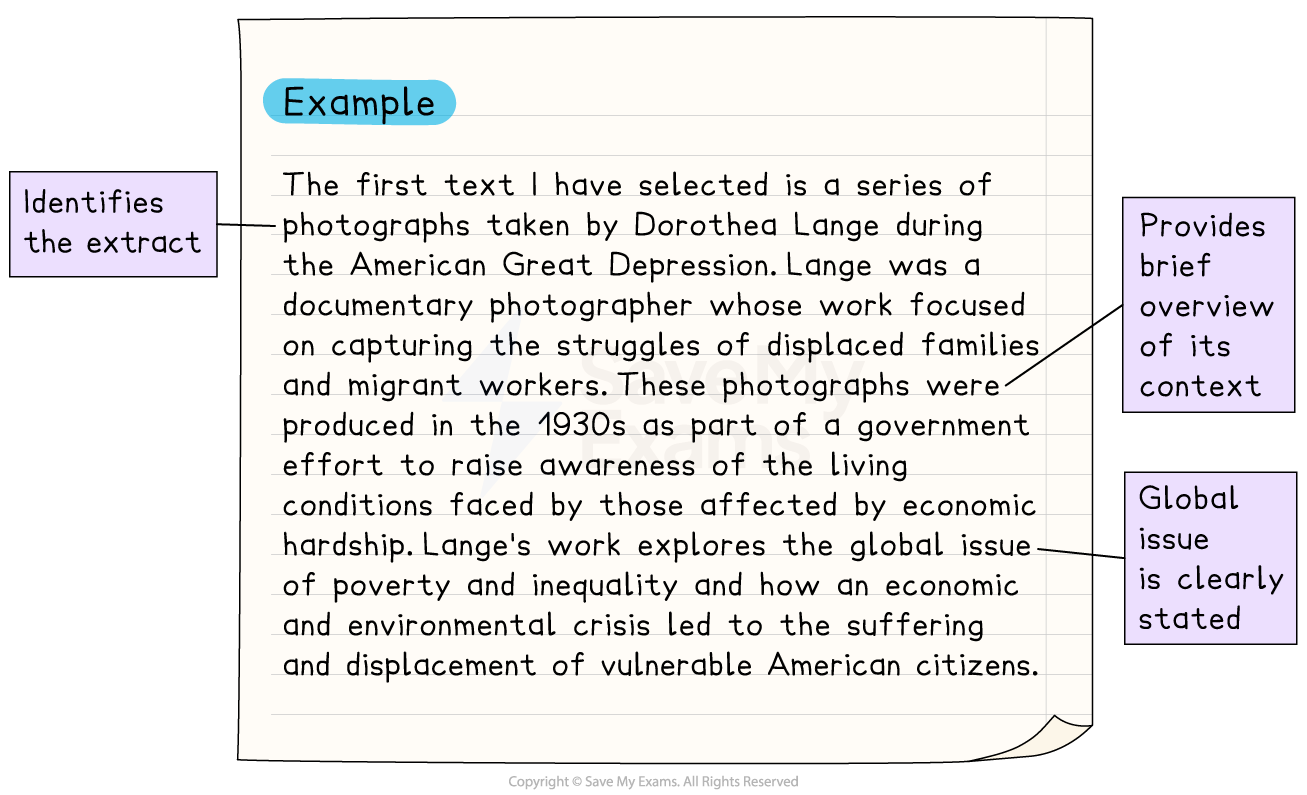
You should begin your analysis of each extract with a brief introduction that identifies your chosen global issue and explains how it is relevant to the extract. You may decide to introduce the global issue first and then link it to the extract or you may decide to begin with the extract and then highlight the global issue it connects to.
While your introduction should demonstrate your knowledge of both texts, the majority of your presentation should focus on your analysis.
Main body text: analysing your extracts
The main section of your Individual Oral is where you should develop a detailed analysis of each extract in relation to your chosen global issue.
Examiner Tips and Tricks
Avoid focusing too heavily on historical, biographical or cultural contexts if it does not link directly to how the global issue is presented in your texts. Although context can be useful, your analysis should primarily focus on the content and form of the extracts and how they convey the global issue. Always ensure that any contextual references support your analysis.
During this part of the oral, you should demonstrate a clear understanding of how the creator’s choices convey the global issue (Criterion B). As you will have the extracts in front of you, you should refer to them directly by highlighting key ideas and specific authorial choices. These references should be used to support your interpretations.
Example |
|---|
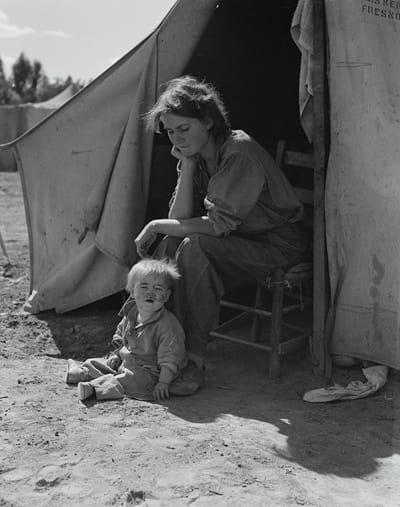
This photo titled ‘Eighteen-year-old mother from Oklahoma, now a California migrant’ introduces us to a young mother, which immediately establishes a tone of hardship and vulnerability. Through the mother’s facial expression, the signs of exhaustion and concern are evident. The deliberate close framing of the image draws our focus solely to her face which isolates her from the broader context of the photograph. Lange intentionally does this to highlight the woman’s emotional state. Further, the simplicity of her clothing conveys the absence of material wealth which reinforces her identity as a migrant affected by the economic crisis. The presence of the young child also conveys the vulnerability depicted in this scene. Sitting on the ground, the child appears physically vulnerable, which illustrates the harsh conditions they are living in. The child’s dirty face, gazing at the photographer, demonstrates the reality of poverty, where neglect is not out of choice but a consequence of circumstances. In contrast, the mother’s downward gaze towards the child suggests concern and protectiveness, despite their hardship. Here Lange conveys how economic hardship disproportionately affects vulnerable families, particularly children. |
Examiner Tips and Tricks
Do not be tempted simply to summarise or describe the extracts. Focus on how the text is constructed and how the creator’s choices reinforce the global issue. A key aspect of Criterion B is your ability to analyse and evaluate the author’s craft. This means examining the technical and stylistic features of the text and explaining how these choices shape meaning.
Conclusion
The conclusion is your opportunity to synthesise your analysis rather than simply repeat what you have already said. You should draw together your key ideas and show how they support your global issue.
A strong conclusion should:
Reinforce your global issue and its relevance
Summarise your key points
Offer a final insight into the writers’/creators’ purpose or message

Unlock more, it's free!
Join the 100,000+ Students that ❤️ Save My Exams
the (exam) results speak for themselves:

Was this revision note helpful?