Contextual Understanding (DP IB English A: Language and Literature: HL): Revision Note

Context involves facts and details about the author’s life and the socio-, political, historical and cultural realities of a given time and place. In each of these realities, you can consider how culture and identity influence the author’s choices in how they produce their text and the audience’s perspective and interpretation of those texts.
Knowing and understanding contextual details can also provide insight into the themes and purposes of texts and allow you to make informed and convincing analytical claims.
Examiner Tips and Tricks
Knowledge of context can help you meet the marking criteria in your English A IBDP assessments.
For example, in the Individual Oral (IO), you should explore your global issue in relation to the specifics of the context of your chosen texts. In Paper 2 , knowledge and understanding of context and how it impacts your reading of literary texts can help you meet Criterion A.
Authorial context
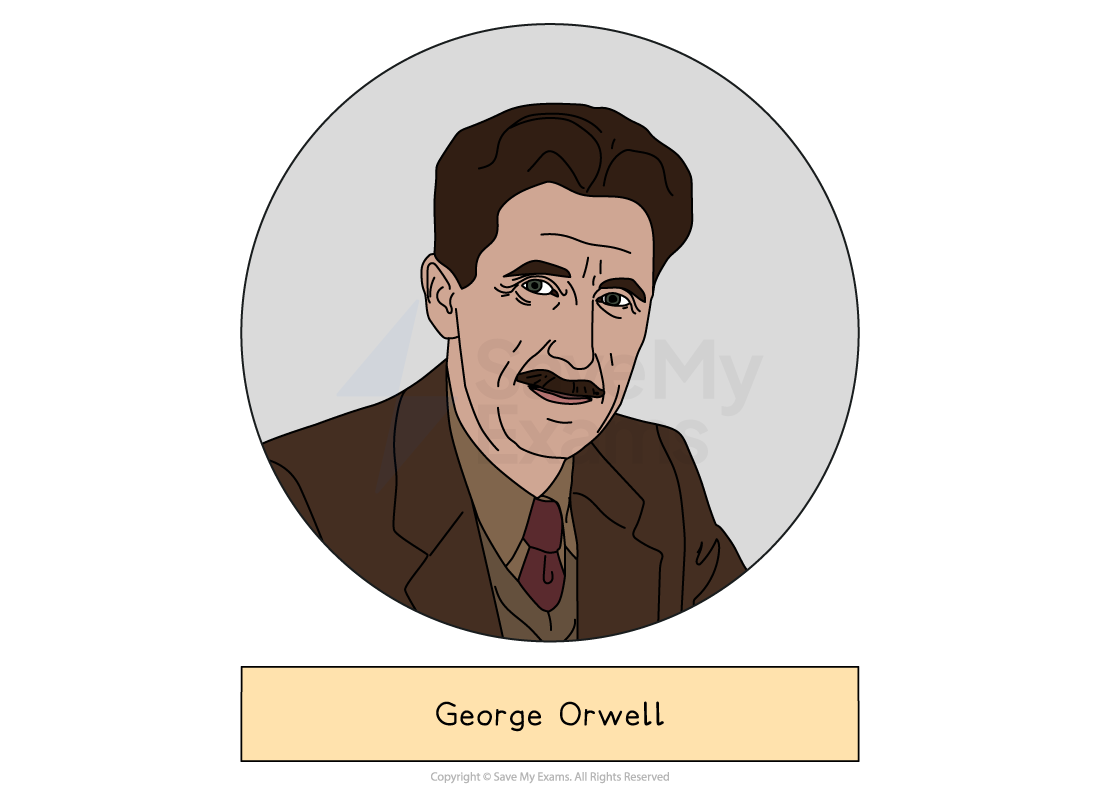
The Area of Exploration (AoE) Readers, Writers, Texts asks you to reflect on how meaning is constructed and interpreted. In your Theory of Knowledge (ToK) class, you will likely have had discussions on how meaning in the Arts is formed through a dialogue between the artist and the audience. As such, it can be useful to know details of the author’s life to infer reasons for their artistic choices as readers interpret their work years after their death.
Eric Blair (pen name: George Orwell) was born in 1903 in Bengal, India:
He was raised in a lower-middle-class family in Oxfordshire, England, and attended Eton on a scholarship
Orwell joined the colonial police-force in Burma in 1922 but, feeling like an outsider, left 5 years later and moved to London and then Paris:
While writing for the Monde, a French political journal, he lived in a relatively impoverished area, as he had in London
He published his first book, Down and Out in Paris and London, in 1933
Back in England, Orwell worked as a teacher while he published his first fiction
In 1941, Orwell took a position with the BBC managing broadcasts to India and Southeast Asia, but did not agree with the propagandised content
Orwell fought with the POUM militia in the Spanish Civil War, having travelled to Spain on press credentials:
During the struggle against fascism, his concern over totalitarianism peaked
His wife, Eileen, worked in the Censorship Department of the Ministry of Information
Orwell’s most famous novels, Animal Farm and 1984, were published after the Second World War, in 1945 and 1949 respectively
Examiner Tips and Tricks
If using details from the authorial context to make an analytical claim, support it with evidence from the text and use the language of hedging (such as “this implies”, “this suggests”, “Orwell appears to”). Remember, you are interpreting, not stating facts.
Social and historical context
The social and historical context is the events, changes, morals and values of the time and place in which the text was written. Orwell’s main influences were political, rooted in the time between 1914 to 1945, a period between two world wars linked by a major economic recession. Some key details of that time and place are explored below to help aid our analysis of how Orwell represented and challenged the society in which his audience lived.
Political ideology
1984 is a product of an era that encompassed an ideological struggle between capitalism, fascism, and communism
Orwell drew on Stalin’s authoritarian rule of the Soviet Union: “Big Brother” is interpreted to have been modelled on Stalin:
Goldstein is modelled on the exiled Bolshevik leader, Leon Trotsky
Trotsky, an influential politician during the beginning of the Soviet Union, was expelled from the Communist Party after a power struggle with Stalin
This mirrors Goldstein’s character in the book, rumoured to be one of the founders of “Oceania”, but he left to found the “Brotherhood”
Orwell’s 1984 draws on elements of Hitler’s Nazi Germany:
Witness to the rise of Hitler and the scapegoating of the Jews and other minorities, Orwell observed the power of mass media to control a population
His novel draws on Nazi Party public propaganda in its references to propaganda-spewing telescreens and nationalistic parades
The choice of a Jewish name for Emmanuel Goldstein reflects the Nazi party’s anti-semitic rhetoric and ethnic cleansing policies
The pessimistic resolution of Orwell’s 1984 leaves unanswered questions about political ideology and stability, serving instead as a warning:
The novel’s protagonist, Winston, believes “if there is hope, it lies in the Proles”
Orwell presents the “Proles” as a working-class majority who are not controlled through propaganda, surveillance, fear, and threats
Instead, they are silent, turning a blind eye to vice and rebellion
Orwell’s political position can be largely viewed as a democratic socialist:
His novel advocates for a society controlled by the citizens, outside of a powerful, intellectual elite
Social context
1984 was published in 1949, soon after the end of World War II:
The setting of “Airstrip One” resembles a mixture of post-war London and a communist state
Examples of post-war austerity in Britain are evident throughout the novel, such as the poor quality Victory products and the rationing of chocolate
Orwell was heavily influenced by the popular science fiction writing of H.G. Wells, as well as Aldous Huxley and Yevgeny Zamyatin:
Similar to Huxley’s Brave New World, children in Orwell’s 1984 society are indoctrinated from birth
Many of Orwell’s ideas are based on historic precedent and societies living under suspicion:
For example, the idea of thoughtcrime was similar to the USSR’s attempts to discredit political dissidents by committing them to psychiatric hospitals
Stalin, like the Party in 1984, encouraged a secret police to spy on citizens, and for citizens to spy on each other
The idea of betrayal and suspicion is interwoven throughout 1984
The Great Purge, similar to the reference to “vaporization” in the novel, was a period of political assassinations against those who disagreed with Stalin
The novel’s aggressive superstates are reminiscent of the constant threat of nuclear conflict following the Second World War into the Cold War
Gender
1949 Britain was, broadly, a patriarchal society:
After the war, there was a concerted push to re-establish traditional gender roles and to reintroduce the nuclear family as an ideal
Women were encouraged to leave any employment in which they had been engaged during the Second World War and return to the domestic sphere
In 1949, Simone de Beauvoir's feminist book, The Second Sex, was published: in it Beauvoir examined the concept of women as a marginalised group:
Although published in the same year, these two texts took very different approaches to questions of freedom and gender
Criticism of Orwell’s 1984 lies, largely, in his depiction of women bound by their sexuality:
The characters of Julia and Katharine (from Winston’s memories) are either promiscuous and rebellious, or frigid and uninterested in sex
Critics suggest Orwell’s objectification of women is evident in his depiction of limited female agency
It could be argued, however, that Orwell reflected elements of his contemporary society
Literary context
The Area of Exploration (AoE) Intertextuality asks us to think about how texts adhere to and deviate from conventions associated with literary forms or text types and how conventions evolve. Orwell’s novel is an interesting text with which to think about these questions. It is classed as a work of science fiction, a work of dystopian fiction and a political satire. The tables below explore features of these genres and where we can see them in 1984.
Science fiction
Features of science fiction | Examples |
|---|---|
Speculation |
|
Technology |
|
Political satire
Features of political satire | Examples |
|---|---|
Hyperbole |
|
Irony |
|
Dystopian fiction
Features of dystopian fiction | Examples |
|---|---|
Setting |
|
Allegory |
|
Characters |
|
Context of reception
In the AoE Time and Space, questions revolve around how audiences “then and now”, or “there and here”, might read/interpret texts differently. Paper 2 questions may ask you to compare texts that make you think about this, and in the IO, you might compare how two different texts in different contexts explore the same Global Issue; therefore, it is useful to know and understand how the audience of the time reacted to Orwell’s work.
Audience reception
The critical reception of 1984 on publication was largely positive, and it sold hundreds of thousands of copies in Great Britain and the USA
The novel was praised by Orwell’s contemporaries Bertrand Russell, E.M. Forster and Harold Nicolson
Early reviews considered it well-structured and an original, if frightening, story, well-told
One of Orwell’s major influences, Aldous Huxley, wrote a letter to Orwell praising the novel as “profoundly important”:
However, he also argued that his version of the future, that the “oligarchy will find less arduous and wasteful ways of governing”, was more likely
He believed that “the world’s rulers will discover that infant conditioning and narco-hypnosis are more efficient” ways to control a population
Regarding its place in society’s psyche, a later review by Isaac Asimov explains “It was almost a matter of patriotism in the West to buy it and talk about it”:
He adds that it was more a case of owning it than reading it, as “it is a dreadfully dull book — didactic, repetitious, and all but motionless”
The Guardian considered it an “instructive book”, necessary for advice
Today’s reader may view the social context of 1984 as a prophetic exploration of the rise of social media and the internet
Exploring critics
Below are two critics who have commented on 1984:
Jem Berkes: “Language as the ‘Ultimate Weapon’ in Nineteen Eighty-Four” (2000)
Berkes’ comments on Orwell’s focus on the power of language as a tool used to manipulate and control large numbers of people:
He states that “language has the power in politics to mask the truth and mislead the public”
He argues that Orwell aimed to increase public awareness of the power of language through his depiction of Winston’s destruction
Berkes suggests that the role of “Newspeak” in 1984 is to “restrict understanding of the real world” in a bid to limit self-expression and control the delivery of information:
Berkes believes that the media in “Oceania” relies on “information that is repeated often enough” to become “accepted as truth”
The characters, he suggests, are “slaves of the media”
The novel portrays Winston’s constant wonder at his colleagues’ acceptance of misinformation
Berkes believes that the warnings carried in the novel are equally relevant today, as is the “fear that politicians and the media abuse language to hide truth”
Beatrix Campbell: “Orwell – Paterfamilias or Big Brother?” (1984)
Campbell’s critique of 1984 can be found in her influential essay published in the collection Inside the Myth: Orwell: Views from the Left:
Campbell’s criticisms include his portrayal of female characters
She suggests Orwell “only holds women to the filter of his own desire — or distaste” and that women are praised for their loyalty to men
Campbell considers the sexual rebellion of Orwell’s character Julia as problematic
She suggests Julia’s only opposition to totalitarianism exists in her rather cynical aversion to virtue
Additionally, she comments on Orwell’s failure to understand the politics of working-class sexual and family life:
She suggests Orwell cannot conceive of the working-class as having the ability to think and, thus, rebel
Campbell comments on Orwell’s portrayal of a classist England that separates the intellectual middle class from the “bawdy” working class
Examiner Tips and Tricks
If writing about the context of reception, be careful not to be dismissive of other audiences’ reactions or interpretations. Remember the course’s key concept of perspective and how understanding and reflecting on different interpretations can give us greater insight into a work’s meaning and impact. For both the IO and Paper 2, comments on these multiple meanings and impacts are appropriate and show good knowledge and understanding.
Sources:
“Inside the Myth: Orwell - Views from the left.” Michael Harrison, https://michaelharrison.org.uk/wp-content/uploads/2022/06/Inside-the-myth-Orwell-views-from-the-Left-edited-by-Christopher-Norris-Lawrence-and-Wishart-london-1984.pdf (opens in a new tab). Accessed 14 April 2026.
“Aldous Huxley to George Orwell: My Hellish Vision of the Future is Better than Yours 1949.” Open Culture, October 27th, 2025. Books, Literature, Sci Fi. Accessed 14 April 2026.
Asimov, Isaac. “REVIEW OF 1984 By Isaac Asimov I.” New Communist Party of Britain, https://www.newworker.org/ncptrory/1984.htm (opens in a new tab). Accessed 14 April 2026.
“Language in George Orwell's Nineteen Eighty-Four (1984).” Jem Berkes, 27 February 2000, https://www.berkes.ca/archive/berkes_1984_language.html (opens in a new tab). Accessed 14 April 2026.
Orwell, George, et al. “Nineteen Eighty-Four by George Orwell: first review – archive, 1949.” The Guardian, https://www.theguardian.com/books/1949/jun/10/georgeorwell.classics (opens in a new tab). Accessed 14 April 2026.

Unlock more, it's free!
Join the 100,000+ Students that ❤️ Save My Exams
the (exam) results speak for themselves:

Was this revision note helpful?