What is the Learner Portfolio? (DP IB English A: Language and Literature: HL): Revision Note

What is the Learner Portfolio?
The IB Diploma Language A: Language and Literature (HL) course requires you to maintain a Learner Portfolio. This is a mandatory collection of the work you complete throughout the two years of the course.
In this guide we will explore:
What is the Learner Portfolio?
The purpose of the Learner Portfolio
Frequently asked questions
Summary
What is the Learner Portfolio?
Overview
The Learner Portfolio is a mandatory and central element of the IB Language A: Language and Literature course. It is your personal record of learning, built up gradually from your very first lesson to the end of your course.
The portfolio is a space in which you:
Explore and reflect on both the literary and non-literary texts you study during the course
Begin to draw connections between those texts and the broader frameworks of the course:
The three Areas of Exploration (AoEs)
And the seven central concepts
Examiner Tips and Tricks
The connections between the texts you study and the broader frameworks of the course do not need to be fully formed from the start. The portfolio is designed to grow alongside your understanding.
The portfolio is your own. No two Learner Portfolios will look the same, and the IB does not prescribe a fixed format or structure for it; the format can be digital or non-digital. What matters is that it documents your learning journey honestly and in enough depth to form the foundation for your assessed components.
At the end of your course, your portfolio will include a completed “Works Studied” form. This records the texts you have studied and shows how they have been used for each assessment component.
The purpose of the Learner Portfolio
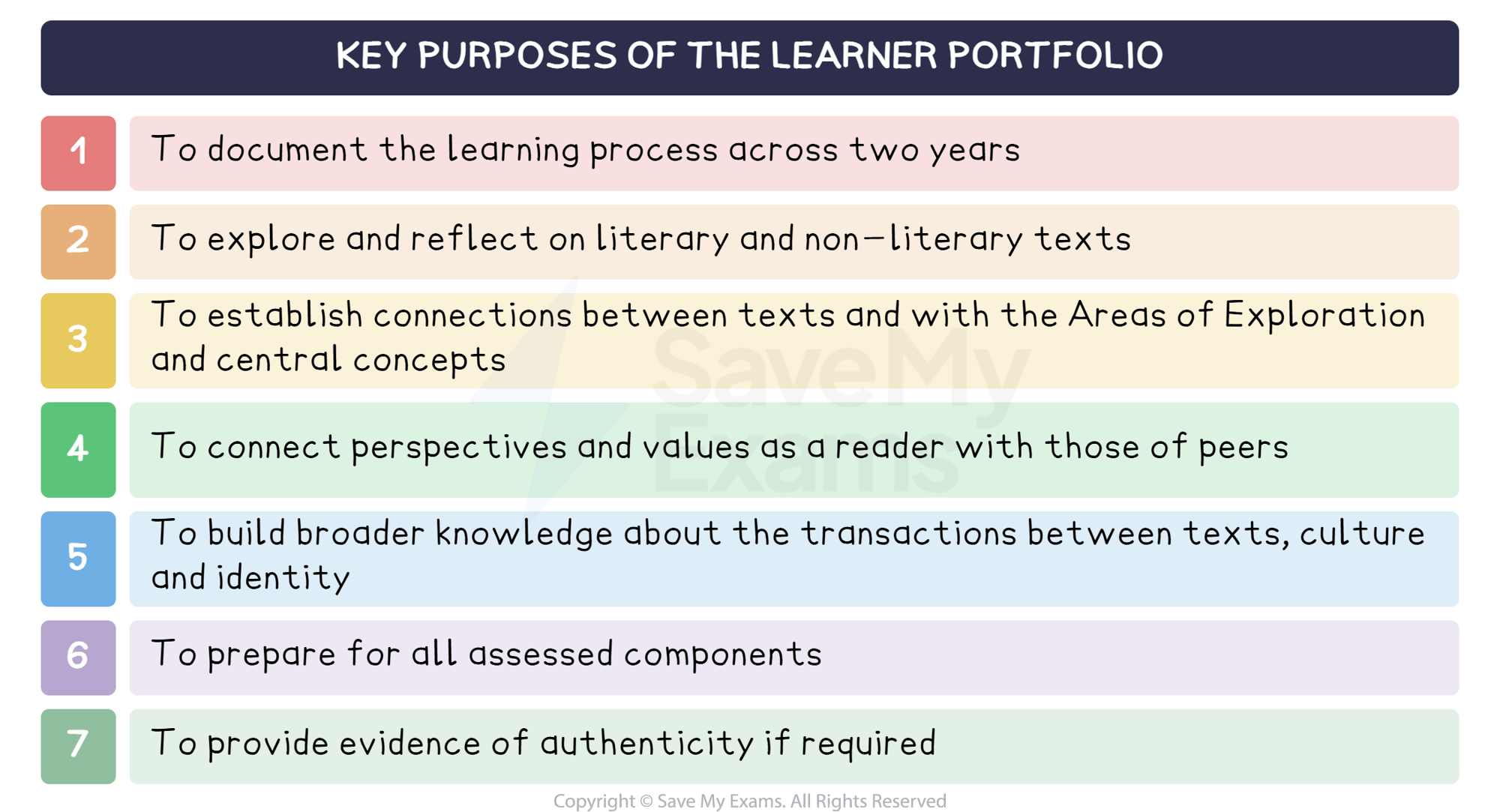
Let’s examine each one of these seven key purposes:
1. To document the learning process across two years
This is the most immediate purpose of the Learner Portfolio. Rather than relying on memory across a two-year course covering a large number of texts, the portfolio gives you a running record of what you have studied, thought and discovered. This means that, by the time you reach your final assessments, you will have far more material to draw on.
2. To explore and reflect on literary and non-literary texts
The portfolio is also designed to deepen your engagement with texts over time. This is a place to reflect on not just what a text means, but on how your reading of it connects to your own perspectives and values, and to those of your peers.
3. To establish connections between texts and with the Areas of Exploration and central concepts
The portfolio helps you to build connections. As you move through the three AoEs and engage with the seven central concepts, the portfolio is where you begin to see how texts “speak” to one another, and how ideas recur and evolve across different kinds of writing.
4. To connect perspectives and values as a reader with those of peers
The portfolio is where you record not just your own responses, but how those responses are challenged, complicated or enhanced by encountering different viewpoints in class discussions.
Examiner Tips and Tricks
Every reader brings something personal to a text. You will have your own perspectives and values as a reader. Your classmates bring different ones: they may notice things you miss, or they might find a different meaning in a work or text.
When you notice these things in a class discussion, you should record this in your portfolio. It is not about just recording what other people said, but also recording what their different interpretations revealed to you about your own.
5. To build broader knowledge about the transactions between texts, culture and identity
When you read, you do not simply “receive” meaning from the writer. You bring something to a text, and a text does something to you in return. This back-and-forth is a transaction.
This table explores a few central ideas when considering these transactions:
Concept | Explanation |
|---|---|
Texts exist within cultural contexts | Texts are produced within particular cultures, at particular moments in time, for particular audiences |
Texts carry cultural values — even unintentionally | A text carries the values, assumptions, anxieties and ambitions of the culture that made it, even when the writer did not consciously intend this |
Texts shape culture | Texts also shape culture. They change how people think, and what stories they tell about themselves and others |
Identity is shaped by texts | Your sense of who you are, individually and collectively, is partly formed by the texts you encounter: the stories you were told as a child, the media you consume, the literary tradition you were educated in |
Identity shapes how we read | Your identity also shapes how you read. Two people from different cultural backgrounds will bring different assumptions to the same text, and will leave it having understood different things |
The process of building your Learner Portfolio involves having an awareness of all of these things and to see patterns. You might notice how certain ideas about gender, power, belonging or language recur across texts that have no direct connection to one another. This contributes to your “broader knowledge” and this is documented in your portfolio.
6. To prepare for all assessed components
This is the most practical purpose of the portfolio. Your portfolio should help you prepare for:
Paper 1
Paper 2
The Higher Level Essay
The Individual Oral
The work necessary to meet the requirements of each assessment component should evolve from the contents of the portfolio. So even though the portfolio does not directly contribute to your assessments, it forms the groundwork for them
7. To provide evidence of authenticity if required
Finally, should the IB have any concerns about the authenticity of your submitted work, or about how a school is running the course, your portfolio may be requested as evidence. It must therefore be kept by your school for at least six months after your final assessments.
Frequently asked questions
Is the Learner Portfolio graded?
No, the portfolio is not graded or marked by the IB in the normal sense. It is, however, mandatory, and forms the basis of preparation for the components that are graded. Your school must keep it and can be asked to submit it. If submitted, it is used to verify authenticity, not to award marks.
When do I start the Learner Portfolio?
From the first lesson of Year 1, across the full two years of the course. Its value lies in the fact it accumulates thinking over time, so it should therefore not be something you construct retrospectively in the final weeks before your assessments.
Is there a required format or structure?
No. The IB does not prescribe a fixed format for the Learner Portfolio. You can keep it digitally, using tools such as OneNote or Google Docs, or you can maintain a physical folder or notebook. What matters is that it is organised well enough for you to find and use your material when preparing for assessments, and accessible enough for your school to retrieve it if the IB ever requests it.
Is there a minimum word count or number of entries?
No. The IB sets no minimum word count or number of entries. However, a portfolio that consists of a handful of sparse notes across two years will not serve you when it comes to preparing for the Individual Oral, the HL Essay, or Paper 2, and it will not convincingly demonstrate genuine engagement with the course if it is ever reviewed.
Does every lesson need a portfolio entry?
No, the portfolio does not need to document every single classroom activity. It should capture a meaningful range of your responses, reflections and connections across the course.
Will my teacher read my portfolio?
This depends on your school. The IB does not require teachers to formally mark or moderate your portfolio, but most teachers will check it periodically to monitor your progress and provide feedback. Your school is also required to be able to access it.
What is the Works Studied form, and do I have to include it?
Yes, this is a compulsory element. The Works Studied form is a document that must be included at the end of your portfolio. It lists all the texts and works you have engaged with during the course and shows how each connects to the assessment components. Your teacher will also authenticate it.
Is the Learner Portfolio the same for SL and HL students?
The requirement is the same for both SL and HL.
What happens if I have not been keeping my portfolio up to date?
Start now: a portfolio built entirely in the final term of Year 2 will not reflect genuine development over time. If you have fallen behind, speak to your teacher and begin rebuilding it as thoroughly as you can from the material you have.
Can I use AI tools to write my portfolio entries?
This is an area where you need to be careful. The portfolio’s core function is to record your own thinking, your own responses to texts and your own developing understanding. Entries generated by AI do not reflect any of that, and if your portfolio is ever reviewed by the IB, AI-generated entries will not help your case. Remember, the IB is asking to see your mind at work, not AI’s.
Summary
The Learner Portfolio is a mandatory and central element of the IB English A: Language and Literature course for both SL and HL students
It is an individual collection of student work built up across the full two years of the course, starting from the very first lesson
It is not a showcase of your best work:
It should reflect your full record of discovery, experimentation and development as a learner, including informal and unfinished thinking
It must contain a diversity of formal and informal responses in a range of forms and media
It is not graded by the IB and does not directly contribute to your final score:
It is however mandatory, and your school must keep it for at least six months after your final assessments
The IB reserves the right to request it at any time, most commonly to verify the authenticity of submitted work or to review how a school is running the course
All four assessed components, Paper 1, Paper 2, the HL Essay, and the Individual Oral are intended to grow directly out of the work done in the portfolio
The IB prescribes no fixed format:
It can be digital or physical, provided it is well organised and accessible
There is no minimum word count or required number of entries, but sparse or superficial portfolios will not serve you at assessment time
Every lesson does not require an entry, but the portfolio should capture a meaningful range of responses and reflections across the course
It must include a completed Works Studied form at the end, listing all texts studied and their connections to assessment components, signed by both student and teacher

Unlock more, it's free!
Join the 100,000+ Students that ❤️ Save My Exams
the (exam) results speak for themselves:

Was this revision note helpful?