Comparative Essay Model Answers (DP IB English A: Language and Literature: HL): Revision Note

For your Paper 2 Comparative Essay on the IB Diploma English A: Language and Literature (HL) exam, it is important to understand how your essay is assessed and what a high-level response looks like in practice.
This section includes:
Overview
Marking criteria
Model answers
Top tips
Overview
Paper 2 is marked out of 25 marks and is assessed using four criteria. Each criterion focuses on a different aspect of your comparative essay.
Criterion A | Knowledge, understanding and interpretation | 5 marks |
Criterion B | Analysis and evaluation:
| 10 marks |
Criterion C | Focus and organisation | 5 marks |
Criterion D | Language | 5 marks |
Total | 25 marks | |
Understanding how these criteria work will help you structure your essay clearly and develop a focused argument. It is important to know the meaning of each of the terms so that you are confident that you know what the differences are between “knowing”, “understanding”, “interpreting”, “analysing” and “evaluating”. Examiners consider all elements of the descriptors when determining your mark for each criterion.
Marking criteria
Criterion A: Knowledge, understanding and interpretation
To do well in Criterion A, you need to demonstrate accurate and relevant knowledge of both works while developing a focused interpretation that directly answers the question. “Interpretation” means using knowledge and understanding to recognise trends and draw conclusions.

To gain top marks you need to meet the following descriptor. The key words are highlighted in bold.
Marks | Descriptor |
5 |
|
Here are some common mistakes to avoid based on IB examiner feedback on Criterion A:
Common mistakes to avoid | |
Using pre-prepared essays |
|
Making general comments without evidence |
|
Focusing on knowledge instead of interpretation |
|
Overusing quotations |
|
Criterion B: Analysis and evaluation
To do well in Criterion B, you need to analyse how the writers construct meaning and evaluate why those choices are significant in relation to the question.
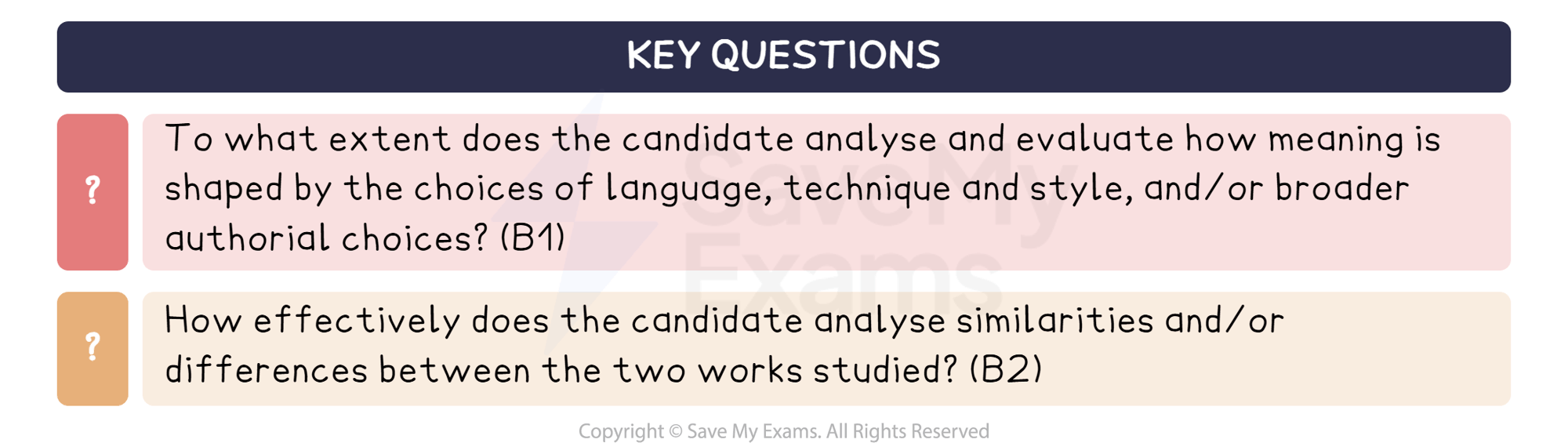
To gain top marks you need to meet the following descriptor. The key words are highlighted in bold.
Marks | Descriptor |
10 |
|
Paper 2 is the only paper where the assessment criteria specifically requires comparison and/or contrast. To access the higher mark bands in criterion B2, this comparison and/or contrast must be made explicitly throughout your response.
Examiner Tips and Tricks
Marks are not awarded based on quantity. Therefore, simply listing similarities and/or differences in your response, without any analysis, is likely to remain in the 1–2 mark bands for Criterion B. What matters most is the quality and depth of your analysis. Stronger responses go beyond summarising and provide an in-depth exploration of the similarities and/or differences between the two works.
Here are some common mistakes to avoid based on IB examiner feedback on Criterion B:
Common mistakes to avoid | |
Identifying techniques without analysing them |
|
Ignoring broader authorial choices |
|
Not including evaluation |
|
Failing to compare authorial choices |
|
Examiner Tips and Tricks
A strong analysis of the organisation and structure of a work, or of the broader decision a writer makes in relation to voice, narrator or perspective and of the relationship the work establishes with its theme and with its readers are just as valid as references to very specific figures of speech or stylistic elements.
Criterion C: Focus and organisation
To do well in Criterion C, you need to present a focused and coherent argument that consistently remains focused on the question while also maintaining a balance between both texts. ‘Focus’ and ‘coherence’ are key.

To gain top marks you need to meet the following descriptor. The key words are highlighted in bold.
Marks | Descriptor |
5 |
|
Here are some common mistakes to avoid based on IB examiner feedback on Criterion C:
Common mistakes to avoid | |
Losing focus on the question |
|
Lack of a clear argument |
|
Over-reliance on memorised formats |
|
Imbalanced analysis of texts |
|
Criterion D: Language
To do well in Criterion D, you need to use accurate and formal language to support your argument and communicate your ideas effectively.

To gain top marks you need to meet the following descriptor. The key words are highlighted in bold.
Marks | Descriptor |
5 |
|
Here are some common mistakes to avoid based on IB examiner feedback on Criterion D:
Common mistakes to avoid | |
Using informal or inappropriate register |
|
Unclear or awkward expression |
|
Frequent grammar and syntax errors |
|
Lack of sentence variety |
|
Model answers
We will now explore how you can create an informed and coherent argument using an example of a question from Paper 2. Read through the question below:
Exam question |
Discuss how the writers of two works you have studied depict social tensions. |
Here is a model paragraph using The Great Gatsby and A Doll’s House.
Both The Great Gatsby and A Doll’s House depict social tensions arising from rigid class and gender expectations, yet they differ in the extent to which individuals can challenge these restraints. In A Doll’s House, Ibsen exposes the tension within bourgeois domestic life through realist dialogue and a confined domestic setting, where Nora’s identity is shaped by societal expectations of femininity and obedience. The repetition of diminutives such as “little skylark” emphasises Torvald’s patronising use of language and Ibsen uses this to portray the power imbalance within their marriage. In contrast, Fitzgerald presents social tensions through the divide between old and new money, which shapes Daisy’s choices and limits her freedom. This effectively confines her within a world of wealth and spectacle, which is evident through Nick’s retrospective narration. Daisy’s identity, described as “full of money”, is symbolically used to align her with materialism. This perhaps suggests that her entrapment is inseparable from the social class she inhabits. While both writers critique patriarchal structures, Ibsen constructs Nora’s awakening through dialogue and the climactic stage direction of “The sound of a door shutting is heard from below”. This conveys her departure as an assertion of her autonomy. In contrast, Fitzgerald presents Daisy’s compliance as cyclical and inescapable, further symbolising the moral emptiness of the American Dream. Consequently, although both texts expose the constraints placed upon women within socially constructed systems, they differ in their depiction of whether individuals can challenge these social tensions and achieve real freedom. |
Examiner Tips and Tricks
During your exam, you will not have access to your studied works. While you are expected to make detailed reference to the works in your answer, you are not expected to include quotations from them.
We will now explore another question using two different literary texts. Read through the question below:
Exam question |
Discuss how the writers of two works you have studied portray female resistance within oppressive or authoritarian systems. |
Here is a model paragraph using Persepolis and The Handmaid’s Tale.
Both Satrapi and Atwood portray female resistance within authoritarian regimes which seek to control female identity, however the type of resistance in each text demonstrates their differing degrees of autonomy. In Persepolis, Marjane’s rebellion is frequently overt, whether through political argument, defiance or public confrontation. Satrapi’s graphic form visually underscores this defiance, as bold, simplified imagery illustrates specific aspects of resistance making them very immediate for the reader. This form enables Satrapi to juxtapose Marjane’s personal rebellion against wider societal oppression. In contrast, Offred’s resistance in The Handmaid’s Tale is largely internal. Atwood’s use of first-person narration confines the reader to Offred’s restricted perspective, where memory and subtle acts of non-compliance become her form of survival. This type of resistance illustrates the pervasive aspect of surveillance and fear within Gilead and suggests that rebellion could have fatal consequences. This contrast suggests that while Satrapi presents rebellion as an expression of a developing autonomy, Atwood portrays resistance tempered by a necessary caution within a regime sustained by surveillance and fear. Consequently both texts critique patriarchal control yet they differ in their portrayal of how resistance can be enacted. |
Examiner Tips and Tricks
Focus on developing your own interpretation of the texts. Strong essays form a clear argument based on your reading of the text and supporting it with relevant evidence. For example, when exploring a particular theme, explain what the writer seems to be stating about that theme and how the evidence supports your interpretation.
Top tips
Maintain a clear focus on the question:
Your essay structure must consistently link back to the question
This connection should be clearly evident in each paragraph
Understand different question types:
Know how to approach a range of different questions, with multiple question stems
You are expected to interpret, analyse and evaluate:
You must complete these skills comparatively between texts
Use the IB key concepts to prepare for the exam:
Having a holistic understanding of these concepts will help you respond to a wide range of Paper 2 questions
Paper 2 is the only assessment component that explicitly requires comparison and contrast:
These comparisons should focus on:
the meanings conveyed by each work
the methods used to construct those meanings
Analyse both texts in a balanced way

Unlock more, it's free!
Join the 100,000+ Students that ❤️ Save My Exams
the (exam) results speak for themselves:

Was this revision note helpful?