Contextual Understanding (DP IB English A: Language and Literature: HL): Revision Note

Context involves facts and details about the author’s life and the socio-, political, historical and cultural realities of a given time and place. In each of these realities, you can consider how culture and identity influence the author’s choices in how they produce their text, and the audience’s perspective and interpretation of those texts.
Knowing and understanding contextual details can also provide insight into the themes and purposes of texts and allow you to make informed and convincing analytical claims.
Examiner Tips and Tricks
Knowledge of context can help you meet the marking criteria in your English A IBDP assessments.
For example, in the Individual Oral (IO), you should explore your global issue in relation to the specifics of the context of your chosen texts. In Paper 2, knowledge and understanding of context and how it impacts your reading of literary texts can help you meet Criterion A.
Authorial context
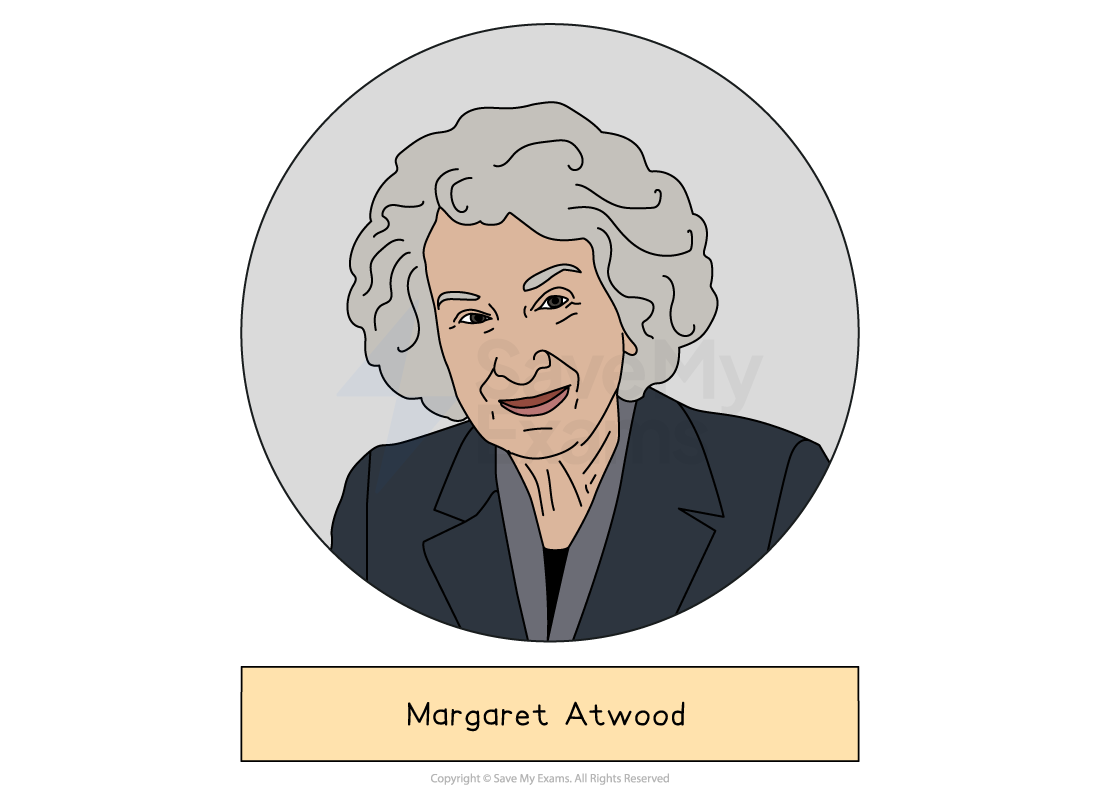
The Area of Exploration (AoE) Readers, Writers, Texts asks you to reflect on how meaning is constructed and interpreted. In your Theory of Knowledge (ToK) class, you will likely have had discussions on how meaning in the Arts is formed through a dialogue between the artist and the audience. As such, it can be useful to know details of the author’s life to infer reasons for their artistic choices as readers interpret their work years after their death.
Margaret Atwood, born in 1939, is a Canadian poet, novelist, fiction writer, and essayist:
Born in Ontario and homeschooled until the age of twelve, Atwood spent much of her childhood with her father, an entomologist, in the wilderness of northern Quebec
She attended the University of Toronto and Radcliffe College in Massachusetts
Atwood has taught English literature at several Canadian and American universities, and her work is taught in schools worldwide
Her influential work has earned her literary awards, including the Booker Prize, the Arthur C. Clarke Award, and the Governor General’s Award
Atwood’s dystopian and speculative fiction is considered modern social commentary; it raises environmental, political, and feminist themes
Atwood continues to write; her most recent work is the autobiographical Book of Lives: A Memoir of Sorts, published in 2025
Examiner Tips and Tricks
If using details from the authorial context to make an analytical claim, support it with evidence from the text and use the language of hedging (such as “this implies”, “this suggests”, “Atwood appears to”). Remember, you are interpreting, not stating facts.
Social and historical context
The social and historical context is the events, changes, morals and values of the time and place in which the text was written. The Handmaid’s Tale was published in Canada in 1985. Some key details of that time and place are explored below to help aid our analysis of how Atwood represented and challenged the society in which her audience lived.
Religious fundamentalism
While The Handmaid’s Tale was published in Canada, American religious context should be considered a backdrop to its themes
In 1980s America, religious fundamentalist groups gained traction:
These groups were characterised by their support for President Reagan and the Republican Party, who valued traditional, heterosexual, nuclear families
Simultaneously, 1980s America saw a resurgence of Puritan ideals within evangelical Protestantism, driven by the rise of the Christian Right
Atwood’s education in Massachusetts likely contributed to an interest in 17th-century American Puritanism in New England:
Puritan society advocated for a strict social order: women were assigned domestic roles, often named after their marital status, such as Goodwife
Puritan women named after aspirational virtues (such as Faith, Mercy, and Rejoice) likely inspired the character Serena Joy in The Handmaid’s Tale
Atwood has dedicated The Handmaid’s Tale in part to Mary Webster, who was hanged in Massachusetts in 1685 for witchcraft — this was because she is an example of a female person wrongly accused and a symbol of hope
The ideologies underpinning Gilead in The Handmaid’s Tale are rooted in Puritan thought
The Cold War
In the early 1980s, increased US-Soviet tensions gave rise to the threat of nuclear war: television adverts warned citizens how to respond to such an event
The Handmaid’s Tale was written during the Cold War, a time of increased surveillance:
Cold War monitoring in order to maintain power likely inspired the surveillance-based society of The Handmaid’s Tale
Prior to 1989 when the Berlin Wall fell, East and West Germany were still divided:
East Germany (the German Democratic Republic, or GDR) remained under Soviet control from 1949 until its reunification with West Germany in 1990
Atwood has said: “I started The Handmaid’s Tale on a German keyboard typewriter” when “Berlin was encircled by the Berlin Wall”
Regimes such as the GDR likely inspired Atwood’s totalitarian Gilead
Gender and sexuality
Atwood wrote The Handmaid’s Tale during the Second Wave of feminism:
The Second Wave was characterised by advocacy for women’s rights, particularly in the workplace and within marriage
In The Handmaid’s Tale, authoritarian leaders brought about a return to the pre-Second Wave conditions of female domesticity and strict gender roles
Offred’s flashbacks of her mother detail the rise of Second Wave feminism
The Handmaid’s Tale critiques the regression of women's rights, using Gilead to portray a reversal of feminist gains made in the 1960s and 70s
At the same time, there existed division in feminist groups, particularly regarding debates over pornography and sexuality:
The novel implies that Offred’s mother was a radical feminist activist through her attendance at a protest which burnt pornographic magazines
Reagan’s American administration in 1980s pushed for a return to tradition, including the domestic role of women, and resistance towards abortion and LGBTQ rights:
The rise of the Moral Majority and conservative evangelical power was a response to Second Wave feminism
In the 1980s, the first cases of HIV and AIDS in the US were reported:
At the time, the prognosis for AIDS was death within a year of diagnosis
This fed into right-wing propaganda that opposed sex outside of marriage, as well as homosexuality
This social landscape likely inspired the backdrop of Gilead
In the novel’s “Historical Notes”, the reader learns that the reduced fertility rate in Gilead was as a result of a sexually transmitted disease
Environmentalism
Environmental issues increased in the late 1970s and 1980s, particularly as a result of oil spills like the 1989 Exxon Valdez incident
Acid rain threatened ecosystems spurring research and regulations:
The 1987 Montreal Protocol addressed concerns over the ozone layer
However, the Reagan government attempted to reduce environmental regulations, ignoring scientific warnings and public opinion
In the 1970s and 1980s, increased awareness of environmental problems caused by the use of pesticides and chemicals led to the banning of certain harmful pesticides:
This theme is highlighted in Atwood’s The Handmaid’s Tale: grocery stores like “Loaves and Fishes” were rarely open as a result of polluted oceans
The novel details the decline in birth rates caused by toxic waste, radiation, and pesticide exposure
The “Colonies” are “toxic dumps” where the “radiation spills”
Literary context
The Area of Exploration (AoE) Intertextuality asks us to think about how texts adhere to and deviate from conventions associated with literary forms or text types, and how conventions evolve. Margaret Atwood’s novel The Handmaid’s Tale is an interesting text with which to think about these questions. Atwood’s novels can be interpreted as key dystopian and speculative fiction texts The tables below explore features of dystopian and speculative fiction and where we can see them in The Handmaid’s Tale.
Dystopian fiction
Features of dystopian fiction | Examples |
|---|---|
Totalitarianism |
|
Environmental ruin |
|
Propaganda and controlled information |
|
Speculative Fiction
Features of speculative fiction | Examples |
|---|---|
Near-future setting |
|
Alternative histories |
|
Detached narrator |
|
Context of reception
In the AoE Time and Space, questions revolve around how audiences “then and now”, or “there and here”, might read/interpret texts differently. Paper 2 questions may ask you to compare texts that make you think about this, and in the IO, you might compare how two different texts in different contexts explore the same Global Issue; therefore, it is useful to know and understand how the audience of the time reacted to Atwood’s work.
Audience reception
The general reaction of Canadian media treated the book as a work of cynical social realism
In her critique, Feminism's Phantoms, Barbara Ehrenreich considers the novel a warning against the repressive tendencies of feminism:
She references 1984, describing Offred as a “sappy stand-in for Winston Smith. Even her friend Moira characterized her as a wimp”
Catherine Stimpson (in a 1986 review in Nation) praised Atwood as “among the most telling political writers in the West”:
However, similar to Ehrenreich, she compares the morality of the Aunts to that of “radical feminists”, arguing that they are “repressive”
In a review for the Times Literary Supplement in 1986, Lorna Sage considers The Handmaid’s Tale through a dystopian lens
She describes The Handmaid's Tale as "a novel in praise of the present, for which, perhaps, you have to have the perspective of dystopia."
Mary McCarthy’s 1986 review in The New York Times critiqued The Handmaid's Tale, suggesting the novel lacked characterisation and was a "peculiar" attempt at satire:
She noted, especially, a lack of depth in the protagonist, Offred
Exploring critics
Below are two notable critics who have commented on The Handmaid’s Tale:
Carol L. Beran: “Images of Women’s Power in Contemporary Canadian Fiction by Women” (1990)
Carol L. Beran is a Canadian writer and literary critic, who has written specifically about Atwood’s works
She explored the idea of Offred as a victim with “some kind of special power”:
In Gilead, Offred is victimised by a system that reduces women to instruments of procreation
However, Offred’s mind and its ability to remember and use language becomes a “symbol of her power over the powerful male”
She “extracts gifts and favours in return for playing the crossword game”
One of Beran’s most famous quotes about The Handmaid’s Tale is: “Offred’s power is in language”:
Her voice and her story continue long after Gilead has fallen
This is contrasted with Professor Piexioto, who is unable to verbalise with any sense of emotion, because to him Offred is an object of scientific study
Beran believes that “in finding power in words, in speaking, Offred has moved from being a victim”:
In Offred, Atwood gives the reader a model of a woman who exemplifies a “creative non-victim”, necessary for Offred to become a heroine
“The power to feel and to create feeling is for Atwood’s heroines woman’s true power; artistic creation becomes the symbol of woman’s greatest power”
Coral Ann Howells: “Science Fiction in the Feminine: The Handmaid’s Tale” (1996)
Coral Ann Howells has lectured and published widely on Canadian literature, including about Atwood’s works
She has written about the presentation of female self-identity and Offred’s resistance to patriarchal authority in The Handmaid’s Tale:
She argues that Atwood’s choice of a female narrator subverts the traditionally masculine dystopian genre
Howells acknowledges that The Handmaid’s Tale is emblematic of a woman’s survival narrative told within the confines of a patriarchal system
She writes: “speaking out in a society where women are forbidden to read or write or to speak freely effects a significant shift from ‘history’ to ‘herstory’”:
Howells explores, though, the idea of the “Historical Notes” representing a shift back from ‘herstory’ to ‘history’
Offred’s narrations are viewed through a male academic lens
However, Howells agrees with Atwood’s assertion that the novel does not fit into the science fiction genre:
In fact, she believes the novel resists classification, “just as Offred’s storytelling allows her to escape the prescriptive definitions of Gilead”
She suggests that the novel is not just concerned with female oppression, but gender politics in a broader sense, controlling basic human desires:
Howells asserts that there is no simple gender division between masculine and feminine qualities in The Handmaid’s Tale
Examiner Tips and Tricks
If writing about the context of reception, be careful not to be dismissive of other audiences’ reactions or interpretations. Remember the course’s key concept of perspective, and how understanding and reflecting on different interpretations can give us greater insight into a work’s meaning and impact. For both the IO and Paper 2, comments on these multiple meanings and impacts are appropriate and show good knowledge and understanding.
Sources:
https://www.penguin.co.uk/discover/articles/margaret-atwood-interview (opens in a new tab).
Atwood, Margaret. “Margaret Atwood: 'The Handmaid's Tale is being read very differently now.'” Penguin Books, 6 April 2018, https://www.penguin.co.uk/discover/articles/margaret-atwood-interview (opens in a new tab). Accessed 23 April 2026.
Bacci, Francesco. “The Originality of The Handmaid’s Tale & The Children of Men: Religion, Justice, and Feminism in Dystopian Fiction.” University of Languages and Literatures of Macerata, vol. 3, 2017. Metacritic Journal, https://www.metacriticjournal.com/article/86/the-originality-of-the-handmaids-tale-and-the-children-of-men-religion-justice-and-feminism-in-dystopian-fiction (opens in a new tab). Accessed 23 April 2026.
Ehrenreich, Barbara. Feminism's Phantoms. The New Republic, 17 March 1986.
McCarthy, Mary. “Book Review.” The New York Times, 9 February 1986, https://archive.nytimes.com/www.nytimes.com/books/00/03/26/specials/mccarthy-atwood.html#:~:text=The%20head%20of%20the%20household%20%2D%20whose%20first%20name%20the%20handmaid,thin%20credibility%20of%20the%20parable (opens in a new tab). Accessed 23 April 2026.
Sage, Lorna. “Projections from a Messy Present.” Times Literary Supplement, 21 March 1986.
Stimpson, Catherine. “Atwood Woman.” The Nation, 31 May 1986, https://scrapsfromtheloft.com/books/handmaids-tale-atwood-woman-review-catharine-r-stimpson-nation/ (opens in a new tab). Accessed 23 April 2026.

Unlock more, it's free!
Join the 100,000+ Students that ❤️ Save My Exams
the (exam) results speak for themselves:

Was this revision note helpful?