Plot Summary (DP IB English A: Language and Literature: HL): Revision Note
An exploration of Trevor Noah’s Born a Crime requires consideration of how themes, characters and relationships develop across the memoir. It is this development that communicates the memoir’s central ideas about identity, power and resilience. To understand these ideas, you must have a clear understanding of the narrative events that shape Noah’s childhood.
Below you will find:
plot timeline
an overview of the memoir
detailed summaries by chapter
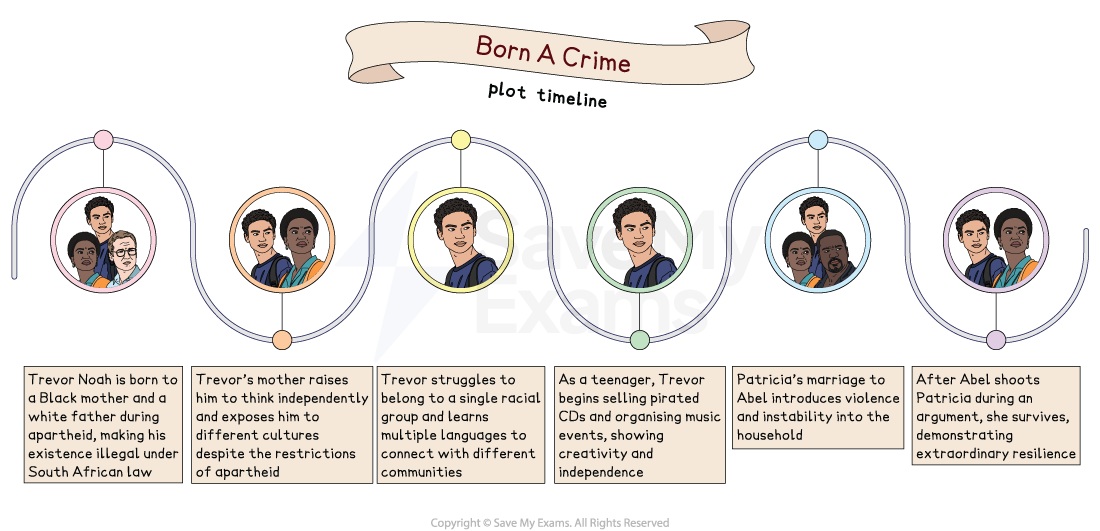
Born A Crime: Plot Timeline
Overview of Born A Crime
Born a Crime: Stories from a South African Childhood is a memoir written by South African comedian Trevor Noah and published in 2016. It recounts Noah’s upbringing during the final years of apartheid and the early years of democratic South Africa. It was a system of racial segregation and discrimination in South Africa (1948–1994) that enforced strict separation between racial groups and limited the rights of non-white people.
Noah was born to a Black South African mother and a white Swiss father at a time when interracial relationships were illegal under apartheid law. Because of this, his very existence represented a criminal act according to the state.
The memoir is structured as a series of interconnected anecdotes rather than a strictly chronological narrative. Each chapter recounts a specific story from Noah’s childhood while also providing historical and social context about apartheid society.
Throughout, Noah reflects on the challenges of growing up in a society structured around racial segregation. His experiences illustrate how apartheid shaped everyday life, influencing where people lived, how they travelled, what languages they spoke and how communities interacted.
At the centre of the memoir is Noah’s relationship with his mother, Patricia Nombuyiselo Noah. Her determination, independence and religious faith strongly influence Trevor’s upbringing and his understanding of the world. It traces Noah’s journey from childhood to adolescence, showing how he navigates racial identity, cultural expectations and social inequality while developing his own sense of independence.
Key events
The key events of the memoir can be understood through six pivotal stages in Trevor Noah’s life.
1 | Trevor’s birth under apartheid |
|
2 | Patricia Noah’s unconventional parenting |
|
3 | Growing up between racial communities |
|
4 | Trevor’s entrepreneurial teenage years |
|
5 | Conflict with Abel |
|
6 | Patricia’s survival and Trevor’s reflection |
|
Born a Crime: Chapter-by-chapter plot summary
Part I (Chapters 1-8)
Chapter 1: Run
Trevor explains he was born during apartheid and these racial laws controlled movement and relationships:
His existence was illegal because his mother was Black and his father was white
Trevor describes his mother Patricia’s strong religious beliefs as she takes him to multiple churches each Sunday:
Church requires long journeys across Johannesburg
Trevor, Patricia and Andrew are forced into a dangerous minibus taxi
Patricia decides they must escape as the situation becomes increasingly unsafe:
Trevor falls asleep and Patricia throws him from the moving vehicle
She jumps after him holding Andrew
Trevor and Patricia are injured but survive:
They reach a petrol station and seek help
Trevor later understands his mother saved his life
○ He recognises her courage and this establishes her protective role
Chapter 2: Born a Crime
Trevor explains apartheid laws banning interracial relationships:
○ His birth itself was a criminal act and mixed children were classified separatelyPatricia valued independence and wanted a child but not marriage:
She chose Robert as Trevor’s father
Trevor is born in 1984 and hospital staff question his appearance:
○ Patricia lies about his fatherTrevor visits Robert secretly as they cannot appear together publicly
Trevor lives partly with his grandmother and he is hidden from authorities
Chapter 3: Trevor, Pray
Church is central to family life and Trevor grows up surrounded by strong religious women:
○ Prayer meetings rotate between homesTrevor enjoys prayer meetings and attends multiple churches weekly:
○ Services last many hours and Trevor often becomes tired and hungryTrevor causes chaos after hiding his faeces indoors:
The family cannot identify the source and they suspect supernatural causes
Patricia believes a demon is present and a prayer meeting is organised
Trevor hides his guilt and participates in prayer as he fears punishment
Chapter 4: Chameleon
Trevor explains his confusion about his racial identity:
○ His appearance differs from relatives and his grandmother treats him carefullyTrevor learns multiple languages:
English from Patricia and African languages from his environment:
This allows Trevor to adapt socially, as language builds trust and he moves between different groups
Trevor avoids robbery through language:
○ He speaks Zulu and potential attackers change their behaviourTrevor attends Maryvale College, with students from mixed backgrounds and where racial identity feels less rigid
Trevor later attends government school, where racial divisions are stronger:
○ Trevor chooses Black peer groups
Chapter 5: The Second Girl
Trevor explains Patricia’s childhood: her parents’ marriage failed and she felt unwanted
Patricia is sent to the Transkei where she experiences poverty and carries out hard labour
Patricia attends a mission school where she learns English, showing how education offers opportunity
Patricia returns to Soweto and her income supports the family
She seeks independence and moves to Johannesburg to build her own life
Trevor explains that his mother chose him a neutral name so that he would be free from expectations or assumptions about his identity
Chapter 6: Loopholes
Trevor describes himself as rebellious, as he questions authority and resists rules
Patricia disciplines creatively by writing letters to Trevor to which he replies
Trevor searches for loopholes by questioning church rules and challenging authority figures:
He steals communion items by drinking the wine and eating the wafers
He brings a knife to school as he fears bullying and is disciplined
Abel begins to enter their lives more regularly and gradually becomes part of the household:
○ Trevor initially likes him
Chapter 7: Fufi
Trevor describes moving to Eden Park which is a new environment with new social challenges
The family keeps cats though as they are linked to superstition, the neighbours kill them
The family get dogs andTrevor bonds with Fufi who becomes his companion:
Trevor discovers that Fufi visits another family and the dog has another name making him feel betrayed
Patricia confronts the other family about the situation:
Trevor learns emotional lessons: love does not equal ownership and relationships are complex
Chapter 8: Robert
Trevor describes his father’s personality as quiet, independent and private
Robert opposed apartheid and ran an integrated restaurant, though authorities forced its closure
Trevor values time with Robert and visits him regularly:
Their calm relationship makes occasions like Christmas feel special
Contact between them gradually decreases and Abel becomes dominant in the household:
Trevor begins to lose his sense of connection though reconnects with Robert later in life
Part II (Chapters 9-14)
Chapter 9: The Mulberry Tree
Trevor describes life in Eden Park:
He does not fit easily into the neighbourhood and feels isolated
He explains why he is treated as different:
Some people reject him because of his Blackness, while others reject him because they think he is acting white
He explains how apartheid shaped identity and how the system encouraged division and resentment
Trevor is bullied by local boys and is mocked:
He is tricked out of his bicycle though his cousin helps him to retrieve it
He realises he misunderstood the situation and learns not to mistake attention for friendship
Trevor recalls a worse incident involving boys near the mulberry tree:
○ He is humiliated and excluded by the boys and this experience deepens his sense of being an outsider
Chapter 10: A Young Man’s Long, Awkward, Occasionally Tragic, and Frequently Humiliating Education in Affairs of the Heart, Part I: Valentine’s Day
Trevor begins thinking seriously about girls:
○He becomes increasingly aware of attraction, popularity and the social hierarchy among boys at schoolHe develops a crush on a girl and arranges for a Valentine’s gift to be delivered:
○ Another boy delivers them on his behalf and the girl assumes the gift is from himTrevor does not get the credit and is humiliated by the situation:
○ He learns that intention alone is not enough
Chapter 11: Outsider
Trevor describes moving through adolescence as someone who does not fully belong to one group:
○ He is comfortable with many different people but remains socially separate at the same timeHe uses humour and confidence to navigate social life:
○ He learns how to make people laugh and becomes skilled at adapting to different situationsTrevor begins building his own identity outside formal authority and becomes increasingly independent:
He starts to find status through resourcefulness rather than belonging
He learns how to move between groups and becomes more socially agile
Chapter 12: A Young Man’s Long, Awkward, Occasionally Tragic, and Frequently Humiliating Education in Affairs of the Heart, Part II: The Crush
Trevor develops another romantic interest:
He becomes more focused on how attraction works and compares himself to other boys
Trevor struggles to express his feelings directly and overthinks situations:
He remains awkward in romantic situations and experiences more embarrassment than success
He continues learning through failure:
He gains awareness without gaining the outcome he wants
His experience becomes part of his broader education in relationships
Chapter 13: Colorblind
Trevor describes a close friendship with Babiki:
○ He values her company and does not initially define the relationship through raceHowever, he becomes aware that other people do and that the relationship is interpreted racially from the outside:
○ Social perception changes how their friendship is seenTrevor realises that private feelings are not enough to escape public assumptions:
○ He becomes more aware of how society and race frames identityHe learns that wanting to ignore race does not remove its effects and that other people still read race into ordinary interactions
Chapter 14: A Young Man’s Long, Awkward, Occasionally Tragic, and Frequently Humiliating Education in Affairs of the Heart, Part III: The Dance
Trevor prepares for a school dance as he wants to improve his chances socially
He tries to manage the expectations attached to the dance:
○ He thinks carefully about how to present himself and hopes things will go differently this timeHe experiences more awkwardness and disappointment:
○ He does not achieve the romantic success he hopes for and the dance becomes another humiliating lessonTrevor continues learning about attraction and performance:
○ Romantic situations remain difficult for him and he understand that social confidence matters
Part III (Chapters 15-18)
Chapter 15: Go Hitler!
Trevor forms a dance group and music and dance become central to his identity:
Public performance gives him confidence and status
The group performs at events and competitions and Trevor becomes more involved in organising them
One of the dancers is named Hitler:
Trevor does not initially understand the historical significance of the name, as in his local context it is used differently
Trevor hears the crowd respond enthusiastically to the name during a performance:
He realises there is a major cultural misunderstanding, which shocks him
Trevor learns that historical meaning is not universally understood in the same way and the moment stays with him:
○ This highlights a gap between local cultural practices and global historical understanding
Chapter 16: The Cheese Boys
Trevor becomes more deeply involved in township youth culture:
○ Social status is closely tied to material display and cars, image and style matter enormouslyHe explains the importance of cars and views them as symbols of masculinity and success:
○ Ownership and appearance affect how young men are judgedHe develops his DJ work and hustling further, by selling his music and building his DJ reputation:
His business becomes an important income source and grows more serious about making money independently
Trevor observes how quickly status can rise and fall:
Money creates influence, but losing it can take that influence away just as quickly
Trevor learns more about the informal economy around music and parties:
Reputation and networks both play a crucial role
Chapter 17: The World Doesn’t Love You
Abel becomes increasingly abusive:
His drinking worsens and his violence grows more serious and dangerous
Patricia refuses to surrender her independence:
○ She does not accept Abel’s authority and continues resisting himTrevor witnesses growing instability in the household:
○ Fear becomes part of everyday life and conflict becomes normalisedPatricia eventually leaves Abel:
Separation does not end the danger and Abel continues to threaten and intimidate her
Trevor becomes more aware of the limits of his own power to protect his mother
Chapter 18: My Mother’s Life
Trevor returns to Patricia’s life story:
○ He reflects on her endurance and her influence over his lifeAbel tracks Patricia down after the separation:
He confronts and shoots her
The bullet passes through her head though Patricia survives
Trevor rushes to the hospital and fears he is losing his mother:
○ He confronts the reality of how close she came to deathPatricia recovers and her resilience continues to define her:
○ Her faith remains central to how she understands what happenedPatricia chooses to forgive Abel though Trevor struggles with this decision:
○ Her forgiveness reflects the depth of her religious convictionTrevor ends the memoir by recognising how profoundly his mother shaped him:
○ Her strength, independence and determination define his understanding of her life
○ Her influence remains at the centre of the memoir
Examiner Tips and Tricks
Remember the memoir is episodic rather than a continuous narrative. Each chapter acts as a thematic case study. Strong IB responses select episodes based on thematic relevance rather than narrative order.
Sources
Noah, T. (2016), Born a Crime: Stories from a South African Childhood, London: John Murray.

Unlock more, it's free!
Join the 100,000+ Students that ❤️ Save My Exams
the (exam) results speak for themselves:

Was this revision note helpful?