Analysing & Evaluating Authorial Choices and Textual Features (DP IB English A: Language and Literature: HL): Revision Note

This section is designed to help you strengthen one of the most important skills required for Paper 1: analysing and evaluating authorial choices and textual features. To score well in Criterion B, examiners expect you to explore how writers construct meaning and/or achieve their purpose through the stylistic and structural choices they make.
This section includes:
What are authorial choices and textual features?
Textual features and impact
Using subject-specific terminology to analyse textual features
What are authorial choices and textual features?
Understanding authorial choices is essential when preparing for Paper 1. Authorial choices refer to the deliberate decisions a writer makes in order to shape meaning. In Paper 1, you are expected to analyse and evaluate how successfully these choices allow the writer to achieve their purpose and/or impact the reader.
Examiner Tips and Tricks
Many Paper 1 texts are multimodal. That is, they make use of more than one mode to convey meaning. Most often, these are visual and textual modes (the text contains both text and images). If you get a multi-modal text in the exam, it is essential that you analyse and evaluate both visual and textual features.
Authorial choices and textual features include:
Visual elements | Textual elements |
|---|---|
|
|
You are required to analyse and evaluate how these choices:
Achieve the writer’s intended purpose
Impact the intended audience
Convey meaning or emotion
Reflect the context or production
Textual features and impact
It is not enough to simply identify and name the textual features in a text. The strongest Paper 1 responses analyse and evaluate the effect of these features by examining how and why they have impact.
Criterion B in the mark scheme specifically assesses the extent to which you analyse and evaluate how a writer’s use of stylistic and structural features shapes meaning. Your analysis must demonstrate that these choices are deliberate and significant.
Let’s explore some key authorial methods and how they can be used effectively in your essay.
Imagery
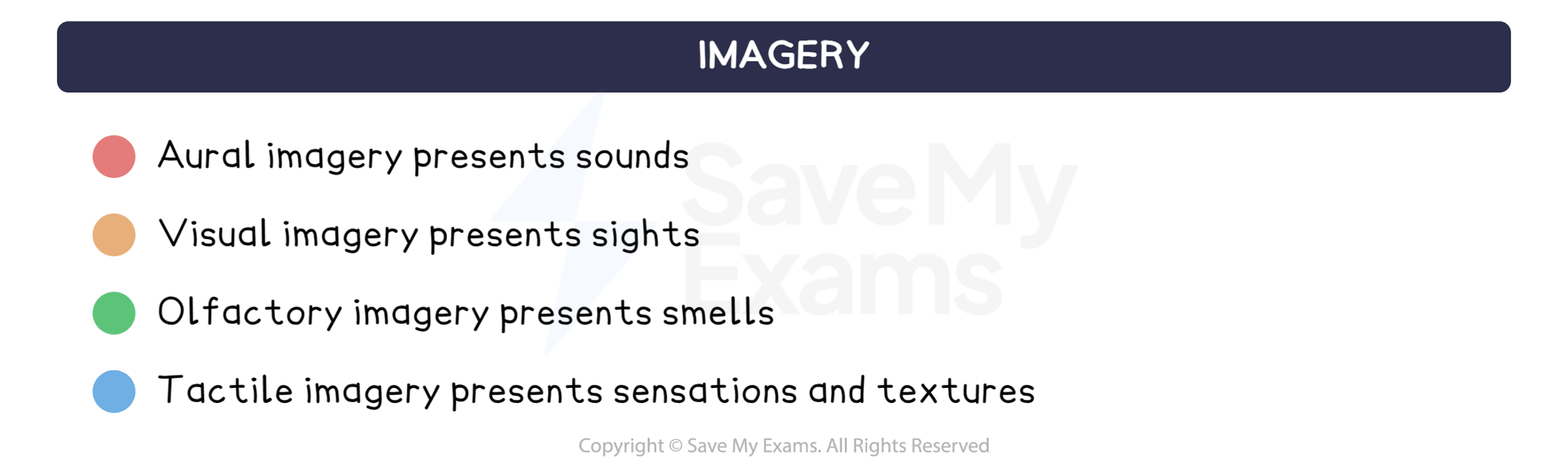
Imagery uses sensory information to shape how an audience thinks and feels about a topic or place. It is a common feature in travel writing, charity appeals, diaries and blogs.
Remember, imagery can appeal to all senses, not just visual:
Here is an example of how you might comment on imagery:
Travel Writing: ‘Hiking into the Heart of Muir Woods’ – Don George |
|---|
George uses sensory imagery to immerse the reader in the environment and remind us of the power of nature to bring solace. He effectively moves beyond description and imbues the nature in the woods with emotions like peace and wonder. We gaze with him at the redwoods, “staggeringly tall, wide, and straight… haloed with sunlight filtering through their branches”. The imagery of the sunlight with the connotation of “haloed” elevates the trees to deities, and we join George in celebrating the feelings of “sanctity, serenity and eternity” that nature can give us, especially in times of crisis and stress. |
Emanata
Emanata are the visual elements that convey a figure's emotions or movements in a comic or cartoon.
Here is an example of how to analyse emanata:
Comic: My Life in a Nutshell, ‘MInecraft’ – Debbie Ohi |
|---|
Ohi uses emanata to convey emotions and add humour to her comic. In the first three panels of the comic strip, the absence of emanata emphasises the protagonist’s focus on her task as she ignores the out-of-panel speaker who reminds her of her love of Minecraft. The sudden, exaggerated emanata in the last panel are highly effective in contrast. The wide open mouth and oversized eyes show her excitement, while the messy hair and drops of saliva exaggerate this emotion to comic levels. Paired with the jagged speech bubble with enormous font in all caps and the multiple question marks and exclamation marks, Ohi cleverly uses both text and image to convey the hilarious level of the protagonist’s excitement about a minor topic: the presence of bunnies in Minecraft. |
Examiner Tips and Tricks
When analysing multi-modal texts, it is a good idea to look at how text and image work together rather than in isolation.
Perspective
Perspective refers to the position of the writer. In formal or academic writing, the perspective is often:
Perspective | Example |
|---|---|
Third person | “He/she/it…” |
Impersonal | “One” |
Passive unnamed | “it is commonly believed…” |
In speeches, proposals, opinion columns, blogs, and diaries, the first-person perspective (“I”) is often used to create a connection between the writer and the audience. Sometimes the collective “we” is effective in implying that the reader and writer hold the same opinions.
Here is an example of how you might comment on perspective:
Speech: ‘I Have a Dream’ – Dr Martin Luther King Jr |
|---|
Dr King delivered an impassioned plea for racial equality from the first-person perspective of a civil rights leader, pastor, Black man, and father. Through the use of the first-person perspective, he aligned himself with the suffering of his fellow people of colour under racism. He made the political personal by linking his experiences with historical decrees and proclamations. He made the theories and hypotheses of social structures a lived reality. Crucially, he humanised the Black man in a system that sought to dehumanise him. His famous lines spoken from the perspective of a father hoping for his “four little children” to be judged by the “content of their character” instead of the colour “of their skin” echoes through the decades and demands the listener heed his call for justice and equality. |
Colour
Colour is a highly effective visual technique used in almost all multi-modal texts. Colour may convey a mood or video, have specific connotations, align parts of a text with each other or create visual associations in the audience’s mind.
Here is an example of how you might evaluate the use of colour in a text:
Magazine cover: Time Magazine: ‘Trump’s Next Move’ |
|---|
The magazine cover makes effective use of a limited colour palette — red, white, black and gold — to convey both seriousness and arrogance. The black and white colour scheme of the iconic chessboard links Trump’s foreign policy to a strategic game. These colours are echoed in the president’s hair and suit, linking him visually to the game. The startling contrast of the one gold piece in Trump’s hand is emphasised with the graphic weighting of the light glinting on it. This makes the piece seem important, and hints that it is a winning move, or at least that the president thinks it is. The suggested arrogance here lies in the president holding the one different piece, as if he can change the rules of an ancient game. The gold connotes wealth, power and self-aggrandising: qualities frequently associated with the man. The red border of the magazine cover is echoed in Trump’s tie and American-flag pin. Now an iconic item of clothing for Trump, the red connotes American patriotism and conservative values. |
Examiner Tips and Tricks
Your analysis of textual features will be enhanced and more convincing if the analysis is linked to specifics of context, audience and purpose. For example, evaluating the effectiveness of testimonials in an advertisement that uses a figure from popular music culture will only be convincing if you have identified the intended audience as young music fans. A soft drink ad using Taylor Swift will not appeal to a 70+year-old woman, but it will appeal to a 19-year-old Swiftie.
Using subject-specific terminology to analyse authorial choices and textual features
An effective way to identify how a writer achieves a purpose or affects a reader is to be able to name textual features. This will help you ensure you are not missing key features, and it will help you do well in criterion D: Language. By using terminology, you will strengthen your analytical writing and develop more sophisticated interpretations of the texts.
Here are some textual features which you should become familiar with:
Objects and figures: what, who and how objects and figures are placed have an impact. Gaze, body language, symbolism and demographics affect how we read a visual text | Imagery: how words create images that invite the reader into an experience or setting | Patterns of denotation and connotation: how particular words impact interpretation | Anaphora: how repeating words or phrases adds emphasis and rhythm |
Syntactical patterns: how words follow or ignore traditional grammatical rules | Rhetorical patterns: the way persuasive techniques, including ethos, pathos and logos, shape the relationship between the writer and reader | Patterns of punctuation: how punctuation affects the meaning of the words around them | Visual/spatial patterns: how the visual appearance of elements of a text impacts flow and level of engagement |
Allusion: how references to events or people link the text under analysis to wider trends | Inclusion: how the writer uses language to include the reader in their experiences and perspective | Anchoring: how different elements of a text are tied to each other in the reader’s mind | Juxtaposition: how elements are compared and contrasted visually, spatially or textually to make the reader reflect on differences |
Sources
King Jr., M. L. (1963), ‘I Have a Dream’, American Rhetoric, https://www.americanrhetoric.com/speeches/mlkihaveadream.htm (opens in a new tab)
George, D. (2020), ‘Old Growth: A Day Trip Hiking into the Heart of Muir Woods’, GeoEx, https://www.geoex.com/blog/old-growth-hiking-into-the-heart-of-muir-woods (opens in a new tab)
Ohi, D. R. (2014), ‘Minecraft’, My Life in a Nutshell, https://debbieohi.com/webcomic-series/my-life-in-a-nutshell/ (opens in a new tab)

Unlock more, it's free!
Join the 100,000+ Students that ❤️ Save My Exams
the (exam) results speak for themselves:

Was this revision note helpful?