Contextual Understanding (DP IB English A: Language and Literature: HL): Revision Note

Context involves facts and details about the author’s life and the socio-, political, historical and cultural realities of a given time and place. In each of these realities, you can consider how culture and identity influence the author’s choices in how they produce their text and the audience’s perspective and interpretation of those texts.
Knowing and understanding contextual details can also provide insight into the themes and purposes of texts and allow you to make informed and convincing analytical claims.
Examiner Tips and Tricks
Knowledge of context can help you meet the marking criteria in your IB English Language and Literature Diploma assessments.
For example, in the Individual Oral (IO), you should explore your global issue in relation to the specifics of the context of your chosen texts. In Paper 2, knowledge and understanding of context and how it impacts your reading of literary texts can help you meet Criterion A.
Authorial context
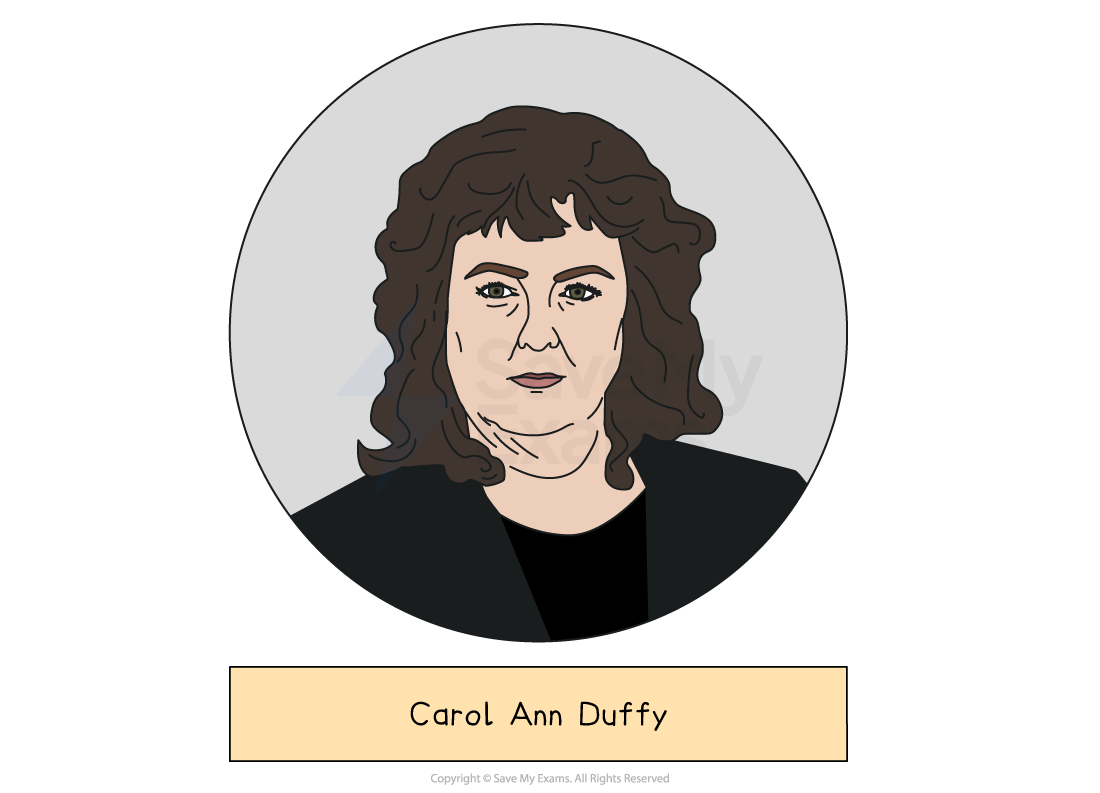
The Area of Exploration (AoE) Readers, Writers, Texts asks you to reflect on how meaning is constructed and interpreted. In your Theory of Knowledge (ToK) class, you will likely have had discussions on how meaning in the Arts is formed through a dialogue between the artist and the audience. As such, it can be useful to know details of the author’s life to infer reasons for their artistic choices as readers interpret their work years after their death.
Duffy was born in 1955 in an underprivileged part of Glasgow, Scotland, to Catholic, Irish-Scottish parents:
Her work often deals with working-class realities and hardships
She has spoken of feeling Scottish and Irish, but not English
Duffy moved with her family to England when she was a young child:
She explores the idea of displacement in her writing
Concepts of home, belonging and identity are present in her poetry
She often describes Scotland with a sense of nostalgia
She writes from the dual perspective of insider-outsider
Duffy is bisexual and was in a long-term relationship with fellow poet Jackie Kay:
She writes some love poems in which gender is not specified
She also writes poetry about queer love
Duffy became the first female Poet Laureate in 2009:
She was the first woman appointed to the role in 400 years
She was also the first Scottish-born and first openly queer poet to hold the position
It was a recognition of her importance in British literature
In this role, she gave voice to topics and people that are often ignored
She challenged the idea of poetry as elitist
Examiner Tips and Tricks
If using details from the authorial context to make an analytical claim, support it with evidence from the text and use the language of hedging (such as this implies, this suggests, Duffy appears to). Remember, you are interpreting, not stating facts.
Social and historical context
The social and historical context is the events, changes, mores and values of the time and place in which the text was written. Duffy has published poetry in Britain since the 1970s and continues to write today. Some key details of late 20th-century Britain are explored below to help aid our analysis of how Duffy represents and challenges the society in which she writes.
Thatcher’s Britain
Margaret Thatcher was the Prime Minister of the United Kingdom from 1979 to 1990
Under her leadership, Britain saw increased free market policies and the privatisation of state-owned industries
Thatcher believed in a reduced role of the government in social matters, so there were cuts to education and social welfare
Trade unions’ power was reduced
There was much social and economic change: unemployment, increased inequality between economic classes and social unrest
In her poetry, Duffy often highlights the voices of marginalised groups who are silenced by economic inequality
Duffy uses her art to speak truth to power
Scottish cultural identity
The 1980s saw a blossoming of Scottish cultural identity:
This was often forged as a point of contrast to English culture
There were referendums in 1979 and 1997 for Scottish devolution:
Ideas of home in Scottish poetry (including Duffy’s) are associated with imperialism, power dynamics and the complexity of British national identity
Duffy’s migration from Scotland makes for complex questions around ‘true’ Scottishness:
Duality and the Other are interesting concepts in Duffy’s poetry
Drawing from her personal identity, Duffy often examines concepts of belonging and who is allowed to belong:
She is interested in the margins and edges of society
She is interested in how national and cultural identity is formed
Second- and third-wave feminism
Second-wave feminism was a movement from the 1960s to the 1980s:
It sought to build on the rights for women gained in the early 20th century, which were largely based on voting rights
Second-wave feminism argued against restrictive and traditional gender roles
It fought for greater reproductive rights and workplace rights
It fought to widen the definition of womanhood
Third-wave feminism emerged in the 1990s:
It focused on diversity and individualism
Duffy’s work often looks at the plurality of female identity:
She aims to portray multiple ways of being an ‘acceptable’ woman
Examiner Tips and Tricks
Social and historical context can help you understand an author’s purpose, message and themes. When you connect this context to the author’s choices in the text, you can make convincing analytical claims that demonstrate strong knowledge and understanding, helping you reach the higher bands of the assessment criteria.
Literary context
The Area of Exploration (AoE) Intertextuality asks us to think about how texts adhere to and deviate from conventions associated with literary forms or text types and how conventions evolve. Duffy is difficult to categorise in terms of literary theories: she is a feminist, working-class, Scottish, and queer, so readings of her poetry may be influenced by overlapping theories. Here, we will examine her writing as Postmodern and Feminist.
Postmodern poetry
Features of postmodernism | Examples |
A balance between seriousness and playfulness |
|
An interest in plurality and uncertainty |
|
Blending private and public concerns |
|
Destabilise the hierarchy between high and low culture |
|
Intertextuality |
|
Feminist poetry
Features of feminist writing | Examples |
Challenges patriarchal assumptions |
|
Gives voice to women’s experiences |
|
Explores power dynamics |
|
Context of reception
In the AoE Time and Space, questions revolve around how audiences “then and now” or “there and here” might read and interpret texts differently. Paper 2 questions may ask you to compare texts that make you think about this and in the IO, you might compare how two different texts in different contexts explore the same global issue; therefore, it is useful to know and understand how the audience of the time reacted to Ibsen’s work.
Audience reception
Readers love Duffy’s blend of humour and emotional depth
Her writing eschews complex poetic language:
Her readers feel invited into her writing
Although British, her writing transcends cultural barriers and is enjoyed internationally, with numerous translations of her work
Critics praise her ability to bridge personal experiences with collective memory and universal themes
Critics praise her for democratising poetry
Duffy features on school reading lists:
However, one of her poems was banned from school curricula for fear it could incite violence
Exploring critics
Below are two notable critics who have commented on Duffy’s poetry
Danette Dimarco: “Exposing Nude Art” (1998)
Danette Dimarco argues that Duffy challenges gender biases by playing with dramatic monologues
Duffy includes the reader in the exploration of power dynamics
In ‘Standing Female Nude’, she explores the appropriation of the female body in art
She gives voice to the previously unheard model
Jane Satterfield: “Voice as Vision: Carol Ann Duffy” (no date)
Satterfield describes Duffy as a poet of mass appeal and the poet of Thatcher’s Britain and beyond
Duffy’s poetry offers a portrait of contemporary British life
Her work shows awareness of the dynamics between the empowered and disempowered
Her poetry, while appearing lyrical or simple, offers sharp social critiques
She demonstrates flexibility and empathy that transcend identity politics
Examiner Tips and Tricks
If writing about the context of reception, be careful not to be dismissive of other audiences’ reactions or interpretations. Remember the course’s key concept of perspective and how understanding and reflecting on different interpretations can give greater insight into a work’s meaning and impact. For both the IO and Paper 2, comments on these multiple meanings are appropriate and show good knowledge and understanding.

Unlock more, it's free!
Join the 100,000+ Students that ❤️ Save My Exams
the (exam) results speak for themselves:

Was this revision note helpful?