Developing your Line of Inquiry (DP IB English A: Language and Literature: HL): Revision Note

Your HL Essay gives you the opportunity to undertake independent research into a literary or linguistic topic of special interest to you. It also allows you the freedom to explore your preferred texts and authors and apply your analytical and interpretative skills. It is intended to promote advanced research and writing skills and critical thinking. Preparation for this component will require independent research, planning, drafting and careful editing of your essay.
This section is designed to help you understand how to choose a line of inquiry for your Higher Level Essay on your IB Diploma English A: Language and Literature (HL) course. It explores:
Connecting the IB concepts to your HL Essay
Using literary critical lenses
Refining your line of inquiry for your HL Essay
Connecting the IB concepts to your HL Essay
Considering how the seven IB concepts operate within your text or body of work enables you to begin identifying potential areas for deeper analytical exploration in your HL Essay. Here are some examples of lines of inquiry across a range of texts.
Concept | Line of Inquiry |
Identity | How does Ralph Ellison, in his novel Invisible Man, succeed in making his narrator a convincing spokesperson for the concerns of African-Americans in the 20th century? |
Culture | How does Robert Capa represent post-Second World War France to qualify/exemplify the brutalities of the French population on former Nazi collaborators in La Femme Tondue? |
Creativity | How do Mario Testino’s portraits manage to convey the personalities of those portrayed in original ways? |
Communication | Which view of love does Matt Groening convey in Love is Hell? |
Transformation | In what ways does The Alan Parsons Project’s Tales of Mystery and Imagination offer a transformative re-reading of Edgar Allan Poe’s tales? |
Perspective | How does Mary Shelley’s protagonist in Frankenstein use the motif of dangerous knowledge to show the perspective of fear and anxiety of excesses in scientific enterprise in early 19th-century Europe? |
Representation | Through what means does Juan Rulfo successfully convey the representation of realistic and non-realistic characters and situations in Pedro Páramo? |
Here is an example of how you might begin mapping the seven concepts to one of your texts. In this example, we will use Persepolis by Marjane Satrapi.
Concept | Text, work or body of work: Persepolis – Marjane |
Identity |
|
Culture |
|
Creativity |
|
Communication |
|
Perspective |
|
Transformation |
|
Representation |
|
Mapping the concepts in this way will help you see which areas offer the most potential for your HL Essay line of inquiry.
Examiner Tips and Tricks
Rather than only thinking about the IB concepts when you start planning your essay, you should consistently explore how they connect to each of your texts throughout the course. To avoid limiting your options later, it is important to record your ideas and interpretations, as you may forget ideas that could form the basis of a strong line of inquiry.
Your learner portfolio is an essential tool in this process. Consistent use of your portfolio will ensure that you have a rich bank of resources and ideas to draw upon when preparing for your HL Essay.
Using literary critical lenses
One effective way to create a line of argument for your chosen text is to examine it through a literary critical lens. This can offer a more structured approach to your interpretations, which will enable you to deepen your analysis.
Literary critics have developed a range of theoretical frameworks which shape the way a text is read and understood
It is important to recognise that a text can produce multiple interpretations when viewed through different critical perspectives
The meaning you construct will depend on the questions you ask and the interpretive framework you adopt
Different frameworks can therefore lead to different, yet equally valid, readings of the same work

Here is a brief overview of some key literary critical lenses and their primary focus:
Critical lens | Primary focus |
Historical/cultural theory |
|
Feminist theory |
|
Marxist theory |
|
Reader-response theory |
|
Race/post-colonial theory |
|
Using some of the literary lenses above, these sample questions show how you might develop a focused research question for your essay. Each one connects a text to a specific theme, theory or literary aspect and shows how critical approaches can help to guide your analysis.
Critical lens | Focus | Examples |
Historical/cultural theory |
| How does F. Scott Fitzgerald foreshadow how Gatsby’s unnatural attachment to the past causes his downfall in The Great Gatsby? |
Marxist theory |
| In what ways would Marxist theory about the stratification of wealth and power explain the violence that runs through the action of the novel A Hundred Years of Solitude by Gabriel García Márquez? |
Reader-response theory |
| To what extent was the characterisation of the protagonist in Patrick Süskind´s Perfume influenced by Franz Kafka´s The Metamorphosis? |
Examiner Tips and Tricks
Remember, you are not required to adopt a specific critical theory in your HL Essay. However, you can use literary critical lenses as a tool to help you refine your interpretation so that you can develop a clear line of argument for your essay.
Applying a literary critical lens
For the HL Essay, experimenting with two or three critical lenses can help you identify which perspective produces the most compelling line of enquiry or argument. You may find that one lens reveals a clear pattern in the writer’s choices, while another may open up contradictions within the work.
Here is an example of how some critical lenses can generate some ideas when applied to Sophocles’ Antigone.
Critical lens | Ideas |
Feminist lens |
|
Marxist lens |
|
Reader-response lens |
|
Examiner Tips and Tricks
You could use the Areas of Exploration (AoEs) alongside different critical literary lenses as these can help you understand what these ideas mean before applying them to your texts. [insert link when publishing]
For example, a Shakespeare play could be explored through the area of “Time and space”. This could introduce critical approaches such as New Historicism or post-colonial criticism, which may challenge traditional interpretations of the play.
Refining your line of inquiry for your HL Essay
Many students find that their initial ideas for their HL Essay do not develop in the way that they originally expected. This is fine; you should understand that revisiting and refining your question is part of the process of writing your essay.
Examiner Tips and Tricks
When developing and refining your line of inquiry, remember that your HL Essay must reflect your own independent thinking. You therefore cannot submit the same question as another student on your course, so aim to create a research question that is original and unique to you.
While personal engagement with your text is important, your focus must also be able to support a sustained literary or linguistic analysis as this is required by the HL Essay. You may find that your original question needs to change as your thinking develops and this is a good sign that you are engaging critically with the task.
Here are some potential lines of inquiry using four different texts:
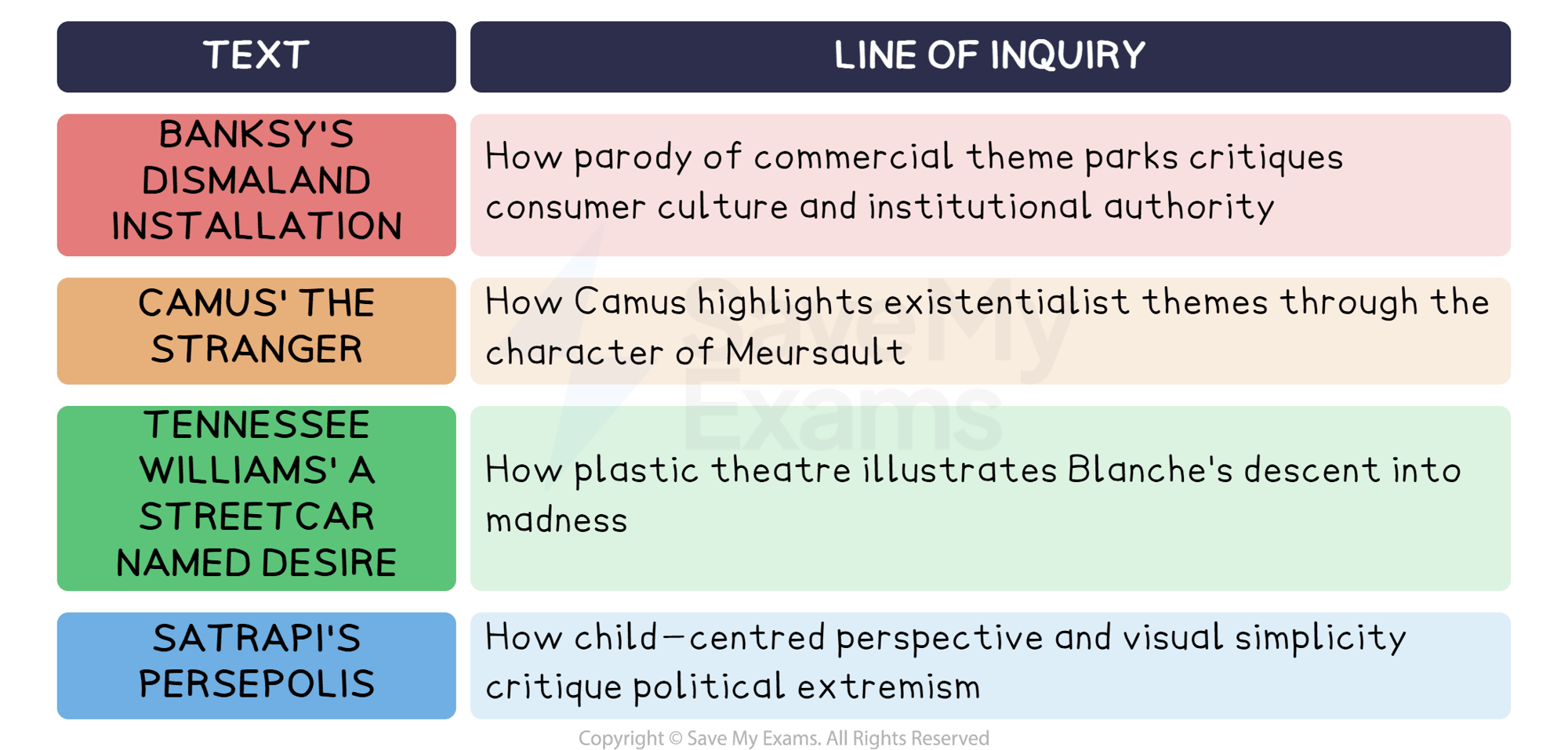
These are successful lines of inquiry as they:
Identify a specific text or body of work
Reference a clear authorial choice (e.g. parody, characterisation, plastic theatre, child-centred perspective)
Link technique directly to a conceptual outcome (e.g. consumer culture, existentialism, madness, political extremism)
Are narrow enough to sustain a detained analysis within 1,500 words
Avoid vague phrasing and focus on how meaning is constructed
Signal an arguable interpretation
Allow for a sustained close analysis
Examiner Tips and Tricks
Another way to develop a line of inquiry for your HL Essay is to think about the aspects of each literary work, text or body of work that you have found particularly interesting. Rather than beginning with a broad concept or critical lens, you could start with something which has genuinely caught your attention, such as a recurring image, a controversial representation or an aspect which you felt was especially powerful. Remember, your interest can be a great starting point for a sustained and original essay.

Unlock more, it's free!
Join the 100,000+ Students that ❤️ Save My Exams
the (exam) results speak for themselves:

Was this revision note helpful?