Intertextuality: Connecting Literary Texts (DP IB English A: Language and Literature: HL): Revision Note

Intertextuality is one of the three Areas of Exploration in your IB Diploma English A: Language and Literature (HL) course. It examines how texts connect to, respond to and build upon other works and broader literary traditions. Recognising these relationships can deepen your comparative analysis by helping you explore how writers engage with shared ideas in different ways. This section explores:
What is intertextuality?
Using intertextuality in your comparative essay
Building strong comparative links
Making effective comparisons between texts
What is intertextuality?
Intertextuality refers to the way literary texts are connected to, shaped by or respond to other texts. When you compare two works in Paper 2, you are often exploring intertextual links, even if the writers did not directly influence each other.
The key idea is to remember that texts do not exist in isolation. Writers borrow ideas, themes, structures and techniques from other works and readers can make connections by recognising similarities and differences between works.
Intertextuality is recognising how works participate in wider ideas such as:
Power
Gender
Identity
Illusion and reality
Social class
Freedom
Intertextuality | ||||
|---|---|---|---|---|
How texts can reflect, challenge, or build on each other | How different genres and forms follow certain conventions and break them | How texts can offer multiple perspectives on the same issue or theme | How your interpretation of one text can be transformed by reading another | How literary and linguistic traditions evolve and influence new works |
Texts may be separated by time, genre or cultural context, yet still engage with similar concerns. Identifying these connections allows you to construct more conceptual and sophisticated comparative arguments. It also helps you to recognise how one text can deepen or transform your understanding of another.
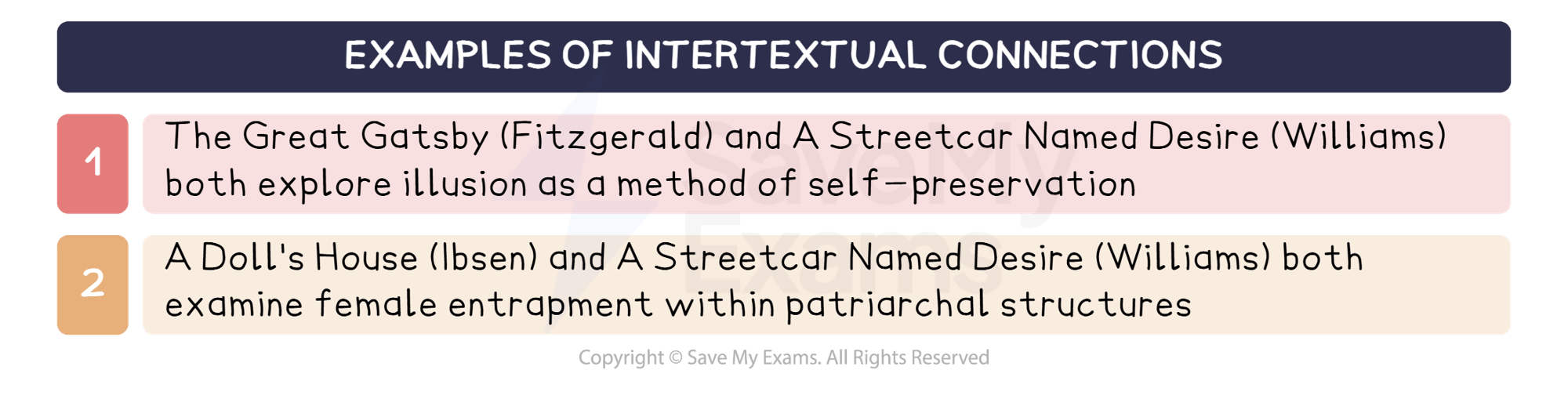
Understanding intertextuality moves your comparison beyond simple thematic overlap. Instead of stating that two texts share a theme, you can analyse how they engage in broader literary and cultural conversations. This leads to a more perceptive and conceptual response to your texts.
Understanding intertextuality strengthens your comparative analysis in Paper 2. It:
Helps you make strong and meaningful comparisons between texts
Allows you to focus on ideas and authorial choices
Supports a fully integrated comparative essay
Shows examiners that you understand texts in their wider context
Types of intertextual connections
Intertextual connections can take several forms. The strongest comparative essays often draw on more than one type.
Intertextual connection | What it means | Examples |
Shared themes | Texts may explore similar concerns but present them in different ways or reach different conclusions | Illusion versus reality:
|
Character archetypes | Texts may include comparable characters types, such as outsiders or tragic heroes | The outsider:
|
Contextual links | Texts may respond to similar historical, social or cultural issues, despite being written in different time periods or places | Patriarchy:
|
Structural parallels | Texts may employ similar or contrasting narrative structures and forms | Realism versus retrospective narrative:
|
Examiner Tips and Tricks
Comparison between your two texts is key to Paper 2. Examiners are not looking for two separate essays on each of your texts but expect you to present an integrated argument that shows how the texts illuminate each other. Strong comparison demonstrates deeper literary understanding as it reveals patterns in how writers explore similar and/or contrasting ideas and themes.
Using intertextuality in your comparative essay
Using intertextuality in your comparative essay is essential. Examiners are looking for your ability to apply it thoughtfully and purposefully in your essay. This means moving beyond simple links between texts and instead exploring how and why writers engage with similar ideas in different ways.
There are three effective ways to include intertextuality in your Paper 2 essay:
1. Using intertextuality to shape your overall argument
Intertextuality should be used to frame your main thesis.
Strong thesis statement | Both texts portray outsiders, yet one depicts isolation as empowering while the other presents it as destructive. |
Here, comparison is integrated into your argument from the beginning.
2. Using intertextuality within individual paragraphs
Intertextuality should be sustained throughout your essay.
A strong comparative paragraph might:
Introduce a shared idea or authorial choice
Analyse how Text 1 presents it
Compare directly with Text 2
Evaluate the significance of the similarity or difference
This approach ensures sustained comparison is used throughout your essay.
3. Using intertextuality to evaluate differences
A strong comparative essay moves beyond similarities and considers how the texts diverge and why they do so. For example, consider the following questions:
Why does one writer present outsider status as empowering, while another portrays it as isolating or destructive?
Does the outsider challenge society, or are they destroyed by it?
How does context (class, gender, race) shape the depiction of the outsider?
This depth of analysis demonstrates conceptual thinking and a mature understanding of how similar ideas can produce very different meanings.
Building strong comparative links
One of the most effective ways to strengthen your Paper 2 essay is through the deliberate use of comparative connecting phrases. These signal to the examiner that your argument is integrated and controlled.
Comparative phrases help you:
Integrate both texts within the same paragraph
Maintain balance between the two texts
Signal shifts from similarity to contrast
Demonstrate conceptual control over your argument
Without clear comparative links, your essay can drift into writing about one text at a time. Strong comparative phrasing prevents this and ensures that your argument remains interconnected throughout your essay.
Comparative connecting phrases
To show similarity | To show contrast | To show evaluation |
|---|---|---|
|
|
|
Strong comparative writing often combines similarity and contrast within a single sentence.
For example, let’s look at this comparative sentence based on A Doll’s House and A Streetcar Named Desire.
Although both Ibsen and Williams critique patriarchal marriage, Ibsen constructs Nora’s departure as an assertion of autonomy, whereas Williams portrays Blanche’s resistance as psychologically unsustainable. |
This sentence:
Identifies a shared thematic concern (patriarchal marriage)
Signals similarity ('both')
Introduces contrast ('whereas')
Makes a clear analytical comment
Examiner Tips and Tricks
To strengthen your comparison:
Ensure your thesis addresses both texts equally
Compare ideas and techniques together, not separately
Use comparative connecting phrasing, for example, similarly, in contrast, however, whereas
Integrate both texts within the same paragraph wherever possible
Making effective comparisons between texts
Making effective comparisons between your two texts is the core skill in Paper 2. Strong comparison answers three key questions:
What is similar? | What is different? | Why is this significant? |
Similarities and differences
When comparing similarities, you need to demonstrate how both writers engage with a shared idea while also analysing their authorial choices.
Let’s consider the following example using Hamlet and 1984.
Text comparison | Hamlet (Shakespeare) | 1984 (Orwell) |
Shared theme | Tension between individual conscience and oppressive systems | |
How it is explored | Hamlet struggles to act morally in a corrupt court and within the expectations of a society that values appearance over truth | Winston struggles to preserve truth and memory under a regime that controls reality through propaganda and surveillance |
In this example, the similarity is evident as both texts explore the conflict between an individual's moral conscience and the systems that surround them. However, to make your comparison stronger you could examine how each writer presents this tension differently.
Both Shakespeare and Orwell present their protagonists as struggling to uphold truth within oppressive systems, which demonstrates the tension between individual conscience and societal control. Shakespeare uses soliloquies and dramatic irony to convey Hamlet’s moral uncertainty to the audience, illustrating the ethical corruption embedded within the Danish court. In contrast, Orwell employs dystopian conventions, particularly the manipulation of language through Newspeak, to depict Winston’s futile attempts to preserve truth. While Shakespeare uses the conventions of tragedy to place Hamlet’s moral conflict as central, Orwell uses dystopian fiction to examine this same tension from the perspective of external, oppressive forces. |
Here, the comparison integrates both texts while analysing thematic and authorial choices together.
Examiner Tips and Tricks
Avoid giving one text significantly more attention than the other. Even if you feel more confident writing about one work, both texts must receive equal treatment.
Examiners reward responses that demonstrate clear understanding of both works and a balanced and sustained comparison shows control and strong conceptual understanding.

Unlock more, it's free!
Join the 100,000+ Students that ❤️ Save My Exams
the (exam) results speak for themselves:

Was this revision note helpful?