Choosing Your Comparative Essay Question (DP IB English A: Language and Literature: HL): Revision Note

Choosing the right question is one of the most important decisions you will make on Paper 2 of your IB Diploma English A: Language and Literature (HL) course. A strong choice can enable you to construct a focused and confident comparative argument. A poor choice, however, can limit your analysis and make it difficult to demonstrate your full understanding of the texts.
This section focuses on:
Understanding the exam question
Matching the question to your texts
Avoiding common mistakes
Understanding the exam question
The most effective way to prepare for your Paper 2 is to familiarise yourself with the types of questions that may appear and to practise answering them regularly. In the exam, you will be given four general questions. You must choose one and answer it by comparing two works you have studied.
Regardless of the topic, the most common mistake students make is not thoroughly understanding the question. Students often focus on one keyword while ignoring another, or they respond to an idea they recognise rather than the precise wording of the question. By paying close attention to the question and understanding it thoroughly, you can significantly enhance your exam performance.
Let’s look at some examples of typical Paper 2 questions:
How do two of the works you have studied portray the struggle to be understood? |
Some literary texts, although set in a particular place or time, convey ideas that are universal. In what ways is this true in two of the works you have studied? |
Discuss how two works you have studied present concepts of good and bad, not as absolute notions, but as a matter of individual perception. |
Referring to two works you have studied, discuss how the author has created a convincing “world”. |
Although the wording of each question differs, each question requires you to:
Compare two texts
Explore a shared concept
Analyse authorial methods
Construct a sustained argument
It is important to choose the right question and the best texts to compare. A good match between your question and your texts can mean the difference between a strong comparative essay and a weak one.
Examiner Tips and Tricks
Remember, you are not restricted to comparing texts of the same form. Cross-genre comparisons, for instance, prose and graphic memoir, can be particularly effective if analysed carefully.
Breaking down the question
The Paper 2 questions are often broad and abstract. Therefore, you should read them more than once so that you fully understand what they are asking you to do. This is especially important in Paper 2 because Criterion A directly assesses how well you understand and interpret the question.
Before choosing a question, you should break it down into four parts.
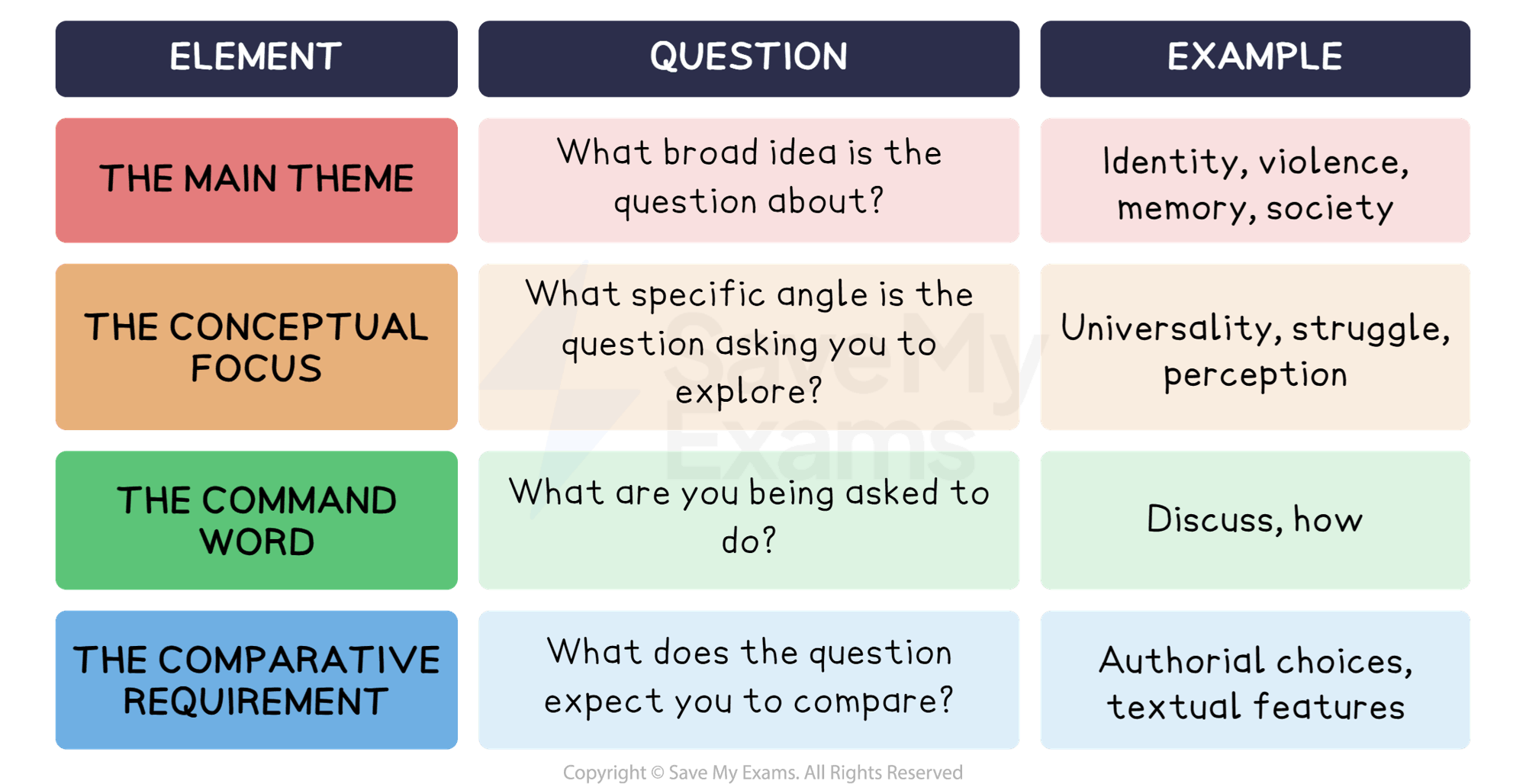
Identifying these four aspects ensures that you respond precisely to the wording of the question rather than writing a general essay.
Let’s examine the following question.
Some literary texts, although set in a particular place or time, convey ideas that are universal. In what ways is this true in two of the works you have studied? |
Examiner Tips and Tricks
Avoid vague generalisations such as “everyone can relate to suffering” when discussing a theme such as universality. Statements like this are too broad and do not demonstrate close engagement with the text.
Instead, show how the writer’s specific narrative choices transform a historically or culturally specific experience into something that resonates more widely. This might include analysing characterisation, symbolism, narrative perspective, structure or imagery.
Matching the question to your texts
It is crucial to choose the question that best fits your two strongest texts. Even if you feel confident about all of the works you have studied, some pairings will naturally produce a deeper and more sustained comparison than others.
Once you have carefully read and understood the questions, you should begin by considering how the three texts you have prepared could fit each option, with the aim of narrowing your choice down to two.
Taking time to plan at the start of the exam can be the difference between a rushed, unfocused essay and a clear, well-developed one. Spend a few minutes identifying which pair of texts best addresses the wording of the question and briefly outline their strongest points of connection and contrast.
Examiner Tips and Tricks
You do not have time to check all three texts against every question. Instead, choose two questions that seem most accessible or interesting to you, then identify two possible pairs of texts for each. For each of those questions, consider two possible text pairings. This allows you to compare your options and decide which combination offers the strongest potential for a sustained comparison.
By narrowing your focus early, you avoid wasting valuable planning time and can move more confidently into structuring a clear and well-developed essay.
Before committing to a question, you should consider:
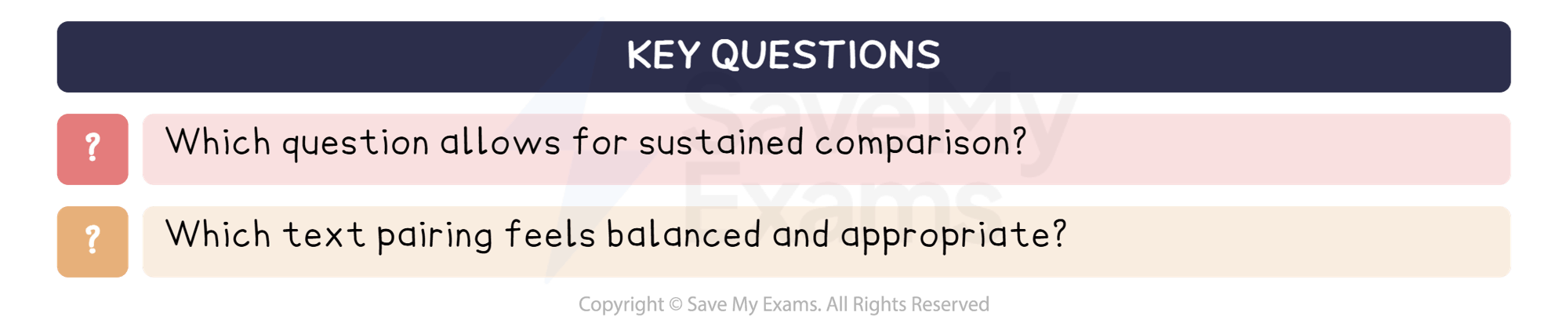
Evaluating strong text pairings
Not every text pairing works equally well for every question. A well-chosen pairing enables you to:
Sustain comparison across your easy
Analyse authorial methods in both texts in meaningful ways
Maintain balance between each text
Develop a clear conceptual argument
If your pairing is strong, you should be able to identify both similarities and meaningful differences. Differences are sometimes where the most sophisticated analysis can emerge as they allow you to examine how writers approach similar concerns from distinct perspectives, contexts or narrative styles.
Here are examples of potentially strong pairings for a Paper 2 question.
Exam question | How do two of the works you have studied portray the struggle to be understood? | ||
Strong text pairings | The Stranger (Camus) and Hamlet (Shakespeare) | Things Fall Apart (Achebe) and The Kite Runner (Hosseini) | The Handmaid’s Tale (Atwood) and 1984 (Orwell) |
Comparisons and contrasts |
|
|
|
Examiner Tips and Tricks
As Paper 2 questions are broad and thematic, there are often many possible similarities and differences you could explore between your pair of texts. However, your comparisons must be:
Specific rather than general
Clearly linked to the wording of the question
Based on detailed knowledge of both works
Supported by analysis of authorial choices
Avoiding common mistakes
When choosing your question and text pairing, avoid these common errors:
Choosing the easiest theme rather than the strongest text pairing
Do not choose a question simply because the theme feels familiar:
Feeling confident about a theme does not always mean it will produce the strongest comparison
Select the question that allows you to develop a balanced and sustained comparative argument:
Make sure both texts engage fully and meaningfully with the focus of the question
Avoid allowing one text to dominate your response
Choosing texts that are too similar
Do not assume that very similar texts will automatically produce a strong comparison:
If both texts present a theme in almost identical ways, your analysis may become repetitive
Ensure your text pairing offers:
Clear similarities
Meaningful differences
Use differences in context, genre, characterisation, narrative perspective or authorial methods to deepen your analysis:
Remember that sophisticated comparison often emerges from examining contrasts, not just shared themes
Examiner Tips and Tricks
Paper 2 questions will be based on the central concepts of the course even though they might not make direct reference to them. Therefore the course concepts are a strong starting point when preparing for possible exam questions. Concepts such as identity, culture, creativity, communication, perspective, transformation and representation may shape the focus of prompts, even when they are phrased in broader or more thematic terms. [Insert link when publishing]
By revising your texts through the lens of these concepts, you can build flexible lines of argument that can be adapted to a range of questions. This also helps you move towards conceptual analysis, allowing you to connect authorial choices to larger ideas.

Unlock more, it's free!
Join the 100,000+ Students that ❤️ Save My Exams
the (exam) results speak for themselves:

Was this revision note helpful?