Understanding Paper 2: Comparative Essay (DP IB English A: Language and Literature: HL): Revision Note

This section is designed to help you understand the structure and expectations of the Comparative Essay on Paper 2 of your IB Diploma English A: Language and Literature (HL) course. It consists of:
How the Comparative Essay is assessed
Core skills assessed in the Comparative Essay
Choosing your texts for the Comparative Essay
How the Comparative Essay is assessed
Paper 2 is the second of the two timed examinations taken at the end of your IB Diploma English A: Language and Literature (HL) course. It is externally assessed and completed under exam conditions.
Overview:
Paper 2 is completed at the end of the second year of your Diploma course
It is worth 25% of the overall grade for Higher Level (HL) students
You have 1 hour and 45 minutes to complete the exam
The exam includes four general literature questions:
You must choose one question to answer
Unlike Paper 1, which involves analysing unseen texts, Paper 2 requires you to write about works studied during your course
You must use two studied works to answer your chosen question
You may select any two works studied during the course, except:
The work(s) used for your Individual Oral
The work chosen for your HL essay
Paper 2 is a closed-book exam:
This means you will not have access to your texts or notes
You are expected to make detailed reference to your works in your answer:
However, you are not expected to include quotations
Core skills assessed in the Comparative Essay
When preparing for Paper 2, you will build many of the same skills you developed for Paper 1. These include:
Reading carefully and critically
Understanding texts in depth
Making inferences and drawing clear conclusions
Using subject-specific literary terminology accurately
Organising and structuring ideas effectively in an essay
However, Paper 2 is a comparative essay, so you will also need to demonstrate comparative skills. For example:
Identifying similarities and differences between works
Analysing how and why writers present ideas in different ways
Building a clear comparative argument
There are four assessment criteria.
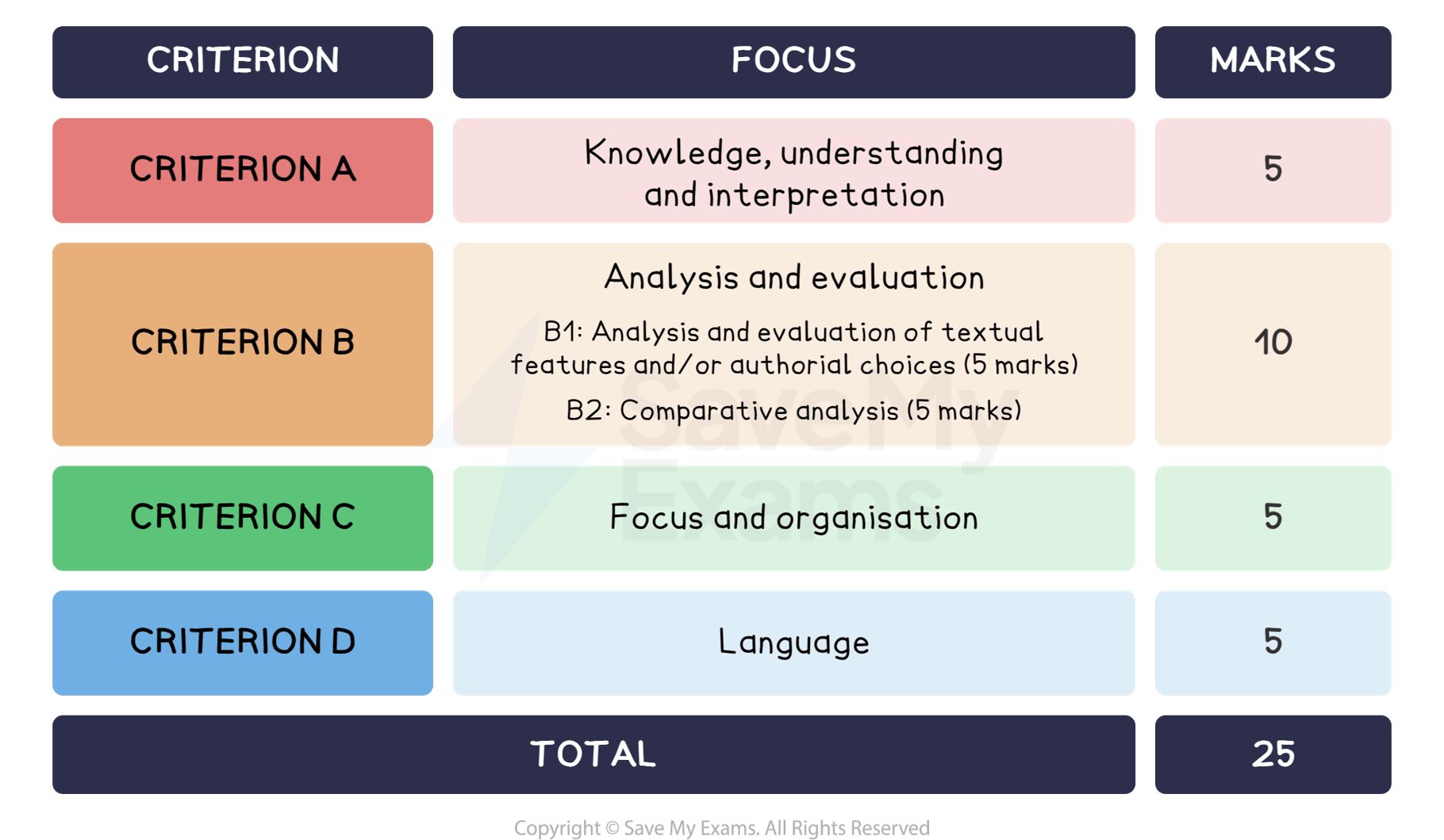
Criterion B1 focuses on the analysis of authorial craft (what, how and why), while Criterion B2 focuses on evaluating the comparison of similarities and/or differences between your two literary works. This criterion allows for a focus on similarities, differences or a mixture of both rather than requiring a strict balance.
Time management
Effective time management is essential in Paper 2. You have 1 hour and 45 minutes, so using your time wisely will help you produce a focused and well-structured comparative essay.
Here is a guide to planning your time in the exam:
10 mins | Choosing the question:
|
15 mins | Planning your essay:
|
60–65 minutes | Writing your essay:
|
5–10 minutes | Checking your essay:
|
Choosing your texts for the Comparative Essay
During your course you will study six literary texts. As you are not allowed to reuse the texts from your Individual Oral (IO) or your HL Essay, you will usually have only three or four texts to choose from for Paper 2. This means it is especially important to study your texts in depth.
It is also important that you prepare the texts you are going to use in the exam in advance:
If one of your texts has not been studied in enough detail, you may find that your choices in the exam are very limited:
This could mean that you are forced to use a text pairing that does not suit any of the Paper 2 questions which will impact your final mark
Even though your choice of texts is relatively limited, you still won’t have much time in the exam to decide which texts to use
The IB recommends selecting three texts in advance to focus on for Paper 2 preparation. The more texts you study, the less likely you are to know them in-depth and the more difficult the decision will be when taking the actual exam. It is therefore important to choose texts that share meaningful connections while also offering clear and interesting differences.
Examiner Tips and Tricks
During your English A course, you will study a wide range of literary and non-literary texts. However, for Paper 2, you must only select literary texts. For example, you may have studied a series of speeches by a particular speaker. However, speeches are classified as non-literary texts and therefore cannot be used for this assessment. Make sure you check which parts of your course count as literary texts so that you do not unintentionally disadvantage yourself in the exam.[Add link when publishing]
Choosing the right texts for Paper 2 is one of the most important parts of your exam preparation. This table outlines key factors to consider when selecting your texts.
Depth | Variety | Connections | Familiarity |
|---|---|---|---|
Select texts that are rich and complex enough to support detailed, sustained analysis. Simpler texts may seem more manageable, but they can limit the depth of your discussion and lead to fewer ideas. | Choose three texts that offer variety in terms of themes, ideas and literary techniques. A broader range will make it easier to use your knowledge in at least one of the four exam questions. | Make sure your texts share meaningful connections. Look for strong similarities or clear contrasts in terms of themes, context, characters or methods, as this will strengthen your comparative argument. | Focus on texts you know thoroughly. Do not rely on works you have not read in full or properly analysed, as this will weaken the quality of your essay. |
The best combination of works for paper 2 will provide opportunities for a wide range of connections to be made. These could be thematic, conceptual, contextual, stylistic or formal.
While it may be tempting to choose texts with the most obvious similarities, try to select works that may initially seem like an unusual pairing. Choosing a less obvious combination encourages you to think more critically about deeper links, such as shared concepts, contrasting perspectives or different contextual influences. This approach can lead to a more original, perceptive and sophisticated comparative analysis, which is what examiners reward in Paper 2.
Examiner Tips and Tricks
When examiners mark responses which use a work that is made up of short literary texts such as poems, song lyrics and essays, they will be looking for evidence of knowledge, understanding, interpretation, analysis and evaluation of the work studied as a whole. It is therefore recommended that you refer to at least two or three poems in a poetic work, two or three short stories in a prose fiction work or two or three essays in a prose non-fiction work, to answer your chosen question.

Unlock more, it's free!
Join the 100,000+ Students that ❤️ Save My Exams
the (exam) results speak for themselves:

Was this revision note helpful?