Understanding the Individual Oral (DP IB English A: Language and Literature: HL): Revision Note

The Individual Oral (IO) gives you the opportunity to connect what you study in your course to the world around you. It encourages you to think about how the texts you analyse relate to real-world issues and ideas.
This section is designed to help you understand the structure and expectations of the Individual Oral on your IB Diploma English A: Language and Literature (HL) course. It consists of:
How the Individual Oral is assessed
Core skills assessed in the Individual Oral
Choosing your texts for the Individual Oral
Top tips
How the Individual Oral is assessed
The IO is the only internally assessed component of your IB Diploma English A: Language and Literature course.
Examiner Tips and Tricks
As part of your course, you will have explored a range of non-literary bodies of work and literary works and a variety of global issues. In the lead-up to your Individual Oral, you need to make a decision about which global issue and which body of work and work — literary text(s) — will be explored in your presentation. To help you with this, your Individual Oral should ideally be based on aspects that you have already explored in your Learner Portfolio.
Overview
The IO is internally assessed but externally moderated:
You will present the oral to your teacher, who will assess your work
It is completed during your course, usually in the second year
It is worth 20% of your overall grade for Higher Level (HL) students
You will deliver a 10-minute oral presentation, followed by a 5-minute discussion with your teacher
You will analyse:
One literary text
One non-literary text (for example, an article, advertisement, speech)
You must refer to:
A specific extract from each text
The wider text as a whole
You must explore a global issue and show how it is presented in both texts
The global issue must be:
Relevant on a global scale
Clearly defined and focused
You are required to focus on only one global issue connecting your work and body of work. Remember, your global issue is the aspect which will give your IO cohesion and coherence so you must refer to it continually throughout your presentation.
For your IO, you must select a focused global issue and explore how two specific extracts and the works or work and body of work they are taken from address it
The IO is not comparative:
There is no requirement that your extracts and works or work and body of work should be compared and contrasted
Your presentation should not be a commentary:
It should be a focused exploration into the connections between the global issue and the extracts and works or work and body of work
The global issue is the lens through which your works or work and body of work should be explored:
Therefore the focus is not simply on your global issue but instead on how the presentation of your global issue in the works or work and body of work is presented
The extracts should be used as a starting point into your discussion of your global issue:
Try to ensure there is a balance between your extracts and to the work or body of work from which it comes
Core skills assessed in the Individual Oral
The IO assesses many of the same skills as Paper 1 and Paper 2 though with a stronger focus on your oral communication skills. Your IO should be based on the following prompt:
Examine the ways in which the global issue of your choice is presented through the content and form of one of the works and one of the bodies of work that you have studied. |
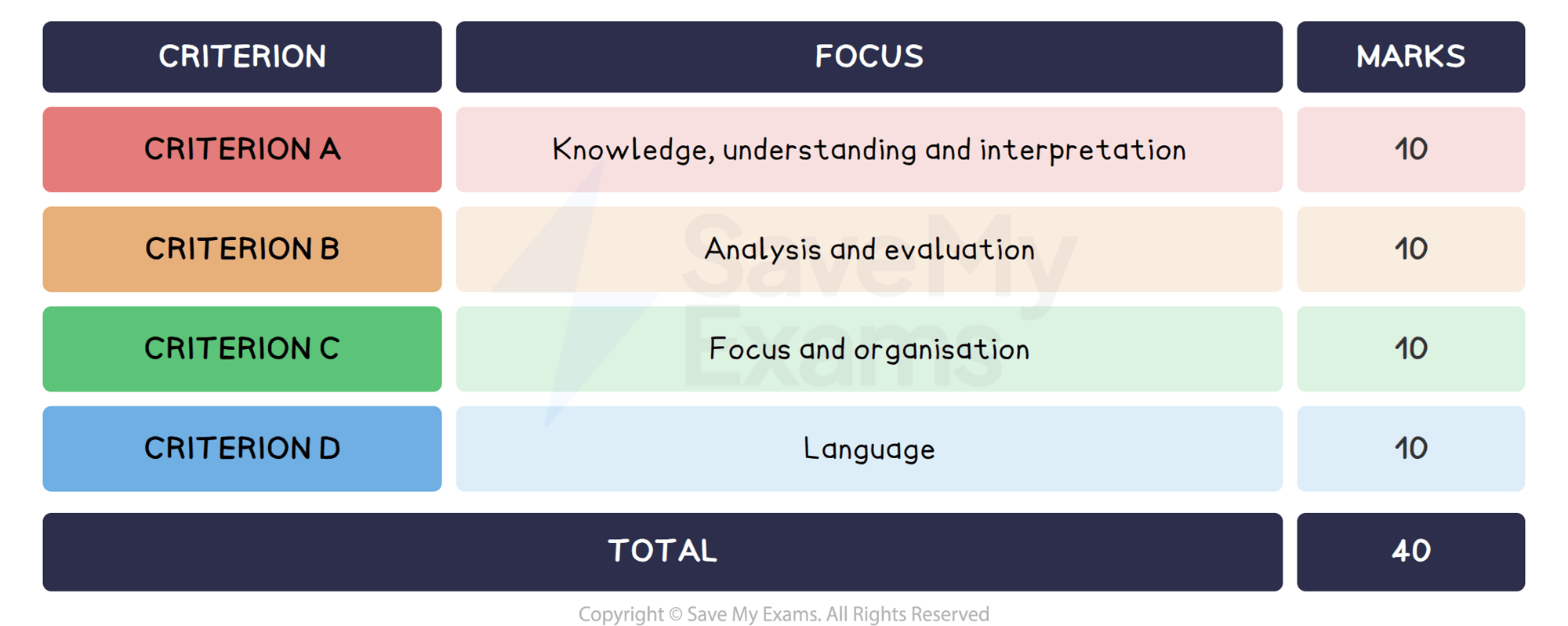
There are four assessment criteria at HL.
Choosing your texts for the Individual Oral
Selecting the right text is one of the most important decisions you will make in preparing for your Individual Oral. For this task, you must select a focused global issue and explore how two specific extracts and the works or work and body of work they are taken from address it.
Here are some important things to consider when selecting your texts:
Your extracts must be continuous: there cannot be an interruption or an ellipsis in your extract
The source of the extracts must be clearly stated, including the names of the works chosen and the names of the authors
An extract may be a complete text in itself, for example a whole poem or an advertisement
An extract may not, however, include more than one text, even if each text is extremely short:
For example, you cannot include two poems as part of a literary extract or two posters or cartoons in a non-literary extract
If the extract is from a literary text which is part of a larger work studied, such as a short story, or if it is a complete text which is part of a work studied, such as a poem, you should discuss relevant aspects of the broader work as a whole
Body of work
According to the IB, a body of work can be:
A single extended, full-length non-literary text
A collection of shorter non-literary texts that are:
The same text type (for example, photographs or advertisements)
Created by the same author, creator or organisation
In some cases, the entire text can be used as the extract:
For example, a complete poem or a single advertisement
Through the Individual Oral, you will explore clear connections between the works or texts you have studied and wider global or local contexts. The task is not comparative and therefore there is no requirement that the extracts and works or work and body of work should be compared and contrasted.
Using your teacher
As you begin preparing for the Individual Oral, your teacher will provide guidance to help you get started.
They will support you in choosing suitable texts and identifying a global issue to explore
The Individual Oral is usually completed towards the end of the first year of your course or at the beginning of your second year:
This gives you enough time to develop your knowledge of the texts before preparing for the assessment
This assessment gives you the opportunity to develop important skills such as self-management and independent thinking
Your teacher will guide and support you but you will be expected to take responsibility for shaping your ideas and preparing your analysis
Your teacher can make sure that the extracts you choose are of an appropriate length
Examiner Tips and Tricks
Your extracts should be long enough to show both larger and smaller choices the writers make in presenting the global issue. However, your extracts should not be so long that you cannot discuss their important features within the 10-minute time limit.
Your extracts should be no longer than 40 lines long; this will enable you to analyse the key ideas and techniques in enough detail during your presentation. If your text is visual or multimedia such as a film, you could use one continuous sequence of film lasting 1–2 minutes.
Top tips
Avoid reading from a script:
Do not memorise your notes as this can make your presentation rushed and sound unnatural
Vary your pace:
This helps convey meaning and keeps your presentation engaging
Emphasise key words:
Use intonation to highlight important ideas
Use inclusive language:
Using the pronoun “we” can make your presentation more inclusive
For example, “In this photograph we see…”
Use precise and appropriate language:
Aim to present in a formal academic tone
Ensure your global issue is given a central focus throughout:
Your teacher will reward responses where the global issue is clearly defined and consistently developed
Focus on one issue only:
Trying to cover multiple issue will weaken your analysis
Ensure your global issue is not too broad or too narrow:
It should be specific enough to analyse but broad enough to apply to both texts

Unlock more, it's free!
Join the 100,000+ Students that ❤️ Save My Exams
the (exam) results speak for themselves:

Was this revision note helpful?