HL Essay Model Answers (DP IB English A: Language and Literature: HL): Revision Note

For your HL Essay in the IB Diploma English A: Language and Literature (HL) course, it is important to understand how your essay is assessed and what a high-level response looks like in practice.
This section includes:
Overview
Marking criteria
Model answers
Top tips
Overview
The HL Essay is marked out of 20 marks and is assessed using four criteria. Each criterion focuses on a different aspect of your essay.
Criterion A | Knowledge, understanding and interpretation | 5 marks |
Criterion B | Analysis and evaluation | 5 marks |
Criterion C | Focus, organisation and development | 5 marks |
Criterion D | Language | 5 marks |
Total | 20 marks | |
Understanding how these criteria work will help you structure your essay clearly and develop a focused argument. It is important to know the meaning of each of the terms so that you are confident that you know what the differences are between “knowing”, “understanding”, “interpreting”, “analysing” and “evaluating”. Examiners consider all elements of the descriptors when determining your mark for each criterion.
Marking criteria
Criterion A: Knowledge, understanding and interpretation
To do well in Criterion A, you need to demonstrate clear understanding of the text and its implications. Your essay should include relevant and precise references that support your interpretation and develop your argument in relation to the line of inquiry.
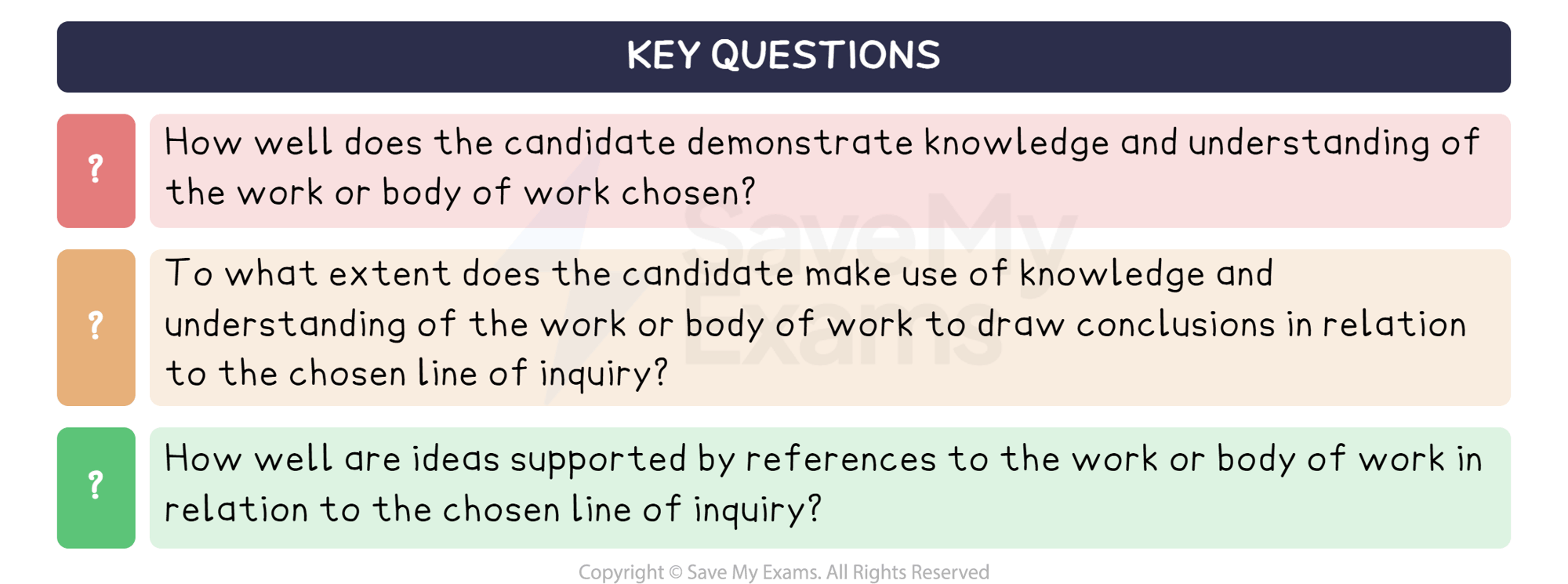
To gain top marks you need to meet the following descriptor. The key words are highlighted in bold.
Marks | Descriptor |
5 |
|
Here are some common mistakes to avoid based on IB examiner feedback for Criterion A:
Common mistakes to avoid | |
Using a weak or overly broad line of inquiry |
|
Relying on general knowledge instead of detailed evidence |
|
Stopping at explanation rather than interpretation |
|
Criterion B: Analysis and evaluation
To do well in Criterion B, you need to analyse how the writers construct meaning and evaluate why those choices are significant.
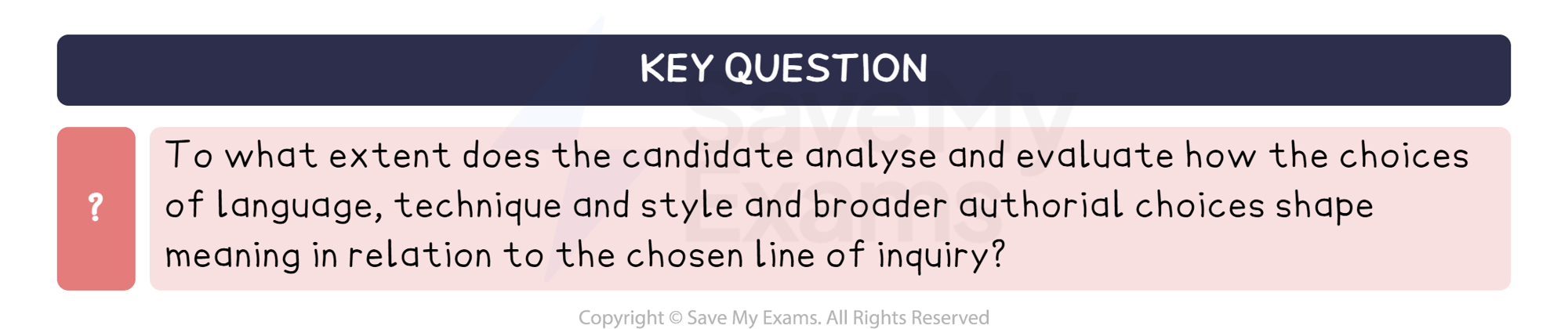
To gain top marks you need to meet the following descriptor. The key words are highlighted in bold.
Marks | Descriptor |
5 |
|
Here are some common mistakes to avoid based on IB examiner feedback for Criterion B:
Common mistakes to avoid | |
Identifying techniques without explaining them |
|
Being overly rigid with terminology |
|
Not developing points in depth |
|
Criterion C: Focus, organisation and development
To do well in Criterion C you need to present a sustained line of inquiry and ensure that each paragraph contributes clearly to answering the central question.
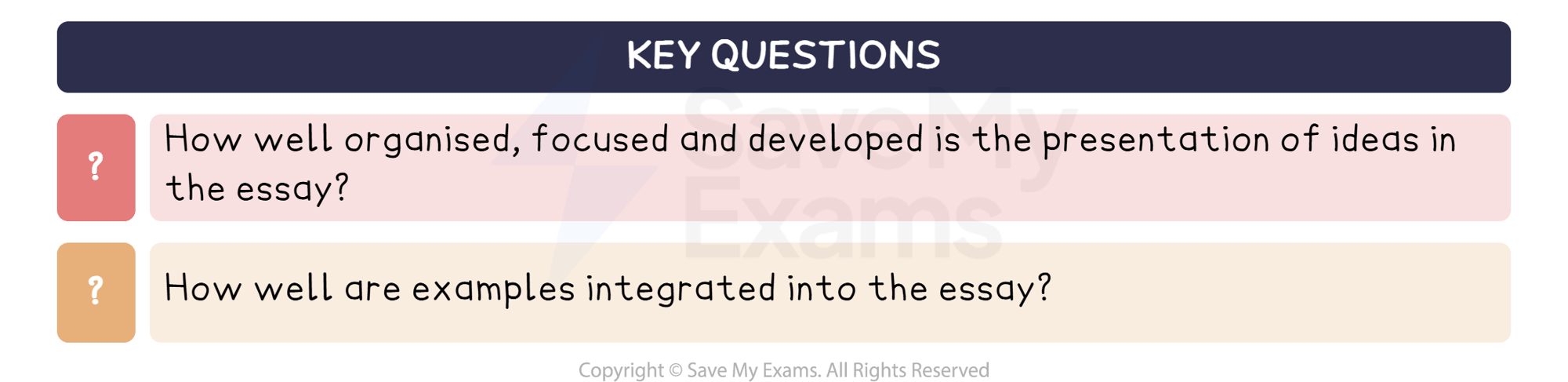
To gain top marks you need to meet the following descriptor. The key words are highlighted in bold.
Marks | Descriptor |
5 |
|
Here are some common mistakes to avoid based on IB examiner feedback for Criterion C:
Common mistakes to avoid | |
Not maintaining focus on the line of inquiry |
|
Weak or unclear essay structure |
|
Poor integration of textual evidence |
|
Criterion D: Language
To do well in Criterion D you need to communicate your ideas clearly and confidently using accurate academic language.
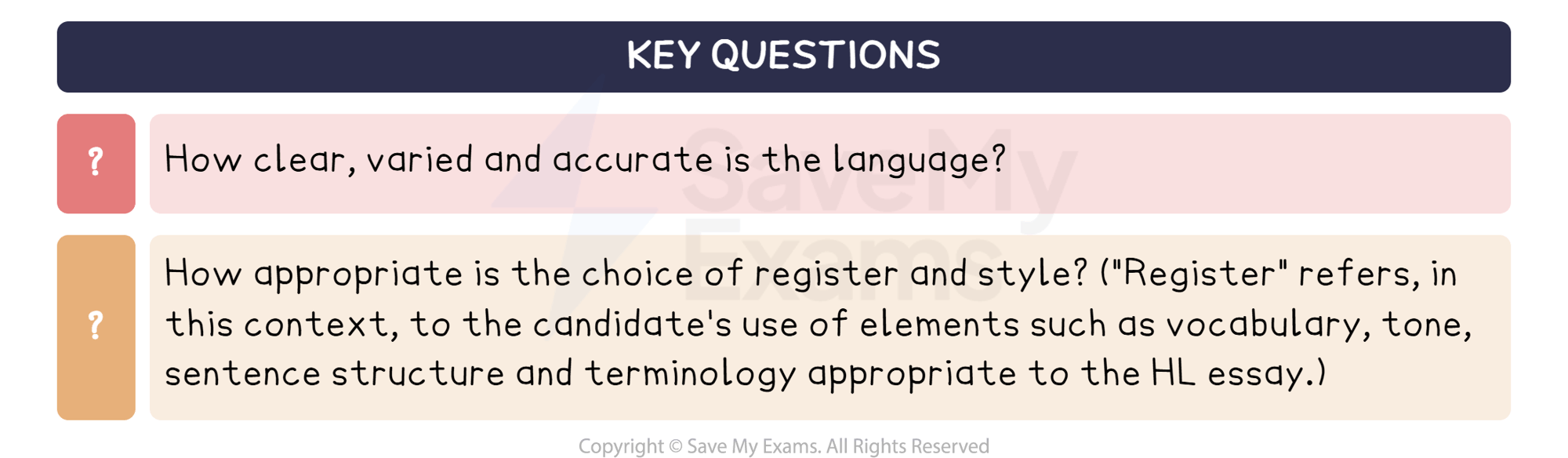
To gain top marks you need to meet the following descriptor. The key words are highlighted in bold.
Marks | Descriptor |
5 |
|
Here are some common mistakes to avoid based on IB examiner feedback for Criterion D:
Common mistakes to avoid | |
Inaccurate or vague word choice |
|
Repetitive or simple sentence structures |
|
Frequent grammar, spelling or punctuation errors |
|
Model answers
Here is an example part of an HL Essay analysing Satrapi’s use of visual symbolism in Persepolis.
Line of inquiry: How does Marjane Satrapi use visual contrast to represent the loss of childhood innocence during the Iranian Revolution in Persepolis? |
Satrapi frequently uses visual contrast to illustrate the loss of childhood innocence during the Iranian Revolution. In the chapter The Veil, the young girls are shown playing with their veils in a series of panels that depict them using the garments as skipping ropes or horse reins (Satrapi, 2000). This playful behaviour reflects their limited understanding of the political and religious significance imposed upon them. However, this innocence sharply contrasts with the veil’s function as a symbol of state control and enforced ideological conformity following the revolution. Through this juxtaposition, Satrapi highlights the disconnection between the children’s perspective and the reality of the political changes occurring around them. Furthermore, the stark black-and-white illustrations underscore this contrast as it reflects the tensions between childhood innocence and ideological repression. Satrapi’s use of simplified and almost playful imagery within a politically charged context intensifies the irony as the reader recognises the seriousness of the situation that the children themselves cannot fully understand. By presenting these scenes through Marji’s youthful perspective, Satrapi invites the reader to recognise how political decisions imposed by authority can reshape the experiences of ordinary citizens. |
Examiner comments:
Sustained link to line of inquiry
Clear focus on authorial choices
Integrates evidence effectively
Includes interpretation
Maintains a clear academic tone
Here is an example HL Essay paragraph analysing Dorothea Lange’s use of composition and framing in her Dust Bowl photography.
Line of inquiry: How does Dorothea Lange use composition and framing to shape the viewer’s understanding of poverty and resilience during the Dust Bowl? |
Lange uses framing and composition to emphasise the impact of poverty during the Dust Bowl. In ‘Migrant Mother’ (Lange, 1936), Lange positions Florence Owens Thompson at the centre of the photograph while her children lean against her shoulders with their faces turned away from the camera. This intentional framing draws the viewer’s attention to the mother’s worried expression, making her anxiety the main focus of the image. The children’s averted faces further reinforce this focus; their hidden expressions illustrate the mother’s role as the central figure responsible for their survival. Furthermore, the tight composition and close cropping exclude any background details. This encourages viewers to focus on the human experience of economic hardship rather than the landscape itself. The triangular composition suggests unity and resilience. Similarly, the mother’s distant gaze conveys uncertainty about the future which illustrates the broader instability faced by migrant workers during this period. Through this composition, Lange presents migrant families not merely as victims of poverty but as individuals demonstrating resilience and determination in the face of hardship. |
Examiner comments:
Clear focus on composition and framing as authorial choices
Effective integration of image details
Develops interpretation of meaning and viewer response
Maintains a clear academic tone
Top tips
Maintain a clear focus on your line of inquiry:
Your focus should be clearly sustained in every paragraph
Develop a clear and purposeful thesis:
Your thesis should answer your line of inquiry and provide a focus for the rest of your essay
Focus on authorial choices:
Your analysis should explore how the writer or creator uses techniques to shape meaning
Use detailed and relevant evidence:
Support your interpretations with carefully selected examples
Ensure your essay is organised and coherent:
Structure your essay so that ideas are clearly developed
Maintain a formal academic style:
Use precise language and avoid informal words
Conclude your essay effectively:
Your conclusion should synthesise your argument
Include relevant references, including a bibliography

Unlock more, it's free!
Join the 100,000+ Students that ❤️ Save My Exams
the (exam) results speak for themselves:

Was this revision note helpful?