Individual Oral Model Answer (DP IB English A: Language and Literature: HL): Revision Note

The Individual Oral (IO) requires you to present a clear analysis of your chosen texts in a confident and logical presentation. This section consists of:
Overview
Marking criteria
Model answer
Overview
The IO is marked out of 40 marks and is assessed using four criteria. Each criterion focuses on a different aspect of your presentation.
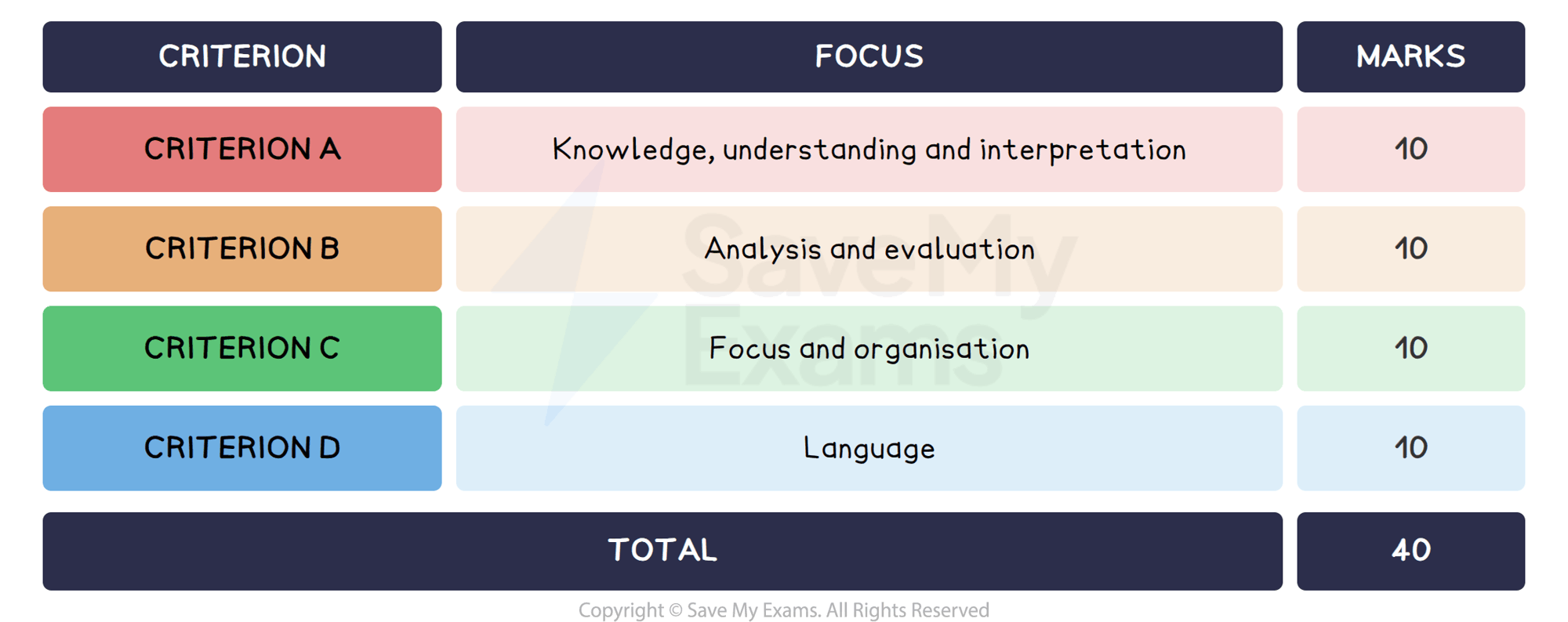
Understanding how these criteria work will help you structure and present your ideas essay clearly. It is important to know the meaning of each of the terms so that you are confident that you know what the differences are between “knowing”, “understanding”, “interpreting”, “analysing” and “evaluating”. Examiners consider all elements of the descriptors when determining your mark for each criterion.
Marking criteria
Criterion A: Knowledge and understanding of the text or extract
To do well in Criterion A you need to show a clear, accurate and detailed understanding of your extracts.
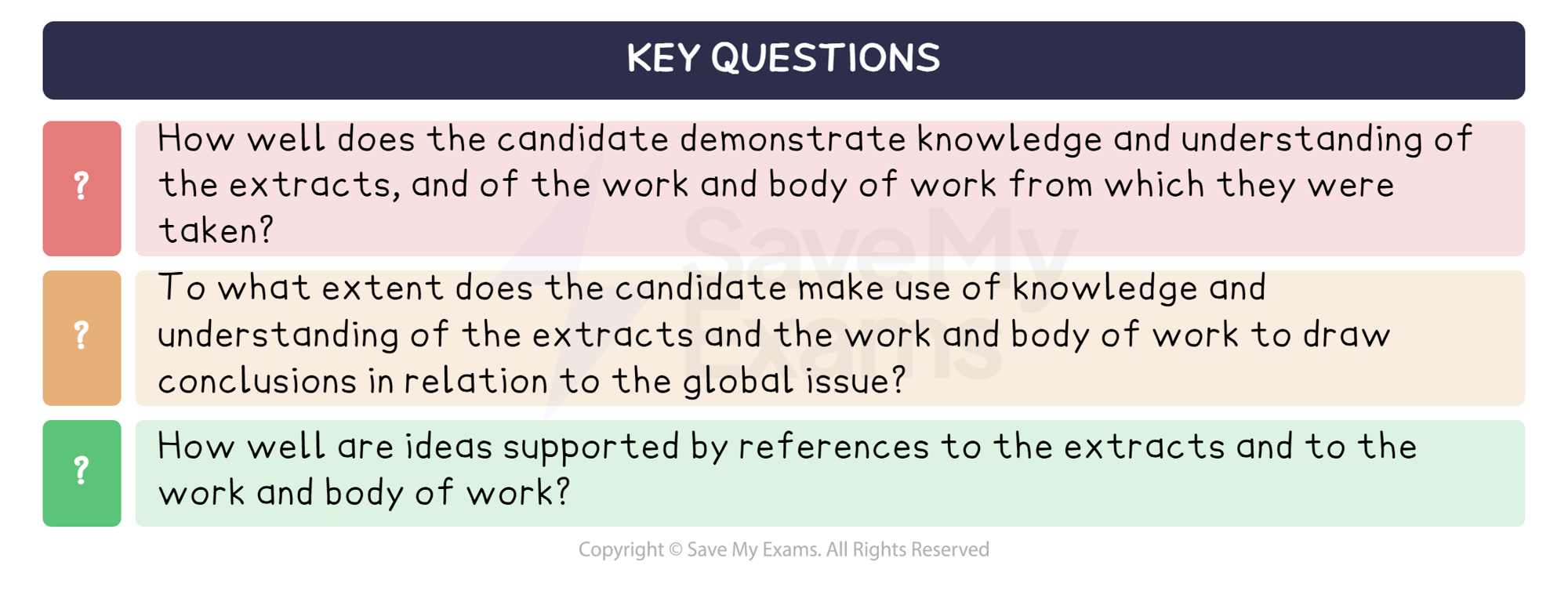
To gain top marks you need to meet the following descriptor. The key words are highlighted in bold.
Marks | Descriptor |
9–10 |
|
Here are some common mistakes to avoid based on IB examiner feedback for Criterion A:
Common mistakes to avoid | |
Focusing too much on the whole texts |
|
Including irrelevant ideas |
|
Paraphrasing instead of analysing |
|
Irrelevant context |
|
Using too many quotations |
|
Not covering enough of the extracts |
|
Criterion B: Understanding of the use and effects of literary features
To do well in Criterion B, you need to show a clear understanding of how the creators use literary features and of their intended effects.
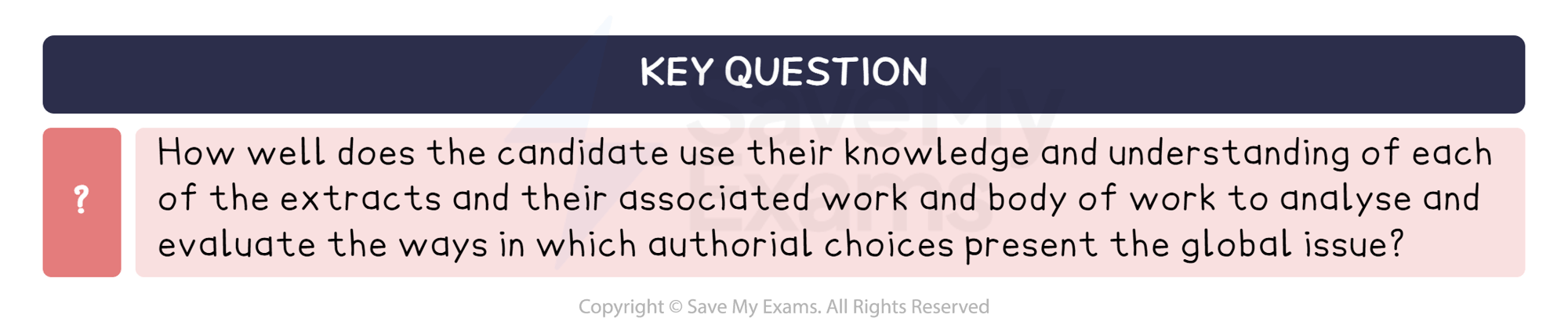
To gain top marks you need to meet the following descriptor. The key words are highlighted in bold.
Marks | Descriptor |
9–10 |
|
Here are some common mistakes to avoid based on IB examiner feedback for Criterion B:
Common mistakes to avoid | |
Identifying techniques without analysing them |
|
Using overly technical terminology |
|
Treating characters as real |
|
Confusing themes with topics and motifs |
|
Showing little understanding of genre |
|
Criterion C: Understanding of the use and effects of literary features
To do well in Criterion C, you need to present your ideas in a clear and logical way.

To gain top marks you need to meet the following descriptor. The key words are highlighted in bold.
Marks | Descriptor |
9–10 |
|
Here are some common mistakes to avoid based on IB examiner feedback for Criterion C:
Common mistakes to avoid | |
Weak or unclear introductions |
|
Not clearly situating the extract |
|
Lack of clear structure |
|
Poor time management |
|
Weak or missing conclusions |
|
Criterion D: Language
To do well in Criterion D, you need to use accurate and appropriate language.

To gain top marks you need to meet the following descriptor. The key words are highlighted in bold.
Marks | Descriptor |
9–10 |
|
Here are some common mistakes to avoid based on IB examiner feedback for Criterion D:
Common mistakes to avoid | |
Unclear delivery |
|
Limited or repetitive vocabulary |
|
Using slang and colloquialisms |
|
Model answer
Here is an example of part of a successful presentation using an image from the photography of Dorothea Lange and an extract from Margaret Atwood’s The Handmaid’s Tale. (Note: it is not the full presentation).
Global issue: The representation and control of female identity under systems of power. |
This extract from The Handmaid’s Tale, written by Margaret Atwood, explores how women’s identities are controlled and reconstructed within a totalitarian patriarchal society. In this extract, Offred reflects on her restricted existence under the regime of Gilead, where her individuality has been systematically removed. This relates to the global issue of how systems of power can define and limit female identity through ideology and language. Atwood uses a first-person narrative to convey Offred’s fragmented identity and her internal monologue reveals the contrast between memory and reality. The controlled and restricted tone of her narration illustrates the suppression of female autonomy, as Offred is unable to express herself within the society where she lives. This conveys an identity which is imposed externally by systems of power and authority. Similarly, ‘Migrant Mother’ by Dorothea Lange conveys the impact of economic and social systems on female identity, this time during the Great Depression. The photograph depicts Florence Owens Thompson and her children during severe hardship, which illustrates the global issue of how women’s identities are shaped by external conditions such as poverty. Lange’s use of central framing positions the mother as the focal point of the image and this immediately draws the viewer’s attention in. Her children are leaning into her body, partially obscuring their faces, which alludes to the idea of a mother as protector. This compositional choice signifies hardship and isolation. |
Examiner comments:
Global issue is sustained throughout
Insightful analysis of authorial choices
Persuasive interpretation
Clear and logical structure
Varied and accurate academic language

Unlock more, it's free!
Join the 100,000+ Students that ❤️ Save My Exams
the (exam) results speak for themselves:

Was this revision note helpful?