Learner Portfolio (DP IB English A: Language and Literature: HL): Revision Note

The IB Diploma Language A: Language and Literature (HL) course requires you to maintain a Learner Portfolio. This is an ongoing record of your learning throughout the course and supports each of your assessment components.
In this section we will explore:
What is the Learner Portfolio?
What to include in your Learner Portfolio
Organising your Learner Portfolio
What is the Learner Portfolio?
The Learner Portfolio is a compulsory part of the IB Language A: Language and Literature course and must be maintained throughout both years of study. It is your personal record of learning and a place for you to explore and reflect upon the literary and non-literary texts you are studying.
Your teacher will guide you in setting it up. It may be kept digitally, in hard copy or in another format that works for you.
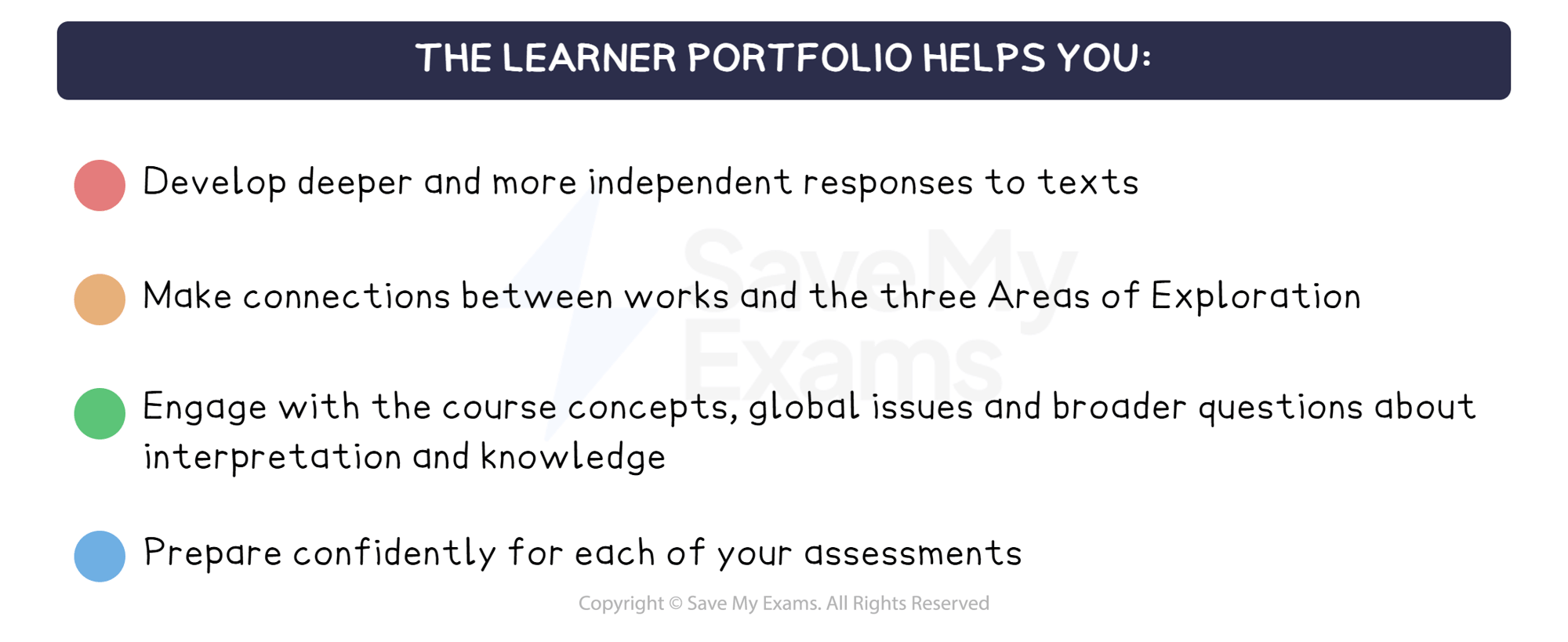
Your portfolio is also an important preparation tool for assessment. You will return to it when:
Choosing a global issue for the Individual Oral
Developing an idea for the HL essay
Practising close analysis for Paper 1
Planning comparisons for Paper 2
It is expected that the ideas, analysis and reflections that you develop in your Learner Portfolio will form the foundation for all of your assessment tasks. This means your Individual Oral, HL Essay and exam preparation should grow naturally out of the work you have already completed and refined in your portfolio. The portfolio is not separate from your assessments; it is the space where your interpretations are developed and where meaningful connections between texts should be formed. For this reason, it should be developed from the very beginning of your course.
At the end of your course, your portfolio will include a completed “Works Studies” form. This records the texts you have studied and shows how they have been used for each assessment component.
What to include in your Learner Portfolio
You will use your portfolio to regularly record your work on each text. This might include class notes, reflection on themes, analysis of key passages, contextual research or responses to class discussions.
As your course progresses, you should begin to connect ideas across texts, identifying similarities, differences and recurring ideas and themes. The portfolio should show not only what you have studied, but how your understanding has developed.
You might include:
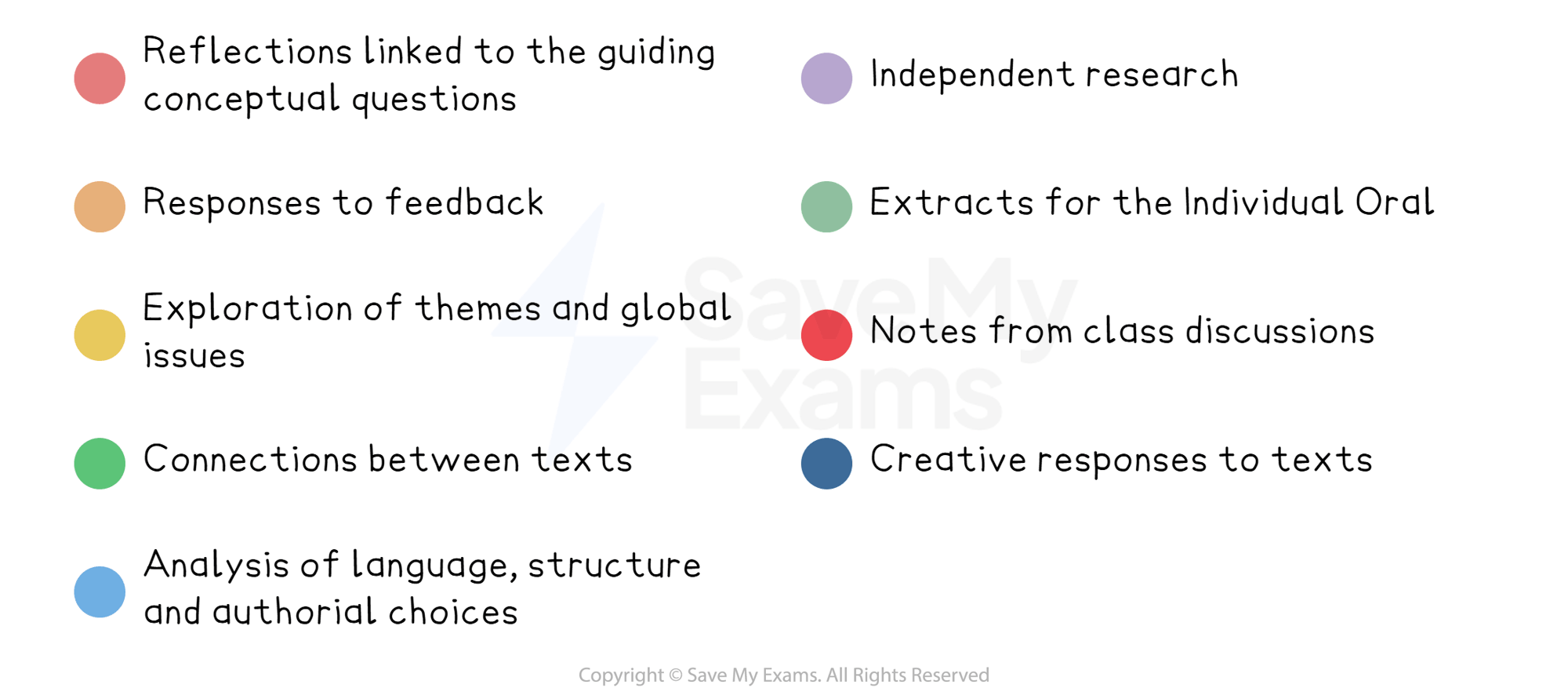
By regularly recording analysis, comparison points, possible global issues and reflections on authorial choices, you will build a bank of resources and notes which will enable you to prepare for your assessments more successfully.
Organising your Learner Portfolio
Your Learner Portfolio should be organised in a way that makes it easy to return to when revising and preparing for your assessments. A well-structured portfolio will save you time and will help you see connections across texts more clearly.
Use a clear structure | Make meaningful connections | Align with assessments | Review and update regularly |
Decide early how you want to organise your portfolio. You might arrange it by text, assessment component, Area of Exploration or through a combination of these. Choose a structure that works for you but keep it consistent. | Use your portfolio to establish links between different works. Look for recurring themes, contrasting perspectives and shared authorial choices as this will strengthen your analytical skills. | Keep assessment in mind as you build your portfolio. Consider how particular extracts, themes or interpretations might be developed in your Individual Oral, the HL Essay or your exams. | Your portfolio should grow and evolve throughout your course. Review your notes regularly and refine your interpretations as your understanding develops. |
Examiner Tips and Tricks
Your portfolio should clearly reflect your development over the duration of the course. The more intentionally and consistently you engage with it, the more confident and developed your assessment responses will be.
Summary sheet
You may find it useful to include a summary sheet in your portfolio to keep track of each text studied. A clear summary sheet can act as a quick reference point when preparing for each of your assessment components.
Summary sheet template | ||
Title of work | The Handmaid’s Tale | |
Author | Margaret Atwood | |
Form | Novel | |
Links to course concepts | ||
Identity | Explores the construction and loss of female identity under Gilead’s regime | |
Culture | Portrays a theocratic, patriarchal society | |
Creativity | Fragmented narrative to reflect memory and trauma | |
Communication | Restricted language | |
Perspective | First-person narrative | |
Transformation | Transformation of society into Gilead | |
Representation | Power structures, gender oppression | |
Links to Areas of Exploration | ||
Readers, texts and writers | Reader positioned to question authority | |
Time and space | Reflects 1980s feminist concerns and Cold War anxieties | |
Intertextuality | Biblical references, parallels with other dystopian texts, e.g. 1984 | |
Authorial choices | ||
Irony | First-person retrospective narration | Repetition and motif |
Non-linear structure | Symbolism | Juxtaposition |
Important passages | ||
The Ceremony scene | Offred’s reflection on her daughter | Historical notes at the end |
Links to assessments | ||
IO | Links to global issues: gender inequality, power and control, freedom and resistance | |
Paper 2 | Comparison with other works which depict dystopian or oppressive societies: 1984, A Doll’s House | |
HL essay | Suitable for study of narrative voice, control of language | |
Learn more
Find out more about the Learner Portfolio.

Unlock more, it's free!
Join the 100,000+ Students that ❤️ Save My Exams
the (exam) results speak for themselves:

Was this revision note helpful?