Contextual Understanding (DP IB English A: Language and Literature: HL): Revision Note

Context involves facts and details about the author’s life and the socio-, political, historical and cultural realities of a given time and place. In each of these realities, you can consider how culture and identity influence the author’s choices in how they produce their text, and the audience’s perspective and interpretation of those texts.
Knowing and understanding contextual details can also provide insight into the themes and purposes of texts and allow you to make informed and convincing analytical claims.
Examiner Tips and Tricks
Knowledge of context can help you meet the marking criteria in your English A IBDP assessments.
For example, in the Individual Oral (IO), you should explore your global issue in relation to the specifics of the context of your chosen texts. In Paper 2 and the HL essay, knowledge and understanding of context and how it impacts your reading of literary texts can help you meet Criterion A.
Authorial context
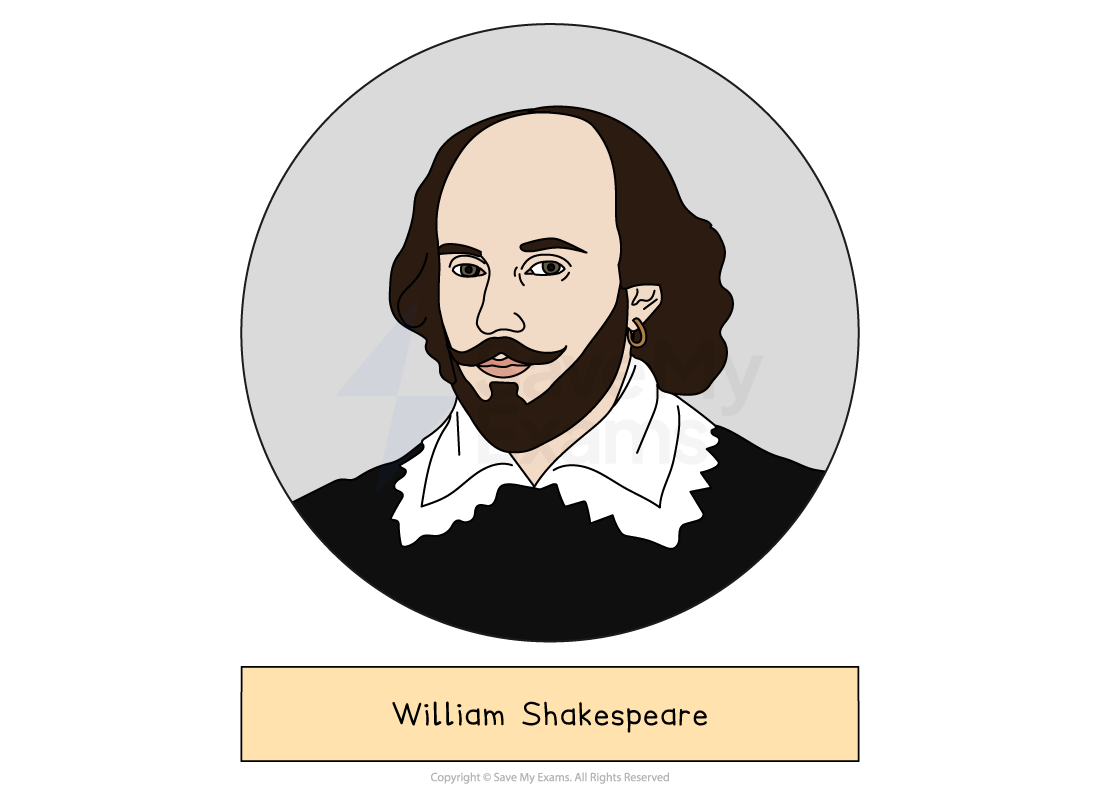
The Area of Exploration (AoE) Readers, Writers, Texts asks you to reflect on how meaning is constructed and interpreted. In your Theory of Knowledge (ToK) class, you will likely have had discussions on how meaning in the Arts is formed through a dialogue between the artist and the audience. As such, it can be useful to know details of the author’s life to infer reasons for their artistic choices as readers interpret their work years after their death.
William Shakespeare (1564-1616) was born in Stratford-upon-Avon, England
As a member of the theatre company the Lord Chamberlain’s Men (later the King’s Men in 1603), Shakespeare spent much of his time in London:
Here, he earned acclaim as a leading playwright and poet of the Elizabethan and Jacobean eras
In 1582, he married Anne Hathaway, with whom he had three children
Shakespeare wrote at a time of political and social change, evident in plays that deal with religion, monarchy, governance, and power
Shakespeare’s plays can be divided into tragedies, historical drama, and comedies
Shakespeare’s plays explore universal themes:
He is considered a humanist due to his focus on the human condition
Examiner Tips and Tricks
If using details from the authorial context to make an analytical claim, support it with evidence from the text and use the language of hedging (such as “this implies”, “this suggests”, “Shakespeare appears to”). Remember, you are interpreting, not stating facts.
Social and historical context
The social and historical context is the events, changes, morals, and values of the time and place in which the text was written. Othello is thought to have been performed for the first time in 1604, likely in Whitehall Palace, London. Some key details of that time and place are explored below to help aid our analysis of how Shakespeare represented and challenged the society in which his audience lived.
Jacobean political and social context
Othello was written in 1604, a year after James VI succeeded to the English throne after the death of his cousin Elizabeth I
Citizens of Jacobean England were subject to strict hierarchical order:
The Great Chain of Being, derived from ancient Greece, remained influential in 17th century Europe
As such, Iago attempts to dehumanise Othello in order to place him in the same category as an animal
King James was an advocate of the Divine Right of Kings, which claimed the monarch held absolute power and a God-given right to rule:
The doctrine aimed to maintain a pure bloodline and a division of society by class, affording the highest status to the nobility and the least to peasants
Othello explores the dichotomies of social mobility achieved through merit within a hierarchical society that prioritises wealth, birth, and status
In the 17th century, English and Scottish citizens were subject to The Witchcraft Act of 1604, which outlawed anything deemed to be witchcraft:
James I had written Daemonologie on the subject in 1597, making the play’s references to spells and charms especially resonant for its first audiences
The play Othello, while set in Venice and Cyprus, evidences Jacobean fears
Brabanzio is suspicious of Othello’s “spells”, believing Desdemona to be bound “in chains of magic”
Othello believes the ill-fated handkerchief he gives Desdemona holds special powers: it was given to his mother by an Egyptian “charmer”
Race
Jacobean England was a time of global exploration and colonial expansion
In 17th-century England, though, most ethnic minorities would include foreign merchants or African servants
Shakespeare’s protagonist Othello may reflect the perceived threat posed by those who were different in race or nationality (fears of the “Other”):
Fearing their part in the breakdown of society, Elizabeth I ordered a deportation of “Blackmoores” in 1596
References in literature often described Africans as savages
Othello is subject to racial slurs: Roderigo refers to his “thick-lips” and Brabanzio mentions his “sooty bosom”
Shakespeare’s presentation of Othello as a sophisticated high-ranking “commander” defies typical European presentations of ethnic minorities
Miscegenation (the mixing of races in marriage or sexual relations) was a concern expressed by many in 17th century England:
In Othello, Brabanzio describes the general consensus of Desdemona and Othello’s relationship as unnatural
He says: “The Duke himself, / Or any of my brothers of the state / Cannot but feel this wrong”
His concerns are that if “such actions” pass, “Bondslaves and pagans shall our statesmen be”
Gender
Elizabethan and Jacobean England was a strictly patriarchal society; gender roles were rigidly defined:
Ideals of masculinity centred on dominance, honour, and physical strength
A woman’s role in a relationship was ideally as a calming influence: Othello praises Desdemona for her ability to “sing the savageness out of a bear”
Women’s roles were predominantly domestic and defined by servitude to husbands and fathers
Othello describes his admiration of Desdemona in terms of how “delicate” she was “with her needle” and as a musician
According to law, women were the property of fathers and husbands:
Thus, Brabanzio laments in Act 1 Scene 3 that Desdemona has been “stolen” from him
Patriarchal attitudes defined male and female sexuality differently:
Male promiscuity, adultery, pre- or extra-marital sex was not condemned
By contrast, women’s promiscuity or sexual relations outside of marriage were considered a threat to the Church and to the fabric of society
Openly sexual women were often considered dangerous temptresses
Iago observes of the prostitute Bianca: “’tis the strumpet’s plague / To beguile many and be beguiled by one”
In this rigidly patriarchal society, acts like rape and adultery were treated as crimes against a man’s reputation rather than offenses against a woman:
This can be understood in terms of Othello’s preference to be a “toad” rather than accept his wife’s infidelity
Literary context
The Area of Exploration (AoE) Intertextuality asks us to think about how texts adhere to and deviate from conventions associated with literary forms or text types, and how conventions evolve. Shakespeare’s Othello is an interesting text with which to think about these questions. Interpretations of the play have evolved significantly over time which reflect shifts in cultural and literary perspectives. It can be interpreted both as a morality play and a revenge tragedy that explores Machiavellian and Marxist concepts. The tables below explore these ideas.
Morality play
Features of morality plays | Examples |
|---|---|
Characters |
|
Setting |
|
Machiavellian
Features of Machiavellianism | Examples |
|---|---|
Machiavellian villain |
|
Corrupted relationships |
|
Marxism
Marxist Features | Examples |
|---|---|
Class conflict |
|
Transactional, commodified relationships |
|
Context of reception
In the AoE Time and Space, questions revolve around how audiences “then and now”, or “there and here”, might read/interpret texts differently. Paper 2 questions may ask you to compare texts that make you think about this, and in the IO, you might compare how two different texts in different contexts explore the same Global Issue; therefore, it is useful to know and understand how the audience of the time reacted to Shakespeare’s work.
Audience reception
The Renaissance marked a revival of interest in the literature, art and philosophy of ancient Greece and Rome:
A Renaissance play, Othello examines reason, agency, and emotions, a shift from religious dogma to themes of human potential and individualism
In the 17th century, Othello was primarily viewed as a revenge tragedy:
This genre of drama, popular in the 16th and 17th centuries, typically featured a protagonist seeking vengeance for a wrongful act
In the case of Othello, the audience sees both Iago and Othello carrying out vengeful acts as a result of their complex emotions
The play is largely based on Un Capitano Moro (A Moorish Captain), from the collection Gli Hecatommithi, written in 1565 by Italian author Giovanni Battista Giraldi
Themes of usurpation and succession resonated with the political climate of the time:
Othello is likely based on the war between the Turks and the Venetian state (1570–1573)
Venice’s control of Cyprus was threatened in 1570, when Sultan Selim II invaded Cyprus to bring it under Ottoman rule
Exploring critics
Below are two notable critics who have commented on Othello:
Thomas Rymer: “A Short View of the Tragedy” (1693)
Thomas Rymer, one of the play’s earliest critics, responded negatively to the idea of a black hero:
He asserted: “a Blackamoor might rise to be a trumpeter, but Shakespeare would not have him less than a lieutenant-general”
He considered the play to fall short of a great tragedy as it did not have a moral lesson and consisted of an implausible plot
Rymer suggested that Othello might serve only as a cautionary tale for daughters to avoid eloping with “blackamoors” without their parents’ consent:
Rymer shared Brabanzio's view that Othello's rhetorical skill was the work of the devil
Rymer compared Iago with Richard III, asserting that the character affects an audience almost beyond endurance
A.C. Bradley: “Shakespearean Tragedy” (1904)
Bradley was a prominent Shakespearean scholar; his work is considered a classic in literary criticism
A.C. Bradley presented a positive analysis of Othello, whom he saw as blameless:
He viewed Othello as “the most romantic figure among Shakespeare’s heroes”
Bradley claimed an audience feels “admiration and love” for the hero
He suggested Othello’s nobility “inspires a passion of mingled love and pity”
Bradley argued that Othello’s marriage, being so new, makes his jealousy credible:
He expressed sympathy with the “passive” Desdemona who is “infinitely sweet and her love absolute”
With regards the construction of the play itself, Bradley noted there is little comedic relief: “...after the conflict has begun, there is very little relief by way of the ridiculous”:
Bradley argued that the play’s tension lies in the matter of “sexual jealousy rising to the pitch of passion”
Examiner Tips and Tricks
If writing about the context of reception, be careful not to be dismissive of other audiences’ reactions or interpretations. Remember the course’s key concept of perspective and how understanding and reflecting on different interpretations can give us greater insight into a work’s meaning and impact. For both the IO and Paper 2, comments on these multiple meanings and impacts are appropriate and show good knowledge and understanding.
Sources:
Bradley, A. C. Shakespearean Tragedy: Lectures on Hamlet, Othello, King Lear, and Macbeth. Penguin Publishing Group, 1991.
Al-Ruwaili, Maijan H. “Iago: "Favoritism" and Social Climbing in Othello.” vol. 3, 1991, pp. 99-121, https://arts.ksu.edu.sa/sites/arts.ksu.edu.sa/files/imce_images/v3m65r2169.pdf (opens in a new tab). Accessed 28 April 2026.
I, Elizabeth. “Open letter by Elizabeth I.” The National Archives, https://www.nationalarchives.gov.uk/education/resources/elizabeth-monarchy/open-letter-by-elizabeth-i/ (opens in a new tab). Accessed 28 April 2026.
Rooney, Mari. “Fall’n in the practice of a damned slave”: Racial Ideology and Villainy in Shakespeare’s Othello.” Arts & Sciences Writing Program, no. 10, 2018, https://www.bu.edu/writingprogram/journal/past-issues/issue-10/rooney/ (opens in a new tab). Accessed 28 April 2026.
Cannan, Paul D. “"A Short View of Tragedy" and Rymer's Proposals for Regulating the English Stage.” The Review of English Studies, vol. 52, 2001, pp. 207-226, https://www.jstor.org/stable/3070446 (opens in a new tab). Accessed 28 April 2026.

Unlock more, it's free!
Join the 100,000+ Students that ❤️ Save My Exams
the (exam) results speak for themselves:

Was this revision note helpful?