Analysing & Evaluating Authorial Choices (DP IB English A: Language and Literature: HL): Revision Note

This section is designed to help you strengthen one of the most important skills required for Paper 2: analysing and evaluating authorial choices. For the Comparative Essay on your IB Diploma English A: Language and Literature (HL) exam, examiners expect you to explore how writers construct meaning and why those authorial choices matter.
This section includes:
What are authorial choices?
Authorial choices and meaning
Using literary terminology to analyse authorial choices
What are authorial choices?
Understanding authorial choices is essential when preparing for Paper 2. Authorial choices refer to the deliberate decisions a writer makes in order to shape meaning. In Paper 2, you are expected to analyse how these choices contribute to the ideas raised in the question.
Authorial choices include the writer’s use of:
Language (diction, imagery, symbolism, tone)
Structure (chronology, framing, narrative order)
Form and genre conventions
Narrative perspective or voice
Characterisation and dialogue
Stylistic devices and literary techniques
Setting
You are required to analyse how these choices:
Influence the reader’s understanding
Shape interpretation
Develop themes and ideas
Reflect context or purpose
Authorial choices and meaning
A strong understanding of authorial choice is essential when preparing for Paper 2. The strongest essays move beyond identifying techniques and instead explain how and why those choices shape meaning.
Criterion B in the mark scheme specifically assesses the extent to which you analyse and evaluate how a writer’s use of language, technique, style and broader authorial choices shapes meaning. Your analysis must demonstrate that these choices are deliberate and significant.
Let’s explore some key authorial methods and how they can be used effectively in your essay.
Narrative perspective
Narrative perspective is the viewpoint from which a narrative is told. It shapes how events are presented and determines what information the reader is given and how it is revealed.
Writers may choose:
First-person narration
Third-person narration
Omniscient narration
Multiple perspectives
Here is an example of how you might comment on narrative perspective.
The Handmaid’s Tale - Margaret Atwood |
Atwood uses first-person narration from the perspective of Offred which creates an immediacy and intimacy, though it also restricts the reader to her limited and subjective viewpoint. This constrained perspective reflects the controlled and fragmented nature of knowledge within Gilead, where information is deliberately withheld. As a result, both Offred and the reader are positioned in a state of uncertainty. However, Offred’s narration could also be viewed as unreliable. She admits that she occasionally imagines alternative versions of events, which reminds the reader that her account is shaped by both fear and memory. This uncertainty therefore encourages the reader to question the stability of truth that is presented within the novel. |
Theme
Theme refers to the main ideas or underlying concerns explored within a literary work. It reflects the broader questions the text explores about universal concepts such as power, identity, love or oppression. In Paper 2, a theme often provides the conceptual link between your two texts.
Here is an example of common themes in two different literary texts: Things Fall Apart and The Kite Runner.
Theme | Things Fall Apart – Achebe | The Kite Runner – Hosseini |
Family and generational conflict |
|
|
Tradition and change |
|
|
Examiner Tips and Tricks
IB examiners often comment that students can sometimes focus more on demonstrating their understanding of the texts and forget to analyse the writer’s choices. It is important to remember that success in Paper 2 depends not only on discussing ideas, but examining how those ideas are constructed by the writer. This means you must go beyond analysing the writers’ craft separately and instead compare and contrast how each writer uses their techniques to create meaning.
Structure and chronology
Structure refers to the way a text is organised and how events, ideas and perspectives are arranged.
Writers may use:
Linear chronology
Non-linear structure
Flashbacks
Framing devices
Fragmentation
Cyclical endings
This table provides some definitions of key structural terms. This list is not exhaustive, but it is simply a guide to some of the techniques that might be most useful when analysing your texts.
Structural technique | |
Linear chronology | Presenting events in chronological order |
Non-linear structure | Disrupting chronological order through shifts in time and perspective |
Flashback | Returning to earlier events |
Framing device | Placing one narrative within another |
Fragmentation | Breaking the narrative into disjointed sections |
Opening | Establishing tone, perspective, setting or key ideas |
Ending | Providing resolution, ambiguity or disruption |
Foreshadowing | Hinting at future events |
Juxtaposition | Placing contrasting elements side by side |
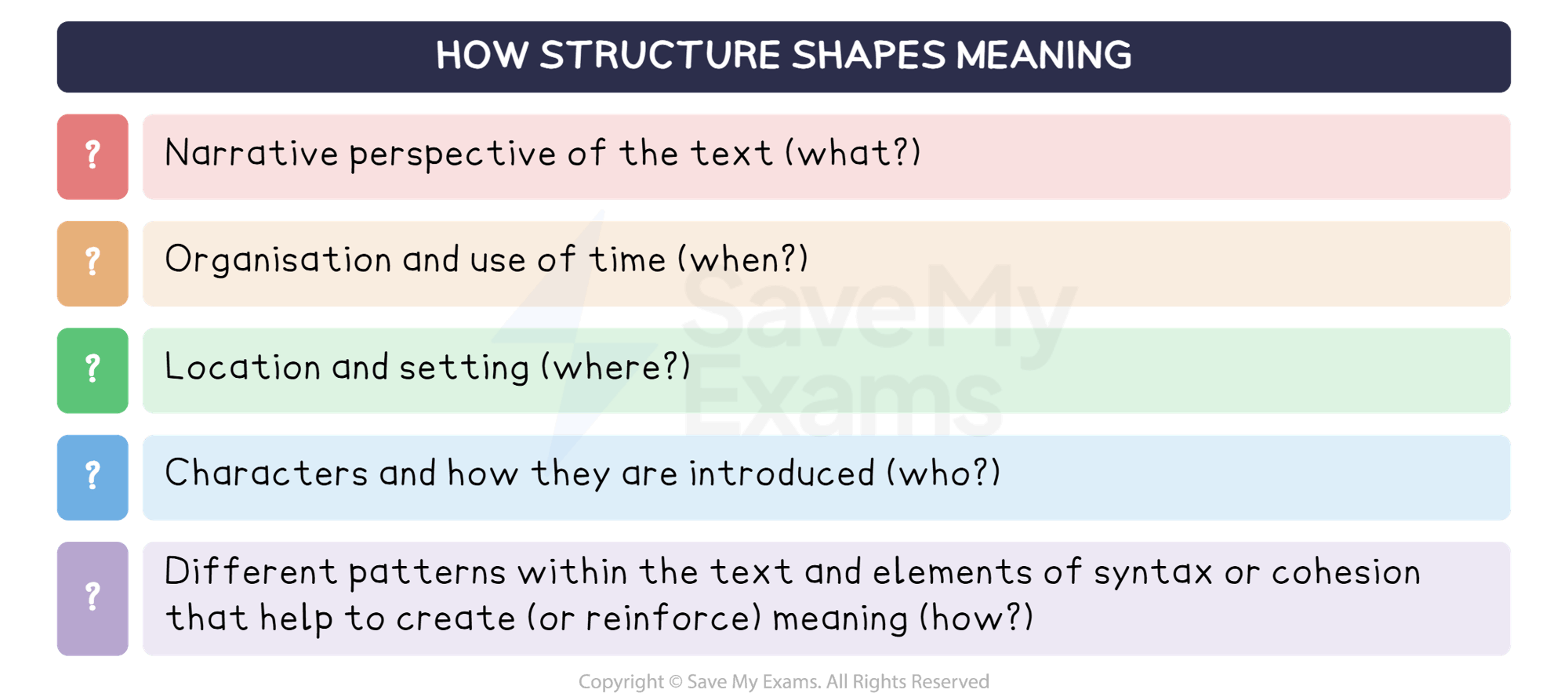
Here is an example of how you might comment on structure and chronology.
Beloved – Toni Morrison |
Morrison employs a fragmented, non-linear structure in which memories surface unpredictably rather than unfolding in a clear chronological sequence. By doing so, Morrison does not allow the past to remain separate from the present. By enabling it to resurface repeatedly throughout the narrative, she suggests trauma cannot be easily ordered or left behind in the past. This shifting chronology also requires the reader to gradually piece together the narrative, which links to the disorientation experienced by Sethe and others. The fragmented structure therefore reinforces the novel’s central theme of memory as persistent and impossible to escape. |
Characterisation
Characterisation refers to the ways in which writers construct and develop their characters. It is important to consider the range of strategies used by writers to create and develop characters in your texts. This includes:
How characters are established
How characters are presented:
Physical appearance (or suggestions about their appearance)
Their actions and motives
What they say and think
How they interact with others
What others say and think about them
How far the characters conform to or subvert stereotypes
Their relationships with other characters
When analysing characterisation, you should consider the role each character plays within the narrative:
Protagonist
Antagonist
Minor characters
Symbolic figures
For example, in A Doll’s House, Nora functions as the protagonist and represents the struggle for individuality within a restrictive marriage, while Torvad functions as the antagonist, since he embodies the societal values and patriarchal constraints that she challenges.
Here is an example of how you might further comment on characterisation.
A Doll’s House – Henrik Ibsen |
Ibsen initially characterises Nora as naive and seemingly dependent in order to align her with the expectations of a patriarchal domestic role. However, as the play progresses, Ibsen gradually reveals her intelligence and her capacity for independent thought. Through shifts in dialogue and tone, particularly in the final act, Nora’s dialogue is presented with clarity and authority, illustrating her rejection of the assumptions that have defined her role. This development of her character heightens the dramatic impact of the play and also strengthens Ibsen’s criticism of restrictive gender roles and the illusion of equality within her marriage. |
Language
Writers use language deliberately in order to shape meaning and influence the reader’s response. Language also establishes tone and perspective, positioning the reader to empathise with certain characters or question particular viewpoints. By analysing the language writers choose to use, you can explore how they shape your interpretation of a text and reinforce or challenge ideas and themes.
When analysing language, it is important to consider the range of devices a writer uses. This includes:
Diction | Connotations | Imagery and symbolism | Figurative language (metaphor, simile, personification) |
Tone | Parallelism | Enjambment | Irony |
Sound devices (sibilance, assonance, alliteration, consonance) | Dialogue | Juxtaposition | Personification |
Volta | Prolepsis | Caesura | Repetition |
Here is an example of how you might comment on how language is used in The Great Gatsby.
The Great Gatsby – Fitzgerald |
One of Gatsby’s most distinctive linguistic traits is his repeated use of the phrase “old sport”. This formal expression creates an air of artificial sophistication and suggests that Gatsby is consciously performing a version of upper-class identity. It therefore highlights how Gatsby’s persona is merely constructed rather than being authentic. While Gatsby reinvents his past and holds extravagant parties to project his own success, he also adopts a manner of speech that signals refinement and sophistication. However, the artificiality of this phrase could be viewed as exposing the fragility of this self-created persona, which reinforces the novel’s theme of the tension between illusion and reality. |
Examiner Tips and Tricks
As you will not have the texts in front of you during Paper 2, your discussion of how meaning is created will likely focus on broader features of your two texts. This means discussing larger stylistic, structural and technical choices by each of your authors and showing how these choices shape meaning across the texts.
Using literary terminology to analyse authorial choices
Understanding the terminology used in literary criticism is essential for analysing your literary texts. In Paper 2, you are assessed not only on your ideas but also on your ability to express those ideas using accurate literary terminology. By using terminology, you will strengthen your analytical writing and develop more sophisticated interpretations of both texts.
Here are some literary terms which you should become familiar with:
Sound patterns: how words create sound effects to help create meaning | Imagery: how words create images that shift and change | Patterns of denotation and connotation: how particular words impact interpretation | Rhythmic/metrical patterns: how words conform to or disrupt a rhythm in the text |
Syntactical patterns: how words follow or ignore traditional grammatical rules | Rhetorical patterns: the way persuasive techniques, including ethos, pathos and logos, shape the relationship between the writer and reader | Patterns of punctuation: how punctuation affects the meaning of the words around them | Visual/spatial patterns: how the visual appearance of the words on the page, especially poetry, impacts meaning |
Patterns of sentence structure: the way variations in sentence length and complexity influence how a character’s voice is understood and interpreted | Patterns of stanza structure: in poetry, how the structure of a poem into discrete units of text shapes its meaning | Patterns of conflict: the way tensions or struggles are established, intensified, resolved or deliberately left unresolved within a text | Dramaturgical patterns: how the conventions of drama are followed or ignored |

Unlock more, it's free!
Join the 100,000+ Students that ❤️ Save My Exams
the (exam) results speak for themselves:

Was this revision note helpful?