Contextual Understanding (DP IB English A: Language and Literature: HL): Revision Note

Context involves facts and details about the author’s life and the socio-, political, historical and cultural realities of a given time and place. In each of these realities, you can consider how culture and identity influence the author’s choices in how they produce their text and the audience’s perspective and interpretation of those texts.
Knowing and understanding contextual details can also provide insight into the themes and purposes of texts and allow you to make informed and convincing analytical claims.
Examiner Tips and Tricks
Knowledge of context can help you meet the marking criteria in your English A IBDP assessments.
For example, in the Individual Oral (IO), you should explore your global issue in relation to the specifics of the context of your chosen texts. In Paper 2, knowledge and understanding of context and how it impacts your reading of literary texts can help you meet Criterion A.
Authorial context
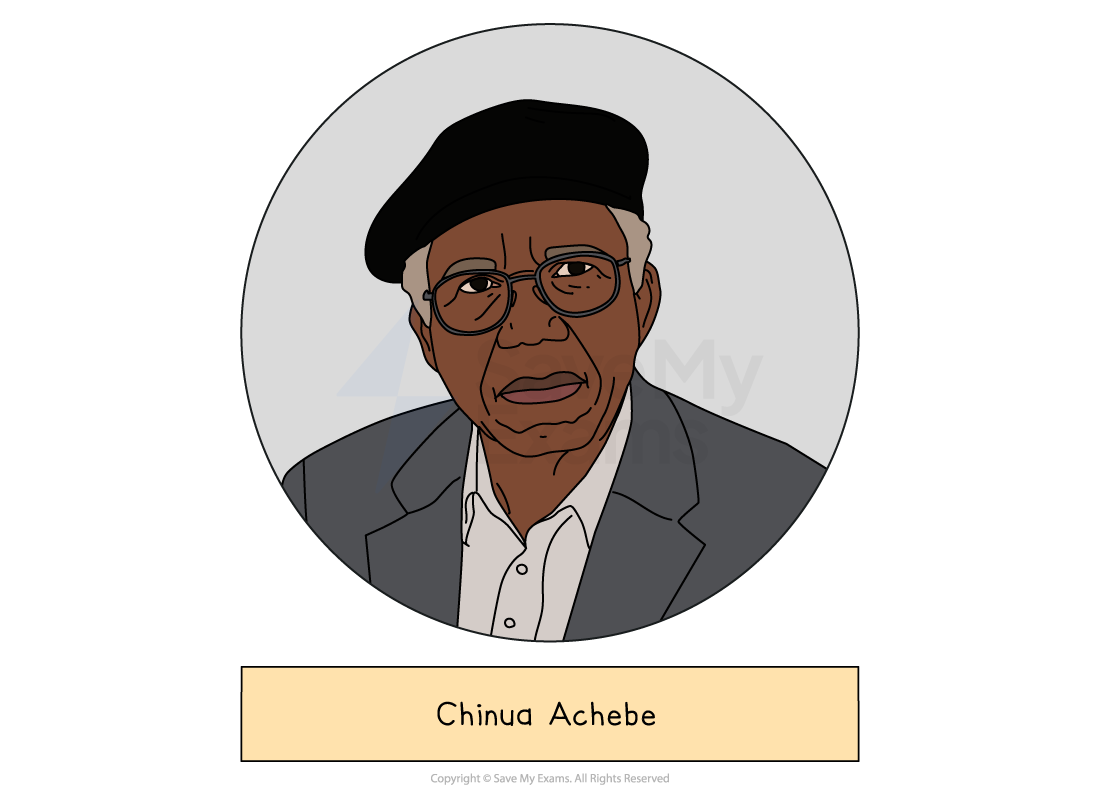
The Area of Exploration (AoE) Readers, Writers, Texts asks you to reflect on how meaning is constructed and interpreted. In your Theory of Knowledge (ToK) class, you will likely have had discussions on how meaning in the Arts is formed through a dialogue between the artist and the audience. As such, it can be useful to know details of the author’s life to infer reasons for their artistic choices as readers interpret their work years after their death.
Chinua Achebe, born in 1930, grew up in an Igbo town in Nigeria, although his parents were Christian
During his lifetime, Achebe witnessed colonial life as well as Nigerian independence from British rule
After attending university in Ibadan, Nigeria, he moved to the capital Lagos and worked for the Nigerian Broadcasting Service
While Achebe’s criticism of the way Western literature depicted Africa is a tenet of his work, his dual heritage affords him viewpoints on Western and Nigerian culture:
Achebe is often referred to as the "father of modern African literature"
After independence, to invigorate lost African heritage, Achebe’s debut novel Things Fall Apart was taught in African high schools as a classic
Examiner Tips and Tricks
If using details from the authorial context to make an analytical claim, support it with evidence from the text and use the language of hedging (such as “this implies”, “this suggests”, "Achebe appears to”). Remember, you are interpreting, not stating facts.
Social and historical context
The social and historical context is the events, changes, morals and values of the time and place in which the text was written. Things Fall Apart was published in London in 1958, yet it gained international recognition for its examination of colonial Nigeria. Some key details of that time and place are explored below to help aid our analysis of how Achebe represented and challenged the society in which his audience lived.
Colonialism
Things Fall Apart, set in the 1890s, depicts the Scramble for Africa, a term that describes the division of Africa amongst European powers
In particular, the novel depicts the clash between Nigeria’s new British colonial government and the traditional culture of the indigenous Igbo people
In the event of protest or resistance against the British, whole villages would be massacred:
Things Fall Apart details the massacre of “Abame” when a group of “white men” started to “shoot” and killed “everyone”
The British government divided Africa according to their own borders, dismissing existing indigenous borders:
Achebe portrays the reactions of Nigerian villagers to the advance of British settlers and colonists
The village’s suspicion is shown in dialogue between clansmen: they describe “strange” white skin and express their powerlessness against men with guns
In order to maintain control after colonisation, the British government sent district commissioners to govern African villages:
This created tensions as commissioners would settle disputes based on British law, which contrasted with African belief systems
Commissioners would often employ native converts to carry out British law
Achebe details the clash of belief systems when the district commissioner begins to govern the villages
Any attempt to enforce traditional Igbo justice led to arrest and torture
Religion
Traditional Igbo belief systems could be interpreted as a pantheistic and polytheistic faith in that it believed the natural world held a spiritual essence:
The earth goddess, for instance, ensured fertility
Crimes like killing a member of the tribe or sacred animals would offend the earth goddess
Animals were sacrificed to gods to ensure a village’s prosperity and health
Igbo faith centred around ancestral spirits who remained active participants in the community: shrines were created and festivals were held to celebrate ancestors:
To represent ancestral spirits, masked egwugwu served as judges and legal authorities
In traditional Igbo faith, oracles (intermediaries between the supreme God, the spirit world, and humanity) were responsible for key decisions regarding the village:
Oracles made decisions about war or murder so that these decisions were not based on personal choice, greed, or desire for power
Within Igbo faith, individuals are assigned Chi, a personal spiritual guardian who acted as a moral custodian that would create one’s fate or destiny
Achebe’s Things Fall Apart details, too, the religious tensions that resulted from the arrival of Christian missionaries in Nigeria in the middle of the 19th century:
Missionaries aimed to convert Igbo natives to Christianity in order to save them from their “paganism”
Their arrival in Africa influenced Igbo judicial, religious, and cultural traditions
Christian denial of all gods but their own created conflict, particularly in their disrespect of sacred animals and the Igbo egwugwu
Missionaries encouraged Western values, such as the idea that reading and writing should replace oral story-telling
Nevertheless, aspects of Christianity, such as the emphasis on equality, appealed to those who felt restricted or oppressed by the rigid traditions of Igbo society
In Things Fall Apart, Achebe depicts how the missionaries and their zealous converts “put a knife on the things that held us together and we have fallen apart”
Gender
Achebe’s Things Fall Apart depicts the rigid gender roles of traditional Igbo culture
Places, crops, crimes, and jobs are gendered: yams are a “man’s crop” and crimes are defined as male or female in terms of motive and intention:
Places are defined as one’s fatherland or motherland
During times of sorrow or exile, men seek refuge in their motherland
Strict gender roles determine that men are wealthy providers and warriors, while women are submissive, nurturing, and domestic:
Men have multiple wives as a symbol of status
Nevertheless, females were believed to hold spiritual power, exemplified by “Chielo”, the “Priestess of the Oracle”
Nigerian Independence
When Achebe wrote Things Fall Apart in 1958, Nigeria was two years away from independence
Under the Constitution of 1960, Queen Elizabeth II remained head of state until 1963
The 1950s was a time of increasing political tension for the British colony
Between 1946 and 1960, Nigeria held a number of constitutions in order to find some balance of power between regional and national bodies of government:
Nigeria is made up of multiple ethnic groups
Achebe’s novel can be understood as a text that attempted to regain cultural identity after a period of British rule
The new Nigerian educational system encouraged renewed cultural pride through the study of pre-colonial Nigerian heritage
Literary context
The Area of Exploration (AoE) Intertextuality asks us to think about how texts adhere to and deviate from conventions associated with literary forms or text types and how conventions evolve. Chinua Achebe’s novel Things Fall Apart is a key text for studying such questions. Achebe’s novels can be interpreted as realist and modernist fiction texts The tables below explore features of realism and modernism and where we can see them in Things Fall Apart.
Realism
Features of Realism | Examples |
Settings |
|
Characters and daily life |
|
Social class |
|
Modernism
Features of Modernism | Examples |
Alienation and cynicism |
|
Fragmented or unreliable narrative |
|
Social commentary |
|
Context of reception
In the AoE Time and Space, questions revolve around how audiences “then and now”, or “there and here”, might read/interpret texts differently. Paper 2 questions may ask you to compare texts that make you think about this, and in the IO, you might compare how two different texts in different contexts explore the same Global Issue; therefore, it is useful to know and understand how the audience of the time reacted to Achebe’s work.
Audience reception
Before Things Fall Apart, novels about Africa had been written from a European and Western perspective:
Joseph Conrad’s Heart of Darkness (1899) presented Africa as uncivilised, while Joyce Cary’s Mister Johnson (1939) perpetuated European attitudes
Achebe aimed to counter depictions of a primitive Africa by documenting the complex social fabric of Igbo culture
After being rejected by a number of London publishers, Things Fall Apart was accepted (hesitantly) by Heinemann in 1958
Critics praised Achebe's writing style on the whole, while others were unsettled by his portrayal of missionaries and British colonialism
The novel went on to sell over ten million copies, translated into over fifty languages, and remains a seminal work in universities and schools worldwide
Exploring critics
Below are two notable critics who have commented on Things Fall Apart:
Michael Valdez Moses: “The Novel and the Globalization of Culture” (1995)
Valdez Moses considers Things Fall Apart as a “telling critique of the Western literary and cultural tradition"
Valdez Moses suggests writers from European and African contexts bear similarities in their ability to depict the realities of their environment:
He discusses comparisons between Achebe and Thomas Hardy in their depiction of a flawed society
Valdez Moses compares Achebe’s fictional world in Things Fall Apart to early Greek society:
He suggests similarities between particular Greek and African civilisations in the way they break down the “dualism of the West and its Other"
Michael Valdez Moses has suggested "like Achilles, Okonkwo is a 'man of action, man of war'”:
Achebe's protagonist as a “larger than life” man who exemplifies virtues admired by the community makes him a traditional tragic hero
He compares the "ethos of Homer's Mycenaean heroes and that of their Igbo counterparts in Achebe's novels”, calling Things Fall Apart a modern African tragedy:
Valdez Moses discusses the "strikingly Homeric quality of Things Fall Apart"
Richard Begam: “Achebe's Sense of an Ending: History and Tragedy in Things Fall Apart” (1997)
In his 1997 essay, Begam argues that Achebe’s novel functions as a blend of historical narrative and tragedy:
He suggests that the novel presents Okonkwo's personal downfall within the larger, inevitable socio-historical shift brought by colonialism
Begam identifies a "series of endings" that shift the focus from Okonkwo’s personal ruin to the impact of colonial history
Begam explores the novel’s balance between the "historical" and the "tragic", as such Okonkwo’s downfall is a conflict of value systems
Begam examines how the novel employs multiple perspectives to describe African history
Begam argues that the novel portrays Igbo culture "from the outside as an object of anthropological curiosity”:
He adds that its “collapse is understood not as an African tragedy but as a European triumph”
Examiner Tips and Tricks
If writing about the context of reception, be careful not to be dismissive of other audiences’ reactions or interpretations. Remember the course’s key concept of perspective, and how understanding and reflecting on different interpretations can give us greater insight into a work’s meaning and impact. For both the IO and Paper 2, comments on these multiple meanings and impacts are appropriate and show good knowledge and understanding.
Sources:
Anjalin, Mary. “Gender Roles and Power Dynamics in Things Fall Apart: A Critical Perspective.” Contemporaneity of Language and Literature in the Robotized Millennium, vol. 2, 2020, https://restpublisher.com/wp-content/uploads/2024/01/Gender-Roles-and-Power-Dynamics-in-Things-Fall-Apart-A-Critical-Perspective.pdf (opens in a new tab). Accessed 25 April 2026.
Begam, Richard, editor. ACHEBE'S SENSE OF AN ENDING: HISTORY AND TRAGEDY IN ‘THINGS FALL APART. vol. 29, Philadelphia, 1997. JSTOR, https://www.jstor.org/stable/29533223 (opens in a new tab). Accessed 25 April 2026.
Bloom, Harold, editor. Chinua Achebe's Things Fall Apart. Chelsea House Publishers, 2002. Accessed 25 April 2026.
Christ, Ronald. “Among the Ibo.” New York Times [New York], 17 December 1967, https://www.nytimes.com/1967/12/17/archives/among-the-ibo.html?smid=url-share (opens in a new tab). Accessed 25 April 2026.
Mosely, Kristian. “The Portrayal of Religion in Chinua Achebe’s Things Fall Apart.” https://lup.lub.lu.se/luur/download?func=downloadFile&recordOId=8925611&fileOId=8925612 (opens in a new tab).
Moses, Michael Valdez. The Novel and the Globalization of Culture. Oxford University Press, 1995. Accessed 25 April 2026.

Unlock more, it's free!
Join the 100,000+ Students that ❤️ Save My Exams
the (exam) results speak for themselves:

Was this revision note helpful?