Contextual Understanding (DP IB English A: Language and Literature: HL): Revision Note

Context involves facts and details about the author’s life and the social, political, historical, and cultural realities of a given time and place. Considering how culture, identity, and lived experience influence an author’s choices allows us to better understand the choices they make and how they hope their audience might understand and engage with their text.
Authorial context
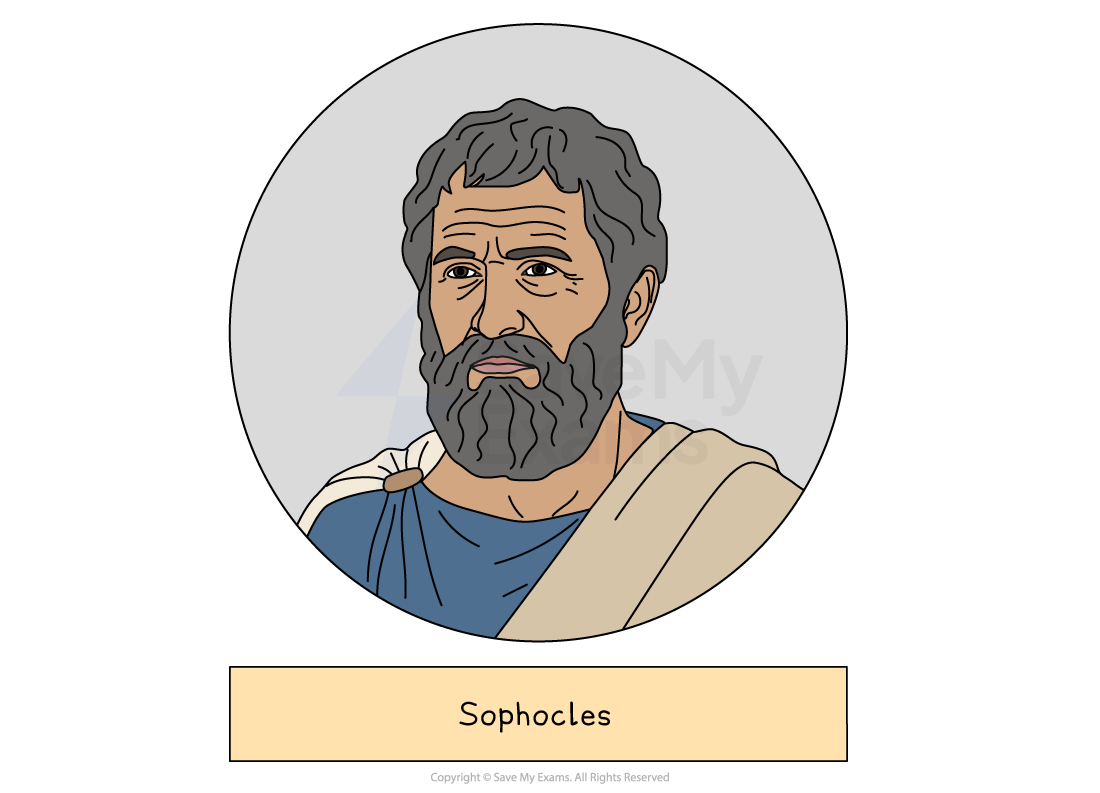
Understanding the lived experience of an author can give us insight into their motivations and choices.
Sophocles was born into a wealthy family in a village outside of Athens in the year 496 BCE:
He received a good education
He had experience working in government roles, as well as experience on the battlefield:
He had insight into the dynamics and challenges of both political and military systems
He won the Great Dionysia festival of 468 BCE, marking the start of his career:
He wrote 123 dramas and is thought to have competed in approximately 30 festivals
He was one of Classical Athens’ three great tragic playwrights:
He even initially acted in some of his plays
He introduced the third actor to Greek drama, allowing for more complex character interactions and a greater number of characters
He may have increased the chorus size from 12 to 15 members
He also introduced stage painting, which enhanced visual storytelling
He was celebrated for his ability to clearly distinguish characters through distinct rhetorical styles
His style often emphasises human limitations in wisdom:
A flaw or failure in thinking affects everyone and leads to ruin
Social and historical context
The social and historical context refers to the events, changes, norms, values and political conditions present at the time and place in which a text was written. Understanding the context of Athens during the period in which Sophocles wrote Antigone helps us better understand the authorial choices behind the play’s plot, themes, and characterisation, as these elements are shaped by the concerns and realities of the society in which the writer lived.
At the time Sophocles wrote this play, Athens was transitioning from aristocratic rule to democracy:
There was a tension between old systems of authority and new civic ideals
Greek religious and moral law was not really codified and functioned through custom, tradition, and shared cultural knowledge
Citizens were increasingly engaged in debates about law, justice, and moral responsibility
Women were largely excluded from public life:
Significant aspects of religious practice fell within a woman’s private domain
Women prepared offerings, maintained household shrines, performed daily rites, and were responsible for mourning rituals, funerals, and births
So Antigone burying her brother is not random rebellion but reflects traditional female religious duty and responsibility for funerary rites and family honour
Women were not allowed to act in Greek theatre and rarely attended Greek theatre:
This makes the choice of Antigone as protagonist all the more interesting
Divine law and ritual were central to Athenian society:
A play that reflects the tension between human law and divine law would resonate with its contemporary audience
Examiner Tips and Tricks
When exploring a text as old as Antigone, it is natural to initially feel disconnected. The world of the play is so far removed from ours. We do not worship the same gods, and ideas about fate, authority, and social structure have changed significantly over time.
It can, therefore, be helpful to focus on what we share with the characters. They, like us, are just human beings struggling to make sense of a world that often feels unfair and unpredictable. While historical and cultural contexts differ, human nature remains very much the same. Pride and stubbornness lead to ruin, competing loyalties still create conflict, and individuals continue to wrestle with difficult moral choices.
By recognising the enduring aspects of human experience, we can build stronger connections to ancient texts, and develop a deeper understanding of their characters and themes. This perspective allows us to more fully engage with Antigone as a meaningful and relevant work of literature.
Literary context
Literary context refers to the conventions, structures, and expectations of the genre in which a text is written. Sophocles wrote within the highly structured tradition of Greek tragedy, which was foundational to Athenian society and followed clear conventions. Understanding this literary context helps us recognise how Sophocles both follows and develops these conventions in Antigone.
Sophocles wrote within the tradition of Greek tragedy, which means his plays incorporated:
The use of the Chorus to reveal social norms, comment on the action of the play, and model for the audience appropriate emotional and intellectual responses
An understanding of tragedy as a moral and philosophical exploration, not just entertainment
An emphasis on fate, hubris, and the moral limitations of humans
Themes often explored in Greek tragedy include:
Conflicts between personal conscience and societal law
Exploration of justice, power, and the consequences of human flaws
Moral and psychological complexity, even for characters seen as heroes or villains
Context of reception
Just as it is important to consider the context within which a text was written, it is also important to think about how audiences at the time may have responded to it. Audience reactions are shaped by the social values, cultural traditions, and political realities of their historical moment, meaning that different audiences may interpret the same text in different ways.
Plays were performed at religious festivals attended by large audiences
Greek tragedy was both entertainment and civic and religious education
Audiences were encouraged to consider the balance of civic duty, family loyalty, and divine law
The performance of Greek tragedy was believed to cleanse the audience’s emotions, providing catharsis, a healthy outlet for feelings like pity and fear
Playwrights frequently used the stage to question traditional beliefs and societal norms, provoking critical thinking and intellectual debate:
Audiences were expected to engage with plays on both an intellectual and emotional level
Antigone has been performed, adapted, and reinterpreted in a number of different contexts:
Jean Anouilh’s Antigone (1944) was performed in Nazi-occupied France, and was sufficiently ambiguous to pass censorship laws
Bertolt Brecht’s Antigone (1948) offered a critique of fascism and authoritarian power
Jean-Paul Sartre’s reading of Antigone was existentialist in nature, viewing the character of Antigone as a symbol of existential freedom
Antigone has been used as a protest text:
Mandela performed it with fellow inmates in prison in South Africa
Modern productions often explore themes of gender, power, and resistance
Examiner Tips and Tricks
No literary text is ever created in a vacuum. Writers are always influenced by the political, social, and cultural conditions of their time, and these forces inevitably shape the ideas explored in their work. The concerns, tensions, and debates present in a society often sit in the writer’s consciousness and influence the themes, characters, and conflicts that emerge in the text they create.
As a result, we can expect that any piece of literature may reflect, critique, predict, warn against, or attempt to make sense of the realities of its historical moment. When analysing a text, it is therefore useful to consider what was happening in the world at the time of its creation and how this might have informed the writer’s choices.
Exploring context in this way can deepen your understanding of authorial choices and intentions, and strengthen your analysis by showing how literature engages with real-world concerns rather than existing in isolation. Some Paper 2 questions specifically ask you to explore how audiences “then and now” or “there and here” might respond differently to a work. These questions create an opportunity to examine how context shapes interpretation, while also considering which aspects of human experience and the human condition remain constant despite changes in time and place.
Sources
Sophocles (trans. P. Woodruff) (2001), Antigone, Hackett Publishing Company
Sophocles (trans. D. Franklin and J. Harrison) (2003), Antigone, Cambridge University Press
Sophocles (trans. R. Fagles) (1984), The Three Theban Plays, Penguin Classics, London
Sophocles (n.d.), “The plays”, Encyclopaedia Britannica, https://www.britannica.com/biography/Sophocles/The-plays (opens in a new tab)

Unlock more, it's free!
Join the 100,000+ Students that ❤️ Save My Exams
the (exam) results speak for themselves:

Was this revision note helpful?