Plot Summary (DP IB English A: Language and Literature: HL): Revision Note

Plot Summary
An exploration of Sophocles’ Antigone begins with a basic understanding of what happens in the play, but quickly becomes something much richer. At the level of plot, the story is quite simple: a young woman breaks the law in order to bury her brother. However, Greek tragedy was never intended to function as a story alone.
What gives this story its meaning, and what makes this play a text that we continue to read more than two thousand years later, has to do with how this story sits within its context, and how it is shaped by the conventions of Greek tragedy and the role of theatre in Greek society. When we approach the play in this way, the plot becomes so much more than a sequence of events. It becomes a powerful means of exploring complex moral, social, and political conflict central to the human condition.
Below you will find:
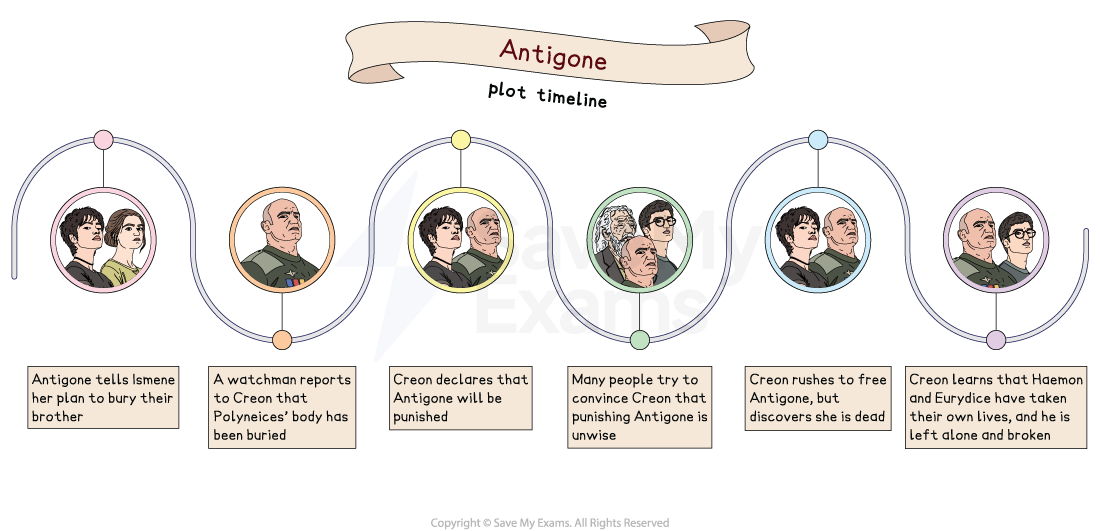
An illustrated plot timeline
An overview of the play
A plot summary broken down into sections of the play
N.B., When we include quotations, or references are made to the text, we are referring to the Paul Woodruff translation of Antigone (Hackett, 2001). Please note that many other translations of the play are available and equally valid, but that quotes and line references in this guide might not match these other translations or editions of the play.
Antigone: plot timeline
Overview of Antigone
Sophocles’ Antigone was written and first performed around 441–442 BCE in Athens. It premiered at the Great Dionysia festival, and was very likely written in response to political events of the time, like the transition of political authority from the aristocracy to the citizens, through the adoption of a new sort of citizen-led democracy. This means that questions concerning law, morality, and civic authority were very much on the minds of Athenians.
Antigone was the first of Sophocles’ Theban plays to be written, though it takes place last chronologically (after the other two plays, Oedipus Rex and Oedipus at Colonus). Because these plays are connected, the storyline of the other plays, as well as characters from the other plays, like, for example, the blind seer, Tiresias, appear within Antigone, indicating a shared cultural knowledge. The audience would be expected to be familiar with these other stories and to draw on that knowledge to help them fully understand and appreciate this particular play.
Modern editions of the play often include explanatory notes to help bridge this gap in knowledge, providing us with the cultural and mythological context that Sophocles’ original audience would have taken for granted. For more details on the typical features and formal conventions of Greek tragedy, check out the Authorial Choices and Textual Features page on Antigone.
Examiner Tips and Tricks
A common trap many students fall into in an exam setting is simply retelling the story. This can be especially true if you are feeling nervous or insecure. In that moment, it might feel safe to stick with what you know is true — the facts of the story.
However, moving from descriptive writing to the analytical writing required by a Paper 2 involves turning your “What?” into “So what?” This involves considering the how and why of the storytelling within a text, paying attention to where the author starts a story, or which point in the plot receives the most attention, or what elements are overlooked.
In Antigone, for example, Sophocles never actually shows us the battle between the brothers, or Antigone burying her brother, or all the various deaths that take place. Instead, we are only shown the aftermath of the events, shown people talking about them and making decisions based on them. So, what does that accomplish? Well, it reveals a little of Antigone’s intention, what he wants his audience to think about. Try asking this “So what?” question with the other texts you are discussing. It is a good way to help you build a habit of analytical thinking.
Antigone: Scene-by-scene plot summary
Prologue (lines 1–99 in the translation by Paul Woodruff)
The play opens with a conversation between Antigone and her sister, Ismene:
Both of their brothers, Polyneices and Eteocles, who were fighting over an agreement concerning taking turns ruling Thebes, died during a battle
They killed each other
The conflict is this: Creon, their uncle, the new ruler of Thebes, has declared that Eteocles may be buried, while Polyneices is not to be given a proper burial
For Antigone, the horrific thought of leaving her brother’s body to rot is made worse by the fact that divine law — the will of the gods — dictates that bodies are to be properly buried:
This is in order to assure safe passage to the underworld
Antigone finds herself in a complicated situation, as either decision will anger someone in charge:
If she buries her brother’s body, Creon will punish her, likely with death
If, however, she leaves the body unburied, the gods will not be pleased, and her brother will not have safe passage to the underworld
Additionally, murder of a kinsman brings about blood-guilt, or miasma, which can only be cleansed through a ritual purification, or else it could become contagious and affect the entire living community
So Creon’s decree, and Antigone’s decision, are not just about two people who disagree about the right thing to do
Their actions could affect everyone in their community
Antigone tells her sister that she has decided to go against Creon’s decree:
Her sister, while sympathetic to Antigone, does not dare join in this act of defiance
Parodos (lines 100–161)
The Chorus of Theban elders enter from the sides, commenting on the recent battle, and the city’s struggle with civil war
They reflect on the destructive power of human ambition and the consequences of family curses
This section introduces the audience to the moral and historical context of Thebes
First episode (lines 162–331)
Creon provides more detail about his decree:
He orders that the body of Polyneices be guarded to ensure that nobody can touch it
A watchman is sent to Creon to tell him that, in spite of the body being watched by a number of guards, it has been buried:
Creon is furious, and is certain that one of the watchmen has been bribed
He threatens the watchman that if he does not find the man who has buried the body, he, the messenger, will be horribly and publicly punished
Through this interaction, the audience gets to know Creon, his values, and his beliefs about his own role and power
First stasimon (lines 332–384)
The Chorus reflects on the duality of humans:
They are resourceful and clever, learning how to tame nature and solve complicated problems
But they are also deceitful
This choral ode introduces the tension between mortal and divine law, and the inevitability of suffering when humans challenge authority
Second episode (lines 385–581)
The watchman returns to Creon, this time with Antigone, who was caught burying her brother:
When confronted by the watchmen, Antigone boldly admits to what she was doing
When questioned by Creon, Antigone shows pride in her decision and strong moral conviction
She is absolutely certain she has done the right thing
She does not believe that the laws of man can ever be more powerful than the laws of the gods
Creon is furious, not just that Antigone disobeyed his law, but that she boasts about it:
Antigone boldly questions Creon’s law, challenging him to justify it
Creon argues that loyalty to the state must override family loyalties
Creon condemns Antigone to death, despite the warnings of the Chorus about stubbornness and hubris
Creon believes that Ismene was involved in the plot to bury Polyneices and threatens to punish her as well:
Ismene tries to say that she helped Antigone, but Antigone will not let her take ownership of an act she did not do
Second stasimon (lines 582–631)
The Chorus meditates on the nature of fate, pride, and the downfall of those who defy divine will
They are shocked that such a great punishment can result from the spreading of a thin layer of dirt
They declare that no human crime can escape punishment, and that there is no escape from imminent disaster
Third episode (lines 632–780)
Creon’s son, Haemon, enters and pleads with his father to spare Antigone’s life:
Creon claims that Haemon is blinded by love and must see that the law is more powerful than any attachment he might have
In keeping with the culture of the time, Creon expects unconditional devotion and obedience from his son:
Haemon initially implies that he agrees with Creon, but — knowing how important public perception is to his father — he shares that Antigone has gained considerable public sympathy
Haemon also predicts that Creon’s rigidity will inevitably lead to tragedy
Creon feels dishonoured by his son, and annoyed by this wave of public sympathy for Antigone
Creon commits all the more fiercely to his decision to punish Antigone
Third stasimon (lines 781–805)
The Chorus again comments on the dangers of excessive pride and the suffering it brings to both rulers and citizens
The Chorus sings about love, how love conquers all, and how tragic it is that Antigone will never have the chance to be Haemon’s bride
Fourth episode (lines 806–943)
Antigone tells the Chorus how unfair it is that she is being punished, that she hasn’t done anything wrong:
She also shares that she may not have risked so much for a husband or a child, but her brother cannot be replaced, especially since both her parents are dead and cannot make her a new brother
Her exit from the stage is like that of a princess or a bride — proud, calm, and self-assured
Creon is completely unaffected by either her grief or her defiant pride
Fourth stasimon (lines 944–987)
The Chorus shares three stories from myth that illustrate the power of fate and connect to Antigone’s plight:
The message is that destiny is inescapable
The connections between the stories and Antigone’s situation are not totally obvious
This hints at how the Chorus is just as confused and troubled as the audience, which means they sometimes struggle to make sense of what they are witnessing
Fifth episode (lines 988–1114)
Up until this point, we have seen Creon in confrontation with Antigone, Haemon, and Ismene
Each of them brought different arguments to try and change his mind
Now, another character appears — Tiresias, the old Theban seer:
Tiresias is familiar to audiences as he appears in many tragedies
He is blind but can “see” what many others cannot
He warns Creon that the gods are not pleased with him for forbidding the proper burial of Polyneices, and that his punishment will be the loss of his son
Initially, Creon believes that Teiresias is mocking him, but he soon begins to fear for his son’s life:
He gives Polyneices a proper burial and decides to free Antigone
Fifth stasimon (lines 1115–1154)
The Chorus, encouraged by Creon’s change of heart, sings a song to celebrate Dionysus and invoke his power to protect the city and cleanse it from the curse and pollution of the citizens’ previous actions
Exodos: the final scene and the end of the Chorus (lines 1155–1353)
In many tragedies, a messenger enters the stage and reports some important event that has happened elsewhere:
In this case, the messenger reports that Haemon is dead
While Creon finally made the decision to free Antigone, his decision comes too late, only after Antigone has hanged herself
Haemon, having seen that his fiancee is dead, takes his own life
Creon’s wife, and Haemon’s mother, Eurydice, also kills herself in grief
At the end of the play, Creon is left alive, but broken, devastated, isolated, and regretful:
He realises too late that his own stubbornness and hubris have brought about the destruction of his family
Examiner Tips and Tricks
The climax of a story is often thought of as the moment of highest tension in a story. It can be helpful to consider that the climax of a story is actually the moment when the protagonist or hero is irrevocably changed, meaning it is the moment when one of the main characters makes a decision or gains knowledge that permanently changes the direction of the story.
In the case of a tragedy, this is the moment when the tragic outcome becomes inevitable. In the case of Antigone, thinking about the climax in this way implies that while Antigone is the catalyst for the story, Creon is actually the tragic hero, as he is the one who has this moment when he makes a decision that ultimately brings about his tragic fate. Thinking about plot progression like this could help you in understanding why particular moments in the plot are worth paying attention to in your exploration.
Sources
Sophocles (trans. P. Woodruff) (2001), Antigone, Hackett Publishing Company
Sophocles (trans. D. Franklin and J. Harrison) (2003), Antigone, Cambridge University Press
Sophocles (trans. R. Fagles) (1984), The Three Theban Plays, Penguin Classics, London

Unlock more, it's free!
Join the 100,000+ Students that ❤️ Save My Exams
the (exam) results speak for themselves:

Was this revision note helpful?