How to Write a Reflection for your Learner Portfolio (DP IB English A: Language and Literature: HL): Revision Note

When writing a reflection for your Learner Portfolio, the focus should be on documenting your personal record of discovery and your evolving understanding of the texts over the two years of the course. Because the portfolio is meant to be a place to explore and develop your thinking, your reflections do not need to follow a formal essay structure.
Below you will find some key areas and approaches to focus on when writing a reflection. It includes:
What is a reflection?
How to write a reflection
Formats for reflection
Top tips
What is a reflection?
A reflection is a different kind of writing to a summary. The IB is not interested in a record of what happened in a text you have read. A reflection is also not a book review or a list of techniques. Rather, it is an exploration of what you think, feel, notice, question and understand as a result of something you have read or studied.
A reflection answers questions such as:
What did this make me think?
What did this make me question?
What did I notice that I did not expect?
How does this connect to something I already know or believe?
What do I still not understand?
What could I think about differently because of this?
How to write a reflection
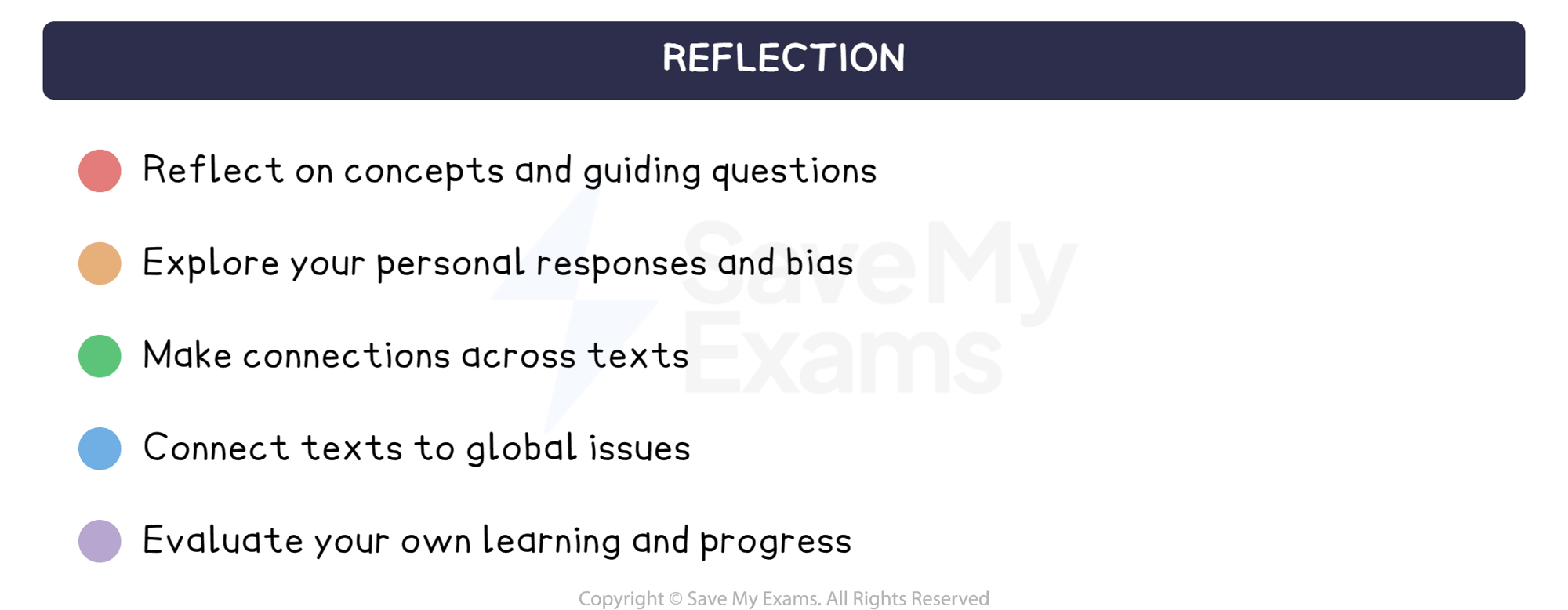
1. Reflect on concepts and guiding questions
The course is fundamentally driven by concepts rather than just content. You should therefore write reflections related to the course's guiding conceptual questions and the seven central concepts (identity, culture, creativity, communication, perspective, transformation, and representation).
For example, you might reflect on how a specific character's identity is constructed, or how a text itself represents an act of communication.
2. Explore your personal responses and bias
A strong reflection examines your own perspective. You should reflect on the personal assumptions, beliefs, and values that form and shape the way you respond to a text.
You might write a "reading log" detailing your first reactions during your first reading of a text, and later trace how your thinking and cultural understanding evolved over time.
3. Make connections across texts
Use your reflections to establish connections among the literary and non-literary texts you study. You should reflect on the similarities, differences and recurring ideas across a range of texts. This is particularly helpful when preparing for your Paper 2 comparative essay.
4. Connect texts to global issues
You should explore how the texts offer insights into social, global and real-world issues. Reflect on how key passages represent different perspectives on a global issue, which will directly help you prepare for your Individual Oral.
5. Evaluate your own learning and progress
Reflections should also be about how you learn. You can use the portfolio for self-assessment to evaluate your own progress. You might reflect on:
The academic challenges you have faced and your achievements
Your responses to feedback from your teacher or even your peers
Reports of classroom discussions and the diverse values and perspectives represented within your class
Which skills (such as those needed for the Paper 1 guided analysis) you feel less confident in and how you plan to improve them
Formats for reflection
The portfolio allows for a "diversity of formal and informal responses". You do not only have to write in free prose; you can write reflections in the form of reading logs, sticky notes, annotations of extracts and visual mind maps. You can even record audio files of your thoughts if you prefer speaking to writing.
You do not need to follow a strict formula, but the following four questions can provide a structure for a portfolio reflection:
What?
What did you encounter, read, discuss or produce? State it briefly: one or two sentences at most
So what?
What did it make you think, feel, notice or question? What was surprising, challenging or significant about it? What assumptions did it confirm or challenge?
Why does it matter?
Why is this relevant to the course, to the texts you are studying, or to your understanding of language and literature more broadly? How does it connect to the central concepts, the Areas of Exploration, or the global issues you are exploring?
Now what?
What do you want to do with this thinking? Does it raise a question you want to investigate further? Does it suggest a connection to another text worth exploring? Does it point towards something useful for one of your assessment components?
Ultimately, the goal is to ask questions and consider detailed answers about why writers write, what choices they make and how you, as a reader, respond.
Top tips
Length is not the same as quality:
There is no required length for a reflection — it should just capture something interesting and specific about your engagement with the material
Don’t fall into the trap of describing rather than reflecting:
If you find yourself writing mostly about what the text contains or what happened in a lesson, stop and ask yourself: what did I think about this? What did it do to my understanding?
Remember, the portfolio is not assessed:
You are writing and recording what is useful for you, not to impress

Unlock more, it's free!
Join the 100,000+ Students that ❤️ Save My Exams
the (exam) results speak for themselves:

Was this revision note helpful?