Plot Summary (DP IB English A: Language and Literature: HL): Revision Note
An exploration of Khaled Hosseini’s The Kite Runner requires you to consider how themes, characters, or relationships develop throughout the novel. It is this development that delivers messages and conveys themes. To understand this, you’ll need to know the plot thoroughly.
Below you will find:
An illustrated plot timeline
An overview of the novel
A plot summary broken down into chapters of the text
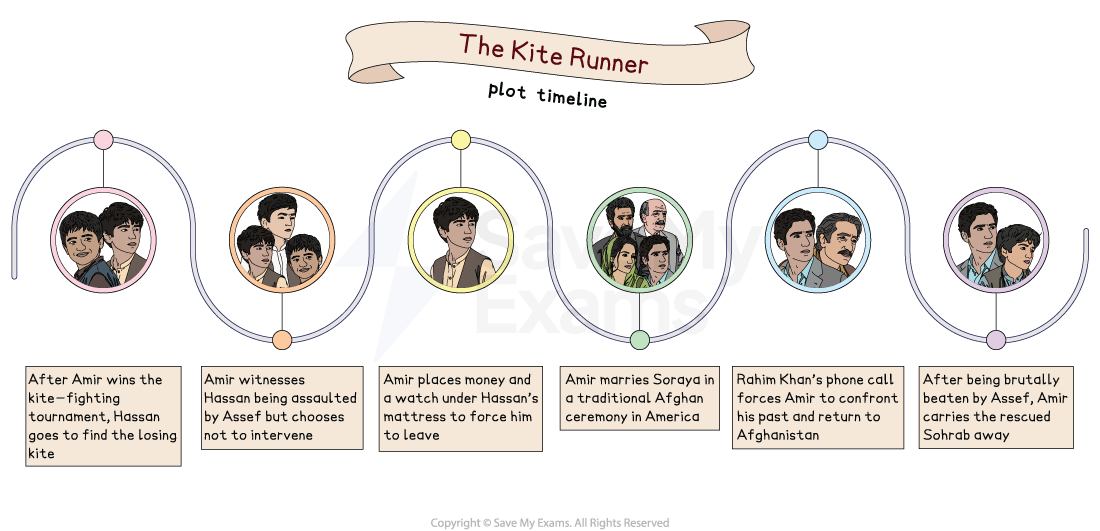
The Kite Runner: Plot timeline
Overview of The Kite Runner
Amir, a privileged boy growing up in Kabul, Afghanistan, spends his childhood seeking the approval of his emotionally distant father, Baba, while forming a deep but unequal friendship with Hassan, the son of his father’s servant.
During a local kite-fighting tournament, Amir finally earns Baba’s pride by winning. However, on the way home, he witnesses Hassan being violently assaulted by Assef, a neighbourhood bully, and chooses not to intervene. This moment becomes one that Amir chooses to let define him, as he is overwhelmed by his guilt. Unable to face his friend, he orchestrates a situation that leads to Hassan and his father leaving the household.
Soon after, the Soviet invasion of Afghanistan forces Amir and Baba to flee to the United States, where they rebuild their lives in California. Amir grows up, becomes a writer, and marries Soraya, but remains haunted by his betrayal of Hassan. Years later, he is contacted by Rahim Khan, a family friend, who suggests that “there is a way to be good again”.
Amir travels back to Taliban-controlled Kabul to rescue Hassan’s orphaned son, Sohrab. He discovers that Sohrab is being held by Assef, now a Taliban official. Amir confronts him and is severely beaten, but ultimately manages to escape with Sohrab. Returning to the United States, Amir and Soraya adopt the traumatised boy, though he struggles to speak or trust others.
The novel follows Amir through his life, and shows Afghanistan throughout different eras of political control, with monarchy, revolution, Soviet invasion, and Taliban tyranny changing the country, while Amir’s identity is shaped by diasporic experience once he settles in the United States.
The Kite Runner: Chapter-by-chapter plot summary
Chapters 1–3
Our narrator says he became who he is today back when he was twelve, on a winter day in 1975
Now in San Francisco, an old friend called Rahim Khan calls:
Rahim asks the narrator to come visit him
Rahim has told him there is a way to be good again
We then get a flashback where the narrator, Amir, takes us back to being a child with his friend Hassan
Amir lives with his father, Baba, while Hassan and his father Ali live in their garden in a mud hut:
Hassan and his father are Baba and Amir’s servants
Hassan was born a year after Amir:
Amir’s mother died giving birth to Amir
Hassan’s mother left him when he was a baby, joining a group of travelling performers
Hassan and Amir first fed from the same wet nurse
We learn that Hassan has a cleft lip
Amir is Pashtun, Sunni Muslim, while Hassan is Hazara, Shi’a Muslim:
They bump into soldiers while out playing who abuse Hassan for being Hazara, and mock his mother
Amir considers himself Baba’s only failure, as he does not feel he meets his expectations:
He overhears Baba’s best friend, Rahim Khan, telling Baba to respect Amir and his love of books
Baba fears that Amir cannot stand up for himself and won’t be able to as an adult
We see that Amir gets quickly and angrily jealous when Baba praises Hassan instead of him
Chapter 4–6
The story jumps back to 1933, when Baba was born
In this year, two men killed Ali’s parents in a drunk-driving incident:
Baba’s father adopts Ali into his home, and he grows up as their servant and Baba’s friend
They have a relationship similar to that of Amir and Hassan:
They do not call each other friends, but they are incredibly close
Their ethnic and religious differences seem to divide them
When Amir is at school, Hassan is home doing his servant work:
Hassan is illiterate, while Amir is smart and enjoys reading
Amir also enjoys teasing Hassan when he reads to him, mocking his inability to read and that he doesn’t understand some of the words
Their favourite story is “Rostam and Sohrab”:
The lead warrior, Rostam, kills his enemy, only to find it is his long-lost son Sohrab
Amir feels all fathers have a desire to kill their sons
Amir makes up a story for Hassan, who likes it, and it inspires Amir to write one of his own:
He tries to show his father, but he is not interested
Rahim Khan encourages him
He later reads the story to Hassan, who points out a plothole:
Amir is annoyed and cruelly thinks he should have noticed something that an illiterate Hazara did
That night, they hear gunfire, which came from Daoud Khan overthrowing the King, his cousin:
A republic in put in place, with Khan as president
Amir calls it the night that ended the old Afghanistan, although they didn’t know it at the time
The next day, Hassan and Amir are attacked by Assef, a renowned bully, and his friends Kamal and Wali
Assef carries brass knuckles and racially abuses Hassan:
He boasts about liking Hitler and agreeing with ethnic cleansing
He calls Hazaras dirty and wants Afghanistan to be just for Pashtuns
Assef says Amir makes things worse by being friends with Hassan:
Amir thinks to himself that Hassan is his servant, not friend, but then feels guilty
Hassan stands up to them and strikes Assef in the eye with a rock, firing it from his slingshot:
The trio back away, vowing to get revenge
Amir describes how there was a time that life seemed to work under the republic, and that they had hope
He then describes a moment in the winter of 1974 where Baba surprises Hassan with a birthday gift:
He arranges plastic surgery to fix his cleft lip
The kids in Kabul fly kites in winter when school is closed:
Amir is annoyed that Baba always buys nice kites for both him and Hassan, wishing his Dad would buy a nicer one for him
They have a kite-fighting tournament each year, where the strings are covered in glass so you can cut an opponent’s kite in the air:
Kite runners chase the kites that fall
The last kite in the air is the winner
Amir calls Hassan the best kite runner in Kabul, and is amazed at how well he can judge where a kite will fall:
One day, waiting under a tree for a kite, Amir tests Hassan’s loyalty by asking if he’d eat dirt for him if asked
Hassan says he would if Amir really wanted him to, and Amir feels ashamed and claims he was joking
On a night before the kite tournament in 1975, Baba tells Amir he thinks Amir will win this year:
Amir feels this is an omen, a sign of his victory to come, and is determined to win the tournament to prove himself to Baba, who won it as a child
He hopes winning might mean Baba forgives him for “killing” his mother in childbirth
Chapter 7–9
After hours of trying, Amir wins the tournament, beating a blue kite he had kept his eye on:
Hassan runs off to get the blue kite, promising it to Amir, telling him he will do anything for him, “for you a thousand times over!”
Amir celebrates, but soon wonders where Hassan is and goes looking for him and the blue kite:
He asks an old merchant, who is suspicious of why he wants to find a Hazara, but eventually reveals he saw Hassan being chased by three boys
Amir finds Hassan, but stands and watches from around the corner as Hassan is cornered by Assef, Wali and Kamal:
After threats and insults, Assef tells Hassan he will let him go without harm, as long as he gives him the blue kite
Hassan refuses, as he has promised it to Amir
They mock him, saying that Amir does not see him as a friend, just a servant
The trio attack Hassan, but Amir stays still, rooted to the spot with fear, just watching
Amir narrates from his perspective now, older and grown, remembering Ali telling him about how they shared the same nursemaid:
Ali says there is a brotherhood between the two as they have fed from the same breast
He remembers a fortune teller they visited, Hassen and he, and how the man looked at Hassan with distress and gave him his money back
Back in the alley, Assef undoes his belt and takes off his and then Hassan’s trousers and underwear:
Wali and Kamal refuse to join in, saying it is sinful, but Assef claims it doesn’t count when it’s a Hazara
Back in the alley, Amir realises he is biting his fist so hard that it is now bleeding:
He has to decide in this moment what to do, and chooses to run
He thinks the blue kite is key to Baba’s love, and sacrifices Hassan to get it
Fifteen minutes later, he sees Hassan walking slowly past and pretends he has only just found him:
Hassan is limping and crying, and then blood falls from between his legs and marks the snow on the ground
Neither say anything, and Hassan gives Amir the kite
Amir wonders if Hassan saw him, but they walk back, pretending nothing happened
Baba embraces Amir, just like he hoped he would, and Amir weeps in his arms
In the week afterwards, Hassan and Amir rarely see each other:
Hassan just about carries out his expected work, but otherwise just stays in bed all day
Ali asks Amir what is wrong with Hassan, but Amir is rude and denies knowing
Amir and Baba go to Jalalabad to visit Baba’s cousin:
In Jalalabad, Amir cannot sleep, struggling with the guilt, and the older Amir, narrating, says that this was the night he became an insomniac
Over the winter, Amir tries to avoid Hassan, while Hassan tries to forge their bond again:
He eventually asks Amir what he’s done wrong, and why they don’t play together any longer
Amir tells him that all he wants is for Hassan to leave him alone and stop harassing him
After this, they barely see each other, and do not talk
In spring, Amir asks Baba if he has ever thought of getting new servants:
Baba is furious, saying both Ali and Hassan are family
This moment seems to break their closeness that had formed after the kite tournament
In the summer, Amir asks Hassan to go up the hill with him, so he can tell him a story he wrote:
Up there, he instead asks Hassan what he’d do if Amir hit him with a pomegranate
The colour drains from Hassan’s face and Amir realises he looks old
Hassan won’t answer, and Amir gets angrier and angrier, throwing the pomegranate at Hassan, screaming for Hassan to hit him back, and hitting him with more and more
Eventually, Hassan gets up, crushes the fruit against his head and asks if he’s happy now, before walking off
That summer, 1976, Amir turns thirteen, and Baba throws a party:
Baba invites everyone, Amir reckoning over 400 people come, and that he only knows about a quarter of them
Baba makes him greet each guest as they come in:
This leads to Assef and his parents arriving, and Amir is confronted by what happened
He feels Assef’s parents are scared of him, and Baba is annoyed at Amir when he is rude to them, especially as Assef shows he can charm Baba with compliments
Assef gives him a present, one of his favourite books
When Amir opens it away from everyone, it is a biography of Hitler
At the party, Rahim Khan tells him a story of nearly marrying his neighbour’s servant, and then tells Amir he can tell him anything, and then looks at him silently for a while:
He then hands him a leather-bound notebook to write his stories in
The next day, Amir thanks Baba for his fireworks, and Baba gives him his present, which is an expensive bike:
Baba offers to go out with him to try it out, but seems reluctant, and Amir says he’s tired
Baba also got him a wristwatch, and Amir throws that in the pile of presents he got from the party, not feeling worthy of gifts
When Ali sees Amir that day, he gives him the present from him and Hassan:
They have bought him a new version of a book Amir has read to Hassan
Amir finds it hard to accept, knowing it’s likely more expensive than anything they could afford
Amir hides it at the bottom of the pile of gifts, unable to look at it
The next day, while Hassan and Ali are out, and Baba is busy, Amir sneaks into Hassan’s hut with envelopes of cash from the party, and the watch he was given:
He slides them under Hassan’s mattress
He waits a little, and then goes to tell Baba that Hassan has stolen from him:
Baba goes to Ali and Hassan and invites them into his office to talk
Thirty minutes later, Ali and Hassan join Baba and Amir, both with red faces from crying:
Baba and Ali ask Hassan if he stole from them, and Hassan says yes, and Amir understands that Hassan is again sacrificing himself for Amir
Baba forgives him, but Ali says they are leaving:
They have already packed their bags
Baba is desperate, and Amir sees now how hurt everyone is, and what he has done:
For the first time, Amir sees Baba cry and he is shaken by it
Ali and Hassan leave, to go live with family in Hazarajat:
It rarely rains in Kabul in summer, but it rains the whole day they leave
Chapters 10–13
It is now March 1981, and Amir and Baba are fleeing Afghanistan for Pakistan, taking a ride in the back of a truck with many others
At a checkpoint, a Russian solider decides the price to pass will be allowing him to rape one of the women in the truck:
Baba stands up to him, and is nearly shot by the soldier for it, until an older soldier comes along and stops him
When they reach Jalalabad, they are informed they will not be able to go to Peshawar:
As they wait, stuck in a basement with many other fleeing refugees, Amir recognises Kamal, Assef’s friend, but he looks unwell
Kamal’s father explains that Kamal was caught by four men and raped, and now Kamal does not speak
They find transport to Pakistan, and Amir thinks of flying kites with Hassan:
He holds onto a happy memory to soothe his panic and sickness
In Pakistan, they find that Kamal has died on the journey:
Kamal’s father wrestles their driver’s gun from him and shoots himself
The story skips forward once more:
Amir and Baba have been living in Fremont, California, for two years, at some point in the 1980s
Baba is struggling with parts of American culture, as much as he likes the idea of its freedoms
Amir is glad to be far away from home, so he can bury his past, but feels more guilty because Baba is doing it only for Amir
Baba works six days a week, 12 hours each day, at a petrol station:
He rejects food stamps, as he is too proud to accept the charity
Amir graduates high school at 20, and Baba is genuinely proud of him:
They celebrate his graduation at an Afghan restaurant, where Baba buys drinks for everyone and makes it a party
Later, he shows Amir his graduation present: an old Ford Torino
Amir is moved by this, but suddenly feels overwhelmed with anxiety when Baba says that he wishes Hassan was there with them
Amir decides to study creative writing at college, and while Baba does not approve, he does not fight it:
Amir likes America. He finds it beautiful, and it helps him escape the troubles and memories of home
The story jumps forward a year to the summer of 1984, and Baba and Amir have started buying cheap items and selling them on for a profit at a flea market:
Soon, a whole section of just Afghan families takes up a part of the market, and a community grows
Baba introduces Amir to a man named General Taheri, who is confident, proud and a forceful personality:
He remembers Baba from Afghanistan and talks him up greatly
The General’s daughter, Soraya, brings tea over
Later, Amir asks Baba about her, and he tells her she was once with another man and it didn’t go well
Amir thinks about Soraya as he falls asleep
Amir cannot stop thinking about Soraya and looks forward to the flea market so he can see her:
Baba discourages Amir, and says the General is a very traditional Pashtun
At the market, Amir visits the Taheris’ booth when Soraya is alone:
They chat about books, and Amir realises that this could start gossip, and only Soraya, as a woman, would be negatively affected by it
Jamila, Soraya’s mother, appears and seems excited that they are talking
Weeks later, Amir gives Soraya one of the stories he has written, but the General arrives and throws it away:
He takes Amir aside and warns him that others will gossip
Soon, Baba gets sick, and Amir catches him coughing up blood:
After initially refusing to be treated by a Russian doctor, Baba is eventually diagnosed with terminal lung cancer
Baba refuses chemotherapy to prolong his life
Baba gets progressively sicker, but has refused to allow Amir to tell anyone:
He keeps working and going to the flea market, but has lost a lot of weight, and people begin to notice
Eventually, he ends up having a seizure at the market, and finds out at the hospital that the cancer has spread to his brain
The next day, the hospital is filled with visiting Afghans, who come to see Baba:
The Taheris arrive, and Soraya consoles Amir
Baba is released two days later, and Amir asks him to ask General Taheri for his permission to marry Soraya:
Baba is proud, and pleased for his son, and goes the next day:
General Taheri accepts
Soraya calls Amir to tell him about her past, and her shame:
Her father had to rescue her from an abusive Afghan man whom she ran away with back in Virginia when she was 18
The next night, they have Iafz, a ceremony to “give word”:
General Taheri is pleased that things are being done the traditional way, and Baba is extremely proud, calling it the happiest day of his life, even though he is visibly tired
They forego some tradition, skipping an engagement party and long engagement, instead having a quick wedding that Baba spends most of his life savings on, renting an Afghan banquet hall and buying the rings and Amir’s tuxedo:
The traditional wedding passes by in a blur, and ends with the pair telling each other they love each other for the first time, and then making love
Soraya moves in with them, to help look after Baba:
One day, Amir sees Soraya hiding Amir’s old notebook, the one Rahim Khan gave him as a boy, under Baba’s mattress
She admits that she and Baba have been reading his stories, which makes Amir so happy that he cries
A month after the wedding, friends come over for a big dinner, and Amir can see Baba is very happy watching his son and his new wife:
Baba dies in his sleep that night
Afghans fill the mosque at Baba’s funeral:
They share stories, and Amir realises his father has defined Amir’s personality his whole life, and now he must do it himself
Amir and Soraya get their own apartment in Fremont, close to her parents
Amir gets a typewriter from General Taheri as a housewarming gift, and soon sells Baba’s van and goes to San Jose State college to study English:
He works security to bring in money, and spends the quiet nights writing his first novel
Soraya enrols, too, and studies to become a teacher, even though her father does not approve
Amir finishes his first novel in the summer of 1988, and is overjoyed that it gets published:
It is released the next year, and he becomes famous in the Afghan community This same year, the Russians leave Afghanistan, but that does not settle the country, with violence a constant presence
Amir and Soraya try to conceive a child, but struggle:
After many tests with different specialists, the pair realise they will not be able to have a child
They discuss adoption, but General Taheri does not think it is right, and Soraya is not comfortable with it, either
Amir thinks this is a punishment for his past, although his writing career is successful and the advance for his second book enables them to buy a house
Chapters 14–21
The story jumps ahead decades, up to June 2001, and Amir has just finished the call with Rahim Khan that started Chapter 1:
Rahim is sick and asks him to come visit in Pakistan, where “there is a way to be good again”
The narrative repeats parts of that first chapter, with Amir walking through Golden Gate Park, watching a man and his son fly kites
Amir believes Rahim knows what happened to Hassan, and that Amir was there, and is offering a chance for redemption
Amir decides he will go
The night after the call, he is in bed with Soraya, and feels their marriage has gone stagnant, with a hole in their lives since they gave up on children:
He falls asleep, dreaming of Hassan
When he arrives at Rahim’s, he sees that his father’s old friend is thin and sickly looking
Rahim explains how he lived in their house after Amir and Baba fled, assuming it would be temporary, but the violence has not stopped since those days
He then tells Amir that he is dying, but that’s not the only reason he wanted Amir to visit
He explains that he was not alone in the house all those years, Hassan had lived with him:
In 1986, he went to Hazarajat to find Hassan, and found him in a small mud hut with a wife, who was visibly pregnant
Rahim invited them to live with him, and while Hassan initially refused, he changed his mind after hearing of Baba’s death
When they got there, Hassan refused to live in the house with Rahim, staying in the old servants’ hut he had grown up in:
His wife gave birth to a stillborn girl, who they buried in the yard, but she became pregnant again some time later
That same year, Hassan’s mother turned up at the house to see her son for the first time since she had left him as a boy, and he eventually forgave her and welcomed her into the home:
She delivered Hassan’s child: a boy they named Sohrab, after the character from the book Amir used to read to him as a child
Hassan’s mother, Sanaubar, lived with them until Sohrab turned four, and then passed away peacefully
The Taliban took over in 1996, and while Rahim was optimistic, Hassan feared what it meant for Hazaras like him:
Two years later, the Taliban massacred many of the Hazaras in the town of Mazar-i-Sharif
Amir asks where Hassan is, and Rahim Khan does not answer, instead giving him a letter from Hassan, one that comes with a photo of Hassan and Sohrab
Hassan tells him of the violence in the area, how he loves his son, and how he hopes Sohrab can grow up in a better world
He says he will be there if Amir ever returns, as his faithful friend
When Amir is done reading, Rahim answers his question:
A month after Rahim had come to Pakistan, he received news that the Taliban had found Hassan living in Baba’s house, and refused to believe a Hazara could own it
They then executed him out in the street, and then shot his wife after she ran out of the house screaming
The Taliban then moved into the house, and sent Sohrab to an orphanage
Rahim explains that he called Amir to visit to help him find Sohrab and bring him to Pakistan:
He wants to leave him at an orphanage nearby with a nice American couple
Amir initially refuses, and Rahim tries to convince him by revealing a long-held secret:
Baba, not Ali, was actually Hassan’s father
Amir is enraged and leaves
He wanders around, thinking back about all the signs that Hassan was Baba’s child, such as always buying him presents, fixing his cleft lip, his sadness when Ali and Hassan left
He starts to feel responsible for Hassan’s death, thinking he may have come with them to America if not for Amir’s actions
He returns to Rahim and agrees to go to Kabul to find Sohrab
A man named Farid drives Amir to Kabul and it is unrecognisable to the place Amir once knew, destroyed by war
They reach the orphanage, but after convincing a reluctant owner to let them in, they find out the Taliban have taken Sohrab away:
He tells Amir that Sohrab was taken a month ago, but the man who took him will be at the football game at Ghazi Stadium the next day
They drive back through Kabul, and Amir visits his old house, and then walks up the hill to the old pomegranate tree that Amir and Hassan carved their names into
They go to the game the next day, and at half-time, the Taliban bring out a man and woman, and bury them up to their chests:
The man in the sunglasses steps out of a truck, and then throws stones at the buried man and woman until their bloodied, bruised and mangled, before forcing them into the back of the truck
Farid manages to arrange a meeting with the official for that afternoon
Chapters 22–24
Farid and Amir go to the meeting, but Farid waits outside as Amir goes in alone
Amir waits, scared, and then the man from the stadium walks out, with blood still on his shirt:
He boasts about how fun it has been for him to kill Hazara families
The man sends a guard to get Sohrab:
Sohrab enters, dressed in blue silk, with bells around his ankles and wearing mascara, and Amir thinks he looks exactly like Hassan did at that age
The man then orders the guards to leave and takes Sohrab in his arms, rubbing his stomach, and then asks Amir what has happened to Babalu:
Amir realises from this that the man is not a stranger, but in fact Assef
After arguing, Assef pushes Sohrab to Amir, and tells him he can have him, but not for free
Assef tells the guards not to come in, no matter what they hear, and that they are to allow Amir to leave if he makes it out alive
Amir is losing the fight, until Sohrab steps in and aims his slingshot at Assef:
Assef lunges for him, and Sohrab fires a shard of the broken table into his eye, and he and Amir run free, out to the car, and Farid drives them away
Amir is in hospital recovering:
He has a ruptured spleen, seven broken ribs, a fractured eye socket, split upper lip, and his jaw is wired shut
He is almost happy to find his lip is split down the middle, just like Hassan’s once was
Farid visits with Sohrab, who barely speaks, and tells Amir that Rahim has left, leaving a note behind for Amir:
The note confirms that he knew what happened with Amir and Hassan, and while Amir was wrong, he has been too hard on himself since
Rahim also says that Baba was hard on Amir because of his guilt, and feeling Amir represented his privilege
It also includes a key to his safe-deposit box in Peshawar, which should cover the expenses of Amir’s trip
The next day, Amir gives Farid the names of the American couple Rahim knew, so that Farid can find them
Three days later, Amir discharges himself from the hospital, but Farid returns to say there is no record of the couple Rahim spoke of:
They decide to take Sohrab to Islamabad, the capital of Pakistan
They go to Islamabad, where Farid leaves them, and Amir gives Farid at least two thousand dollars as a thank you for his help
After a few days, Sohrab starts to show interest in America, and eventually agrees to go back to America with Amir:
Amir calls Soraya to explain everything, including his betrayal of Hassan in the past, and she agrees that Sohrab must come back with him
She is excited to meet Sohrab
Amir goes to the American embassy with Sohrab, but they are told adoption will be almost impossible, as there are no papers to show that Sohrab is an orphan:
He says they would need the cooperation of Sohrab’s home country, and there is no embassy in Kabul
He suggests he could try talking to an immigration lawyer, but offers no hope
Back at the hotel, Amir calls Soraya again, and she explains that she has family contacts who might be able to help
The next day, Amir visits the immigration lawyer, but is told that the best chance they have is to leave Sohrab in an orphanage for up to two years, and then adopt him
That night, Amir tells Sohrab, who screams and cries in fear about what they will do to him, much like how he was abused by the Taliban
They both fall asleep, and Amir awakes to a call from Soraya, while Sohrab is in the bath:
She explains that they can get him a visa to America, and it will be easier to adopt him once he’s in the US
Amir goes to tell Sohrab, but finds him passed out and bleeding in the bathtub
Chapter 25
Sohrab is taken to the emergency room, but Amir cannot go in with him, and instead goes off to pray for the first time in 15 years:
He realises that he does still believe in a God, and asks that God will forgive him, and that he will pray every day if God saves Sohrab
Amir falls asleep, and dreams of Sohrab in the bloody bathtub, but is woken by a doctor, who tells him that Sohrab is alive but has lost a lot of blood
Days later, Sohrab wakes up, but will not speak to Amir and appears lifeless
After some time, Sohrab says he wishes he could go back to his old life, and that Amir had left him to die:
Amir wants to take him to America, and Sohrab stays silent
Eventually, Amir takes that as Sohrab accepting, and they arrive in America a week later:
Soraya meets them at the airport, and they take him to their home and show him his room, but Sohrab still does not respond
The next night, Soraya’s parents visit:
The General seems not to approve of a Hazara boy being in their house, but Amir explains Baba’s past, and then warns the General never to call Sohrab a Hazara boy ever again
Sohrab remains a quiet child, and Amir and Soraya have to accept they will not be a typical happy family together, a redemption they thought they may get from Sohrab
In March of 2002, Amir describes a small but significant moment with Sohrab:
The family go to a park to celebrate Afghan New Year
Amir sees a kite seller, buys a kite and asks Sohrab if he wants to join in
Sohrab says no, but when Amir runs off with the kite in flow, he sees Sohrab has followed
Amir does his old move, and cuts down another kite
As people cheer, Amir sees Sohrab smile a little, and it gives him hope
To end, Amir asks if Sohrab would like him to go run the kite:
Sohrab nods yes, and Amir says, “for you, a thousand times over” like Hassan used to, and runs after the kite with a smile
Sources
Hosseini, K. (2003), The Kite Runner, Riverhead Books

Unlock more, it's free!
Join the 100,000+ Students that ❤️ Save My Exams
the (exam) results speak for themselves:

Was this revision note helpful?