How to Structure your Learner Portfolio (DP IB English A: Language and Literature: HL): Revision Note

The IB does not prescribe a fixed structure for your Learner Portfolio; it should be organised in a way that makes it easy to return to when revising and preparing for your assessments. A well-structured portfolio will save you time and will help you see connections across texts more clearly.
The following guide contains:
Structural approaches
Sections to include
Format
Structural approaches
Most students organise the portfolio in one of two ways: chronologically or thematically.
Chronological structure
A chronological structure means that you add entries in the order they happen across the two years, organised by date or unit. This is the easiest to maintain, particularly if you are keeping the portfolio digitally and adding to it regularly.
However, a strictly chronological structure can make connections between texts less obvious. To address this, it is useful to use a course map or tracking table (summary sheet) at the front or back of your portfolio. This can be a simple running table with columns for:
The text or entry
The date
The Area of Exploration it relates to
The concepts it engages with
The global issues it touches on
The assessment component it is most relevant to
Every time you add a new entry, add a row to the table. For example:
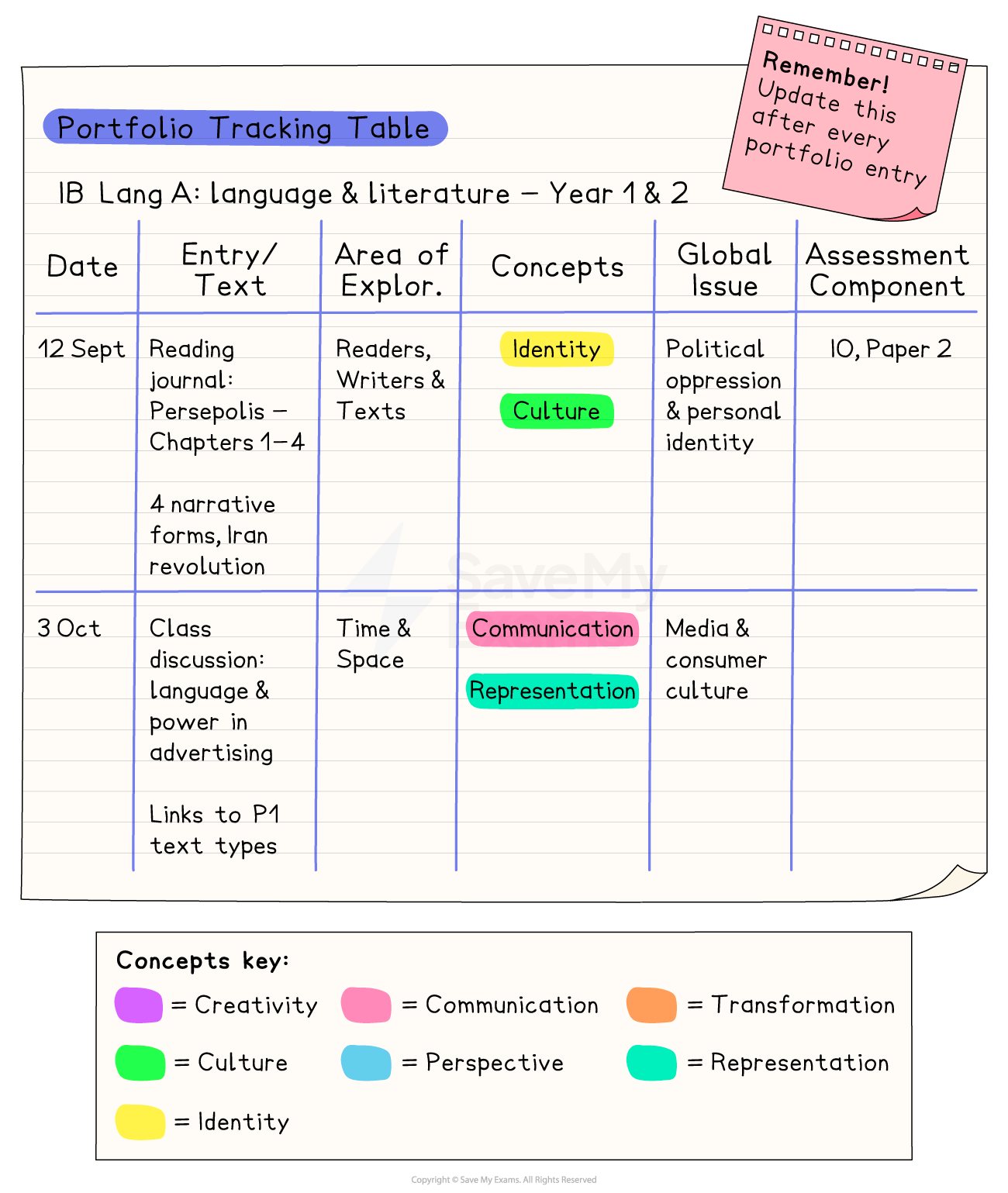
If you are keeping a digital portfolio, you can assign tags to each entry for the relevant area of exploration, concepts, global issues and assessment components. For example, in OneNote you can filter all entries by a single tag. This effectively gives you a thematic view on top of your chronological structure.
Thematic structure
A thematic structure may organise entries by the Areas of Exploration (AoEs), by the seven central concepts, by the texts studied or by assessment component. This makes connections more obvious and can be useful especially for preparing for Paper 2 or the Individual Oral. However, this does require more organisation from the start. A thematic portfolio is easy to use for making links between texts, but it can be difficult to maintain.
You may choose to use the seven central concepts — identity, culture, creativity, communication, perspective, transformation and representation — as your primary organising principle, with the AoEs and individual texts as secondary layers within each section. For example:
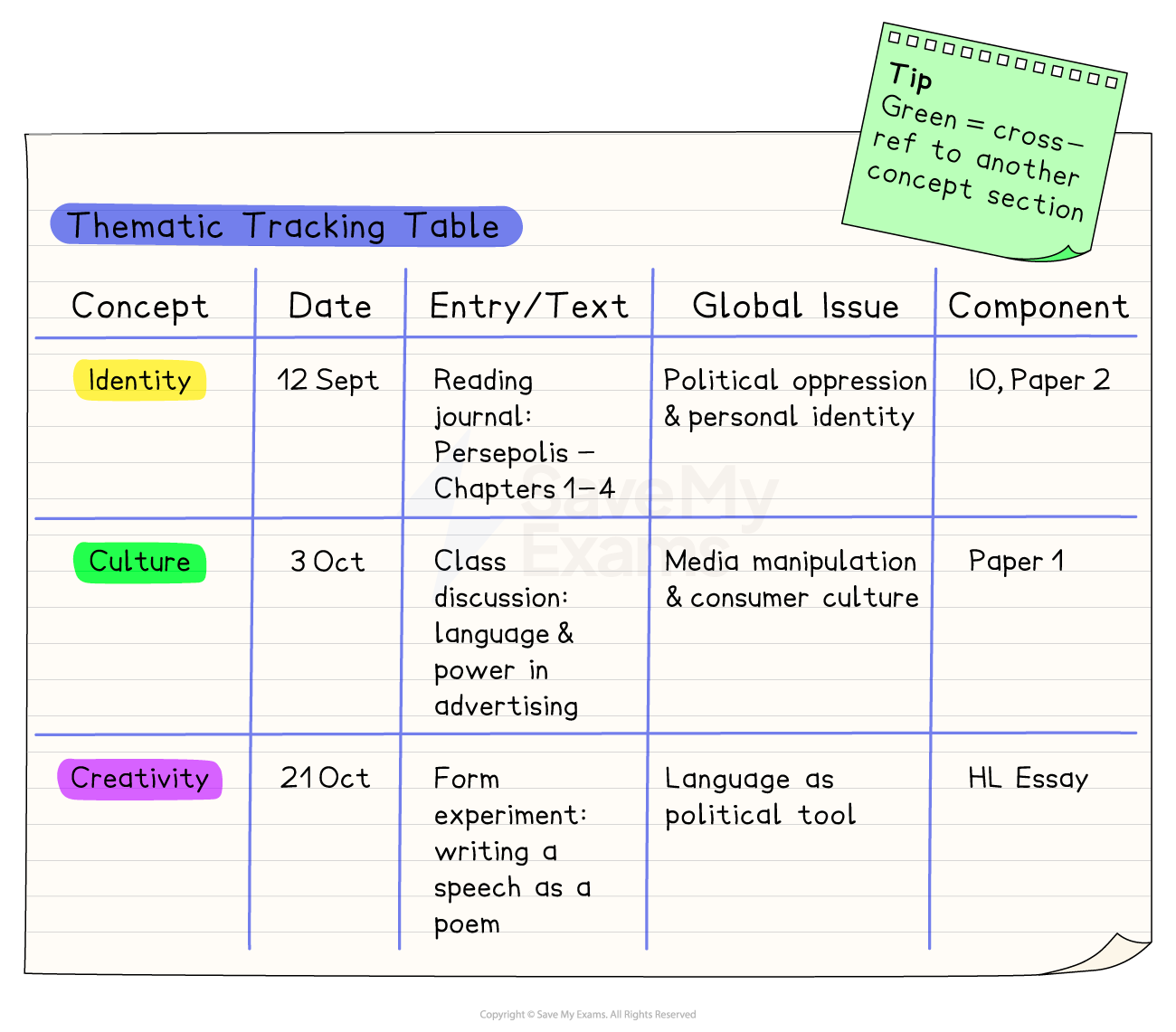
Again, a simple running log at the start or end of your portfolio will help you add to and organise your thematic portfolio over time.
You are, of course, not just limited to these two organising structures. You can also arrange your portfolio by text, assessment component, AoE or a combination of these. Ultimately, the IB recommends deciding early on a structure that works best for your learning style and keeping it consistent.
Sections to include
Whatever structure you choose, a well-organised Learner Portfolio should contain the following:
A contents page or index:
A clear index demonstrates that you have engaged actively with the process and organised your portfolio deliberately
Sections based on your primary organising principle:
You may choose to organise your portfolio chronologically, or by Areas of Explorations, by assessment component, by text, by the seven central concepts, or a combination of these
A section for text-specific responses:
You should be able to locate all your material on any given text quickly
A section for assessment preparation notes:
This would include draft ideas for your Individual Oral global issue, working notes and comparative thinking for Paper 2
The Works Studied form:
This must appear at the end of your portfolio and list all the works and texts engaged with during the course, showing how each connects to the assessment components
Format
The IB does not dictate what format your Learner Portfolio should be in: you have the option of digital or physical. Here are some advantages and disadvantages of each approach:
Format | Pros | Cons |
|---|---|---|
Digital |
|
|
Physical |
|
|
Ultimately, you have the freedom to choose between paper, digital software, or a blended format based on what works best for your own organisation and learning style. Whatever structure you choose, the important thing is that when you sit down to prepare for your assessed components, you are able to find what you need quickly.

Unlock more, it's free!
Join the 100,000+ Students that ❤️ Save My Exams
the (exam) results speak for themselves:

Was this revision note helpful?