Analysing Opinion Columns (DP IB English A: Language and Literature: SL): Revision Note

Analysing Opinion Columns
Paper 1 asks you to analyse unseen non-literary texts. A non-literary text broadly means a text that is not a novel, poetry, drama or literary non-fiction (such as a memoir). While you cannot predict what type of text will come up in the exam, it is a good idea to practise analysing common text types so that you are familiar with typical features and conventions of a variety of texts.
One type of text you may be asked to analyse is opinion columns.
Here we will cover these aspects of analysing opinion columns:
Overview of opinion columns
Opinion columns: genre norms
How to annotate opinion columns
Opinion columns: Paper 1 model answer
Overview of opinion columns
Opinion columns are written texts that aim to express an opinion and persuade an audience to agree with it.
In order to convincingly analyse an opinion column, you need to be able to make detailed, specific claims about what it is trying to do and why (see more in Approaching Unseen Non-Literary Texts: Purpose, Audience, Context).
Purpose
The purpose of an opinion column is the reason it was written and delivered. To effectively identify the purpose of the opinion column, ask yourself:
What is the writer trying to achieve?
What is the writer trying to make the audience feel/think/do?
While it seems logical to conclude that opinion columns express an opinion, other possible purposes to consider include:
Raising awareness of an issue
Prompting a reaction or emotion from the reader
Persuading
Calling to action
Proposing a solution or change
Audience
The intended audience of an opinion column is who the text is targeted at and who it was made for. To effectively identify the intended audience of the opinion column, ask yourself:
Who is the text aimed at?
What type of person would notice/pay attention to/be interested in/be impacted by the opinion column?
Consider age, gender, demographics, interests, lifestyle, values, concerns
Where is it published?
Opinion columns often appear in newspapers, so the readership of the newspaper is likely the readership of the opinion column
Context
The context is the facts of time and place that influence how and why an opinion column was written. To effectively identify the context, ask yourself:
When was the opinion column written?
Where was the opinion column published?
What economic/political/cultural/social factors influence why the opinion column was written and how it might be received (i.e., the context of production and the context of reception)?
Examiner Tips and Tricks
Honing the skill of identifying specific purposes, audiences and contexts can help you score well on multiple criteria: Criterion D: Language, because you are using effective, accurate and precise vocabulary for textual analysis; Criterion A, because you are showing understanding of the text; and Criterion B, because you can make convincing analytical claims by evaluating how a specific textual feature allows the writer to achieve their specific purpose on a specific audience in a specific context.
Opinion columns: genre norms
Criterion B in Paper 1 assesses your ability to analyse how a text achieves a purpose or has an impact on the audience. While many textual features can be found across text types, some are specific to certain text types.
Here, we will examine some genre norms and techniques that are frequently found in opinion columns.
Examiner Tips and Tricks
Criterion D assesses your use of effective and appropriate language. One good way to do well in this is to use subject-specific vocabulary when naming textual features. However, overly using technical language without fully understanding its meaning is not effective. Use the list below to examine opinion columns and understand how they are constructed. Ensure you understand the terms and build a dictionary with definitions that make sense to you.
Opinion columns are comparable to speeches, but they are written rather than spoken. You need to be able to interpret how language is used to persuade.
Not all of these stylistic features are found in all opinion columns, but it is a good idea to look out for them as you begin to annotate and analyse speeches.
Clear perspective |
|
| |
A provocative headline |
|
| |
Tone |
|
| |
Inclusion |
|
Emotive language |
|
|
How to analyse opinion columns
Before you write an answer to any Paper 1 question, it is important that you select the best evidence from your source text. A great way to do this is to identify the focus of the guiding question, and then annotate your text with this focus in mind.
Here is an example of how you might annotate an opinion column in the exam:
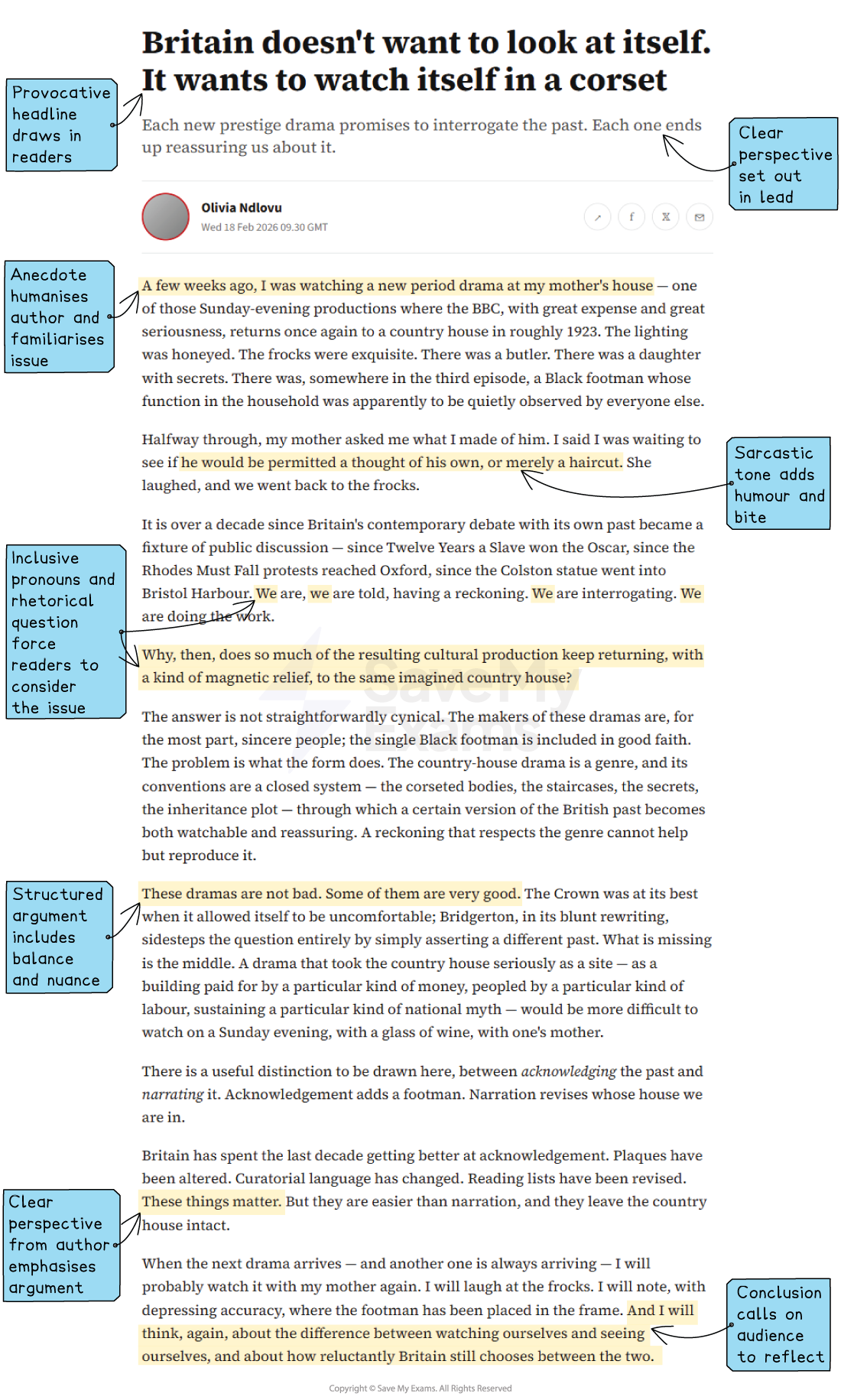
Opinion columns: Paper 1 model answer
Below is a top-mark answer to the following Paper 1 question on an opinion column. We’ve included where the answer has hit the assessment criteria to show you exactly why it would achieve full marks.
Source: Olivia Ndlovu column in The Sentinel, February 2026 Question: How and to what effect is tone used to express the writer's opinion in this column? |
Olivia Ndlovu’s 2026 opinion column questions the depiction of race in British period dramas. With a well-structured argument that gently prods the reader, she asks the audience to reflect on our easy feelings of comfort versus a necessary reflection and acknowledgement.
The provocative headline uses humorous synecdoche to draw the reader’s eye. The image of Britain in a corset is a light way to hint at Ndlovu’s collective accusation that Britain refuses to look at history (and the present) with honesty. The subheading clarifies her clear perspective with further juxtaposition of “interrogates” and “reassuring”, and the inclusive “we” involves the reader in this choice of comfort over truth.
Ndlovu uses anecdotes of watching these TV shows with her mother. She sets up the scene with familiar imagery and the tropes of these shows, so the reader is easily aligned with her. She then jarringly shifts to a sarcastic tone about wondering if the Black footman “would be permitted a thought of his own, or merely a haircut”. The reader laughs, but squirms at the realisation that they too have mindlessly enjoyed “the frocks” and perhaps not queried the perpetuation of racial stereotyping in contemporary popular culture.
Alluding to broader social and political conversations about race in Britain, Ndlovu cleverly situates the argument within the “more serious” spheres of debate. Again, she includes the collective Britain in these allusions with the echo of the defensive “We are interrogating. We are doing the work”. And, again, she poses an uncomfortable question: “Why, then, does so much of the resulting cultural production keep returning, with a kind of magnetic relief, to the same imagined country house?”
Ndlovu then makes a structured argument about the role of the arts to use genre norms while also prompting change and reflection in the audience. She alludes to well-known examples of shows and societal changes to query the ease with which some aspects change, and some we prefer to keep the same. Her clear perspective acknowledges her own role in watching with comfort but makes a plea for honest reflection and braver acknowledgement.

Unlock more, it's free!
Join the 100,000+ Students that ❤️ Save My Exams
the (exam) results speak for themselves:

Was this revision note helpful?