Ripple Tank (Cambridge (CIE) IGCSE Physics): Revision Note
Exam code: 0625 & 0972

Investigating waves with a ripple tank
Ripple tanks are commonly used in experiments to demonstrate the following properties of water waves:
Reflection at a plane surface
Refraction due to a change in speed caused by a change in depth
Diffraction due to a gap
Diffraction due to an edge
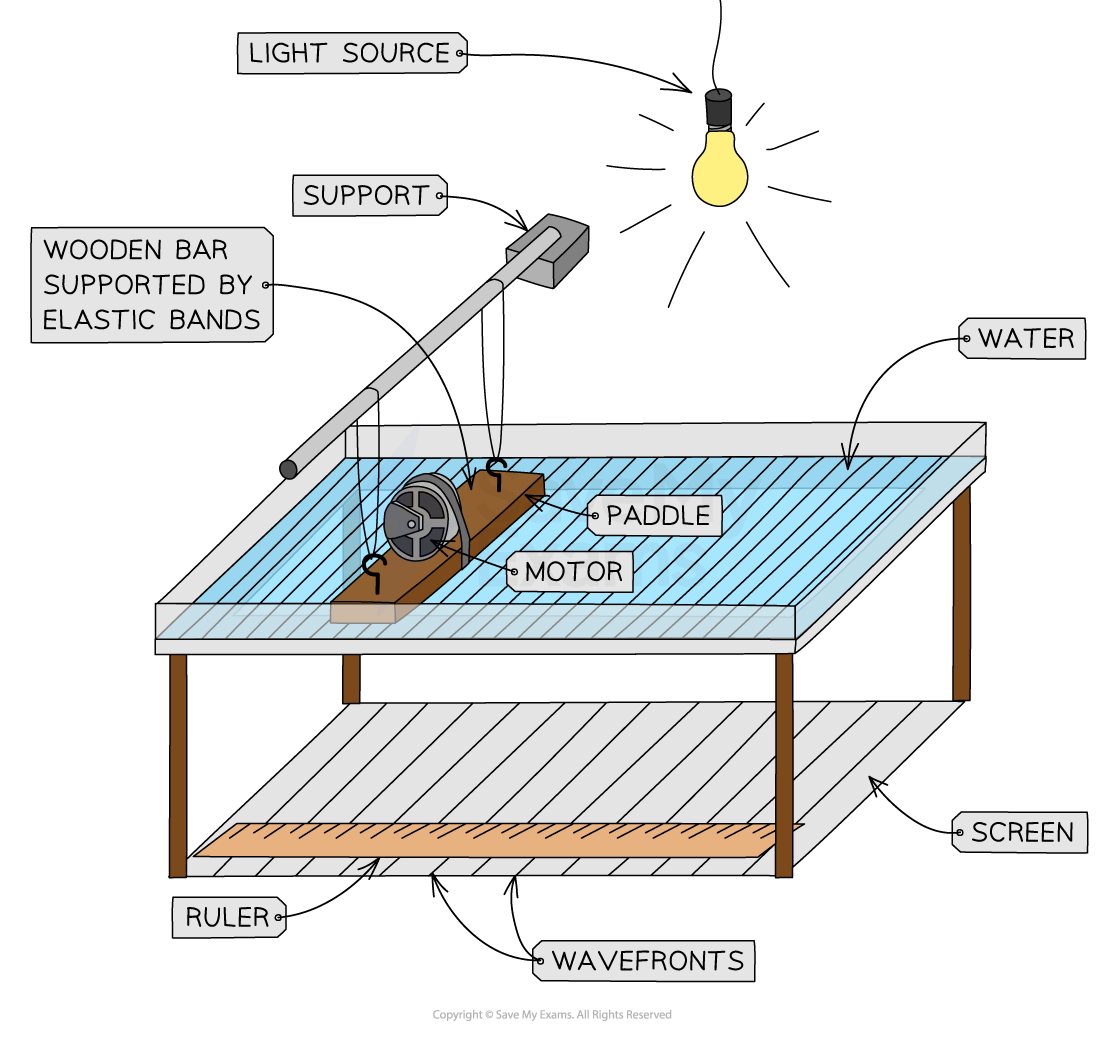
Reflection, refraction and diffraction can be demonstrated using a ripple tank
A lamp above the tank shines through the water, projecting the wavefronts onto a screen below the tank, where they can be viewed and analysed
Investigating reflection
Wavefronts are reflected off a metal bar (plane surface) placed in the water of the ripple tank
When the bar is placed at an angle, the wavefronts generated by the paddle reflect according to the law of reflection, which states that:
Angle of incidence (i) = Angle of reflection (r)
Diagram of reflected wavefronts in a ripple tank

Wavefronts reflect off the barrier so that the angle of reflection equals the angle of incidence
Reflected wavefronts in a ripple tank

In this arrangement, the barrier is at 45° to the incident wavefronts, so the incident and reflected wavefronts meet at right angles
Investigating refraction
Refraction can be shown by placing a glass block in the tank
The glass block should sit below the surface of the water and cover only some of the tank floor
The depth of water becomes shallower where the glass block is placed
Since speed depends on depth, the ripples slow down when travelling over the block
The water surface waves slow down when passing from deep to shallow water in the ripple tank
The wavelength also becomes shorter in the shallow water, while the frequency stays the same
Refracted wavefronts in a ripple tank

When water waves travel from deep areas to shallow areas they slow down
Investigating diffraction
Diffraction can be shown in a ripple tank by placing small barriers with a gap or an edge in the tank
The amount of diffraction that occurs can be changed by changing the wavelength of the waves compared to the gap size
Diffraction at the edge of a single barrier shows waves curving around the edge into the region behind it
The longer the wavelength, the more the waves bend around the edge
Changing the gap size for diffraction in a ripple tank

When the gap size is bigger than the wavelength, less diffraction occurs and the waves spread out less after passing through
Changing the wavelength of waves in the ripple tank
The motor creates the up-and-down movement of the paddle
The frequency of the motor affects the wavelength of the waves generated by the paddle
The diagram below shows how the wavelengths differ with frequency in a ripple tank
The higher the frequency of the motor, the shorter the wavelength
The lower the frequency of the motor, the longer the wavelength
Wavelength and frequency of waves in a ripple tank

Ripple tank patterns for low and high-frequency vibration
Examiner Tips and Tricks
If the wavefronts change direction at a boundary where the depth changes, the effect is refraction. Diffraction happens at a gap or an edge, not at a change of depth.

Unlock more, it's free!
Join the 100,000+ Students that ❤️ Save My Exams
the (exam) results speak for themselves:

Was this revision note helpful?
Build on this topic