Circular Motion (College Board AP® Physics 1: Algebra-Based): Exam Questions

1 hour24 questions
1a
Sme Calculator
2 marks

State the properties of an object required to travel in uniform circular motion.

1b
Sme Calculator
2 marks

i) Define the term period.

ii) State the equation linking period and frequency.

1c
Sme Calculator
2 marks

Describe the direction of linear speed in terms of the motion of an object in circular motion.

1d
Sme Calculator
4 marks

State the equation linking constant linear speed and the period of an object in uniform circular motion and define the variables.

2a
Sme Calculator
3 marks

i) State the direction of the centripetal acceleration for an object in uniform circular motion.

ii) State the direction of the centripetal force that produces the centripetal acceleration. Justify your reasoning.

2b
Sme Calculator
4 marks

Centripetal forces can arise from a single force exerted on an object. State the force creating the centripetal acceleration in the scenarios below.

i) A ball attached to the end of a string is rotated in horizontal circular motion.

ii) A satellite is in a uniform circular orbit about the Earth.

iii) A car is traveling around a corner on a banked road and maintains contact with the surface.

iv) An electron maintains its orbit around a nucleus.

2c
Sme Calculator
4 marks

Centripetal forces can arise from multiple forces exerted on an object. Identify the forces creating the centripetal acceleration in the scenarios below.

i) A ball attached to the end of a string is rotated in a vertical circular motion.

ii) A rollercoaster carriage performing a loop, the loop in a vertical circle on a track.

2d
Sme Calculator
2 marks

Describe both quantitatively and qualitatively the relationship between centripetal acceleration, linear speed and the radius of the circular path travelled by an object.

3a
Sme Calculator
2 marks

Define tangential acceleration.

3b
Sme Calculator
5 marks

i) Define the term instantaneous speed.

ii) State the equation needed to find an object's change in speed, and define the variables.

3c
Sme Calculator
5 marks

i) Define the term net acceleration for an object moving in a circle.

ii) State the equation needed to find the net acceleration of an object moving in a circular path, and define the variables.

3d
Sme Calculator
2 marks
Diagram of a circle with labelled points A, B, C. Vectors v1 and v2 are tangential; radius r, arc ∆s, and chord ∆r connect the points.

Figure 1

The diagram in Figure 1 shows an object in uniform circular motion rotating about a fixed point A.

Draw a vector triangle to show the change in speed of the object as it moves from point B to point C.

1a
Sme Calculator
2 marks

A small object of mass m is attached to a string of variable length L and set into conical pendulum motion, where the object moves in a horizontal circular path while the string traces out a cone. A group of students is asked to verify the relationship between the angular velocity \omega of the object and the angle \theta the string makes with the vertical.

i) Indicate quantities that could be measured by the students that would allow them to verify the relationship between the angular velocity of the object and the angle of the string, using a linear graph.

ii) Briefly describe a method to reduce experimental uncertainty for the measured quantities.

1b
Sme Calculator
2 marks

i) Indicate what quantities students could plot on the horizontal and vertical axes to create a linear graph that can be used to verify the relationship between the angular velocity of the object and the angle of the string.

ii) Briefly describe how the graph could be analyzed to verify the predicted relationship \omega = \sqrt{\frac{g}{L \text{cos}\textrm{ } \theta}}.

2
2 marks

A small object of mass m is attached to a string of variable length L and set into a conical pendulum motion, where the object moves in a horizontal circular path while the string traces out a cone. The system allows for adjustment of the string length L and measurement of the angular velocity omega of the object.

If the length of the string is increased, indicate whether the linear velocity of the mass increases, decreases, or remains constant. Justify your reasoning.

3a
Sme Calculator
4 marks

A student investigates the forces acting on the pendulum bob as it moves in a vertical circle. The student uses a pendulum bob of mass m space equals space 0.15 space kg and a string of unknown length L. A force sensor is used to measure the tension T in the string, and a motion sensor is used to measure the speed v of the bob as it passes through the lowest point of the swing. The recorded data is shown in Table 1.

Table 1

Velocity, v (m/s)

Tension, T (N)

1.0

2.4

1.5

3.9

2.0

5.4

2.5

7.9

3.0

10.4

The student correctly determines that the relationship between T and v at the lowest point is given by:

T space minus space m g space equals space fraction numerator m v squared over denominator L end fraction

The student wants to determine an experimental value for the length L of the string.

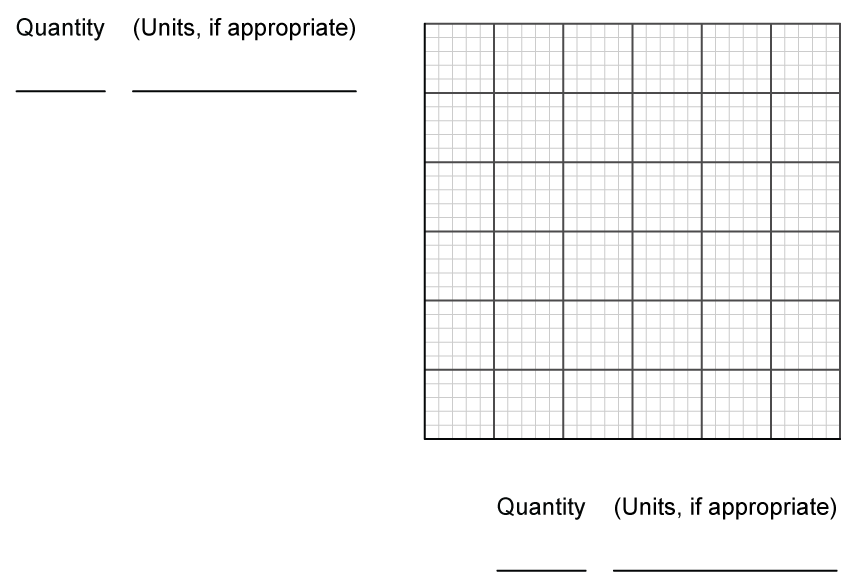
i) Label the axes of Figure 1 with measured or calculated quantities. Include units, as appropriate. The graphed quantities should yield a linear graph that can be used to determine L.

ii) On the grid provided in Figure 1, create a graph of the quantities indicated in part a)i).

  • Clearly label the horizontal and vertical axes with numerical scales.

  • Plot the corresponding data points on the grid

  • Any columns added to Table 1 for scratch work will not be scored.

Blank graph with spaces for "Quantity" and "Units (if appropriate)" labelled on both axes.

Figure 1

iii) Draw a best fit line for the data plotted in part a)ii).

3b
Sme Calculator
2 marks

Calculate an experimental value for the length of the string using the best-fit line that you drew in part a)iii).

4a
Sme Calculator
4 marks
A spacecraft orbiting the Earth in a circular path of radius R from the Earth's center.

Figure 1

A spacecraft of mass m is in a clockwise circular orbit of radius R around Earth, as shown in Figure 1. The mass of Earth is M_{E}.

Express your answers for i) and ii) in terms of m, M_{E}, R and physical constants as appropriate. In each case, begin your derivation by writing a fundamental physics principle or an equation from the reference information.

i) Derive an equation for the orbital speed v of the spacecraft.

ii) Derive an equation for the orbital period T of the spacecraft.

4b
Sme Calculator
3 marks

A second spacecraft of mass 2 m is placed in a circular orbit with the same radius R.

Indicate whether the orbital period of the second spacecraft is greater than, less than, or equal to the orbital period of the first spacecraft by writing one of the following:

  • T_{2} > T_{1}

  • T_{2} = T_{1}

  • T_{2} < T_{1}

Justify your reasoning.

1a
Sme Calculator
3 marks
Diagram of a circular path for an object moving counterclockwise. Point A is marked at the bottom of the circle and Point B is marked at 30 degrees above the horizontal.

Figure 1

A ball of mass m is attached to a rope of length L and swings with constant speed v in a vertical circle, as shown in Figure 1. At Point A, the ball passes the lowest point in its path, and at Point B, it makes an angle of 30 degree with the horizontal. The magnitude of the tension in the rope at Point B is equal to three-quarters of the magnitude of the tension in the rope at Point A.

Starting with Newton's second law, derive an expression for the tension in the rope as the ball passes Point A. Express your answer in terms of v, m, L, and physical constants as appropriate. Begin your derivation by writing a fundamental physics principle or an equation from the reference information.

1b
Sme Calculator
2 marks

Determine an expression for the speed v of the ball in terms of L and physical constants as appropriate.

2a
Sme Calculator
3 marks

A car of mass m travels around a banked curve of radius r at a speed slower than the ideal speed of v_{i d e a l}for the given banking angle. The coefficient of static friction between the tires and the road is to be determined.

Starting from Newton's second law, derive an expression for the ideal banking angle required for the car to stay on the curve without friction at the ideal speed.

2b
Sme Calculator
3 marks

The car is moving at speed vwhich is slower than the ideal speed.

Derive an expression for the minimum coefficient of static friction required to prevent sliding.

2c
Sme Calculator
2 marks

The speed of the car is increased beyond the ideal value.

Indicate the direction of the frictional force acting on the car by writing one of the following:

  • up the incline

  • down the incline

  • perpendicular to the incline

Justify your reasoning.