Vectors & Motion (College Board AP® Physics 1: Algebra-Based): Exam Questions

1 hour24 questions
1a
Sme Calculator
2 marks

Describe the process for analyzing motion in two dimensions.

1b
Sme Calculator
2 marks

A projectile is launched at an angle theta​ with initial speed v subscript 0​.

Determine an expression for the horizontal and vertical velocity components of the projectile just before it strikes the ground.

2a
Sme Calculator
2 marks

A soccer player kicks a ball from the ground with an initial speed v subscript 0​ at an angle theta above the horizontal.

Derive an expression for the time the ball remains in the air in terms of v subscript 0, theta and physical constants, as appropriate. Begin your derivation by writing a fundamental physics principle or an equation from the reference book.

2b
Sme Calculator
2 marks

Determine an expression for the maximum height, h subscript m a x end subscript, of the soccer ball in terms of v subscript 0, theta subscript 0 and g.

2c
2 marks

Determine an expression for the range, R, of the soccer ball in terms of v subscript 0, theta subscript 0 and g.

2d
Sme Calculator
2 marks

The soccer player kicks the ball again with the same initial speed v subscript 0, but at different angles. The first kick has an angle of 30 degree to the ground. The second kick has an angle of 60 degree to the ground.

Indicate whether the horizontal range of the second kick R subscript 2is less than, equal to, or greater than the range of the first kick R subscript 1.

⎽⎽⎽⎽⎽⎽⎽⎽⎽⎽ R subscript 2 space less than space R subscript 1 ⎽⎽⎽⎽⎽⎽⎽⎽⎽⎽ R subscript 2 space equals space R subscript 1 ⎽⎽⎽⎽⎽⎽⎽⎽⎽⎽ R subscript 2 space greater than space R subscript 1

Justify your reasoning.

3a
Sme Calculator
4 marks

A cyclist is moving at an initial velocity of 10.0 space straight m divided by straight s at an angle of 25 degree above the horizontal on a sloped path. The cyclist maintains this motion for 5 space straight s.

Determine the horizontal and vertical displacement of the cyclist during this time.

3b
Sme Calculator
3 marks

Identify whether the cyclist is riding uphill or downhill. Justify your reasoning.

4a
4 marks
Diagram of an inclined line intersecting a horizontal line, forming an angle θ. An arrow on the inclined line indicates velocity v.

Figure 1

Figure 1 shows the final velocity of a projectile as it strikes its target. The initial horizontal velocity of the projectile is 3.5 space straight m divided by straight s.

Identify whether the final horizontal velocity of the projectile is less than, equal to, or greater than 3.5 space straight m divided by straight s.

⎽⎽⎽⎽⎽⎽⎽⎽⎽⎽ v subscript x space less than space 3.5 space straight m divided by straight s‎ ‎ ‎ ‎ ‎ ‎ ‎ ‎ ‎ ‎ ⎽⎽⎽⎽⎽⎽⎽⎽⎽⎽ v subscript x space equals space 3.5 space straight m divided by straight s ‎ ‎ ‎‎ ‎ ‎ ‎ ‎ ‎ ‎ ⎽⎽⎽⎽⎽⎽⎽⎽⎽⎽ v subscript x space greater than space 3.5 space straight m divided by straight s

Justify your reasoning.

4b
Sme Calculator
1 mark

The vertical component of the final velocity is 3.8 space straight m divided by straight s. Determine the magnitude of the final velocity of the projectile.

4c
Sme Calculator
2 marks

The horizontal distance between the launch position and the target is 27 space straight m.

Calculate the time taken for the projectile to reach the target. 

5a
Sme Calculator
1 mark

Define the term projectile.

5b
Sme Calculator
1 mark

State two conditions that must be met for an object to undergo projectile motion.

5c
1 mark

Name the only force acting on an object in projectile motion.

5d
Sme Calculator
2 marks

Define the following key terms for projectile motion:

i) Time of flight

ii) Range

1a
Sme Calculator
1 mark
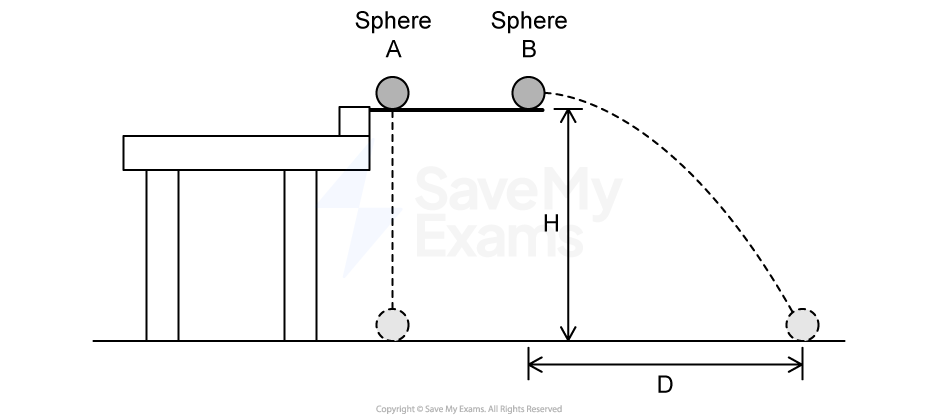
Diagram showing two spheres; sphere A drops vertically, sphere B rolls and falls off the end of the table, travelling a horizontal distance D while descending height H.

Figure 1

Two identical spheres are released from a device at time t space equals space 0 from the same height H, as shown above. The device is shown in Figure 1.

Sphere A has no initial velocity and falls straight down. Sphere B is given an initial horizontal velocity of magnitude v subscript 0 and travels a horizontal distance D before it reaches the ground. The spheres reach the ground at the same time t subscript f, even though Sphere B has more distance to cover before landing. Air resistance is negligible.

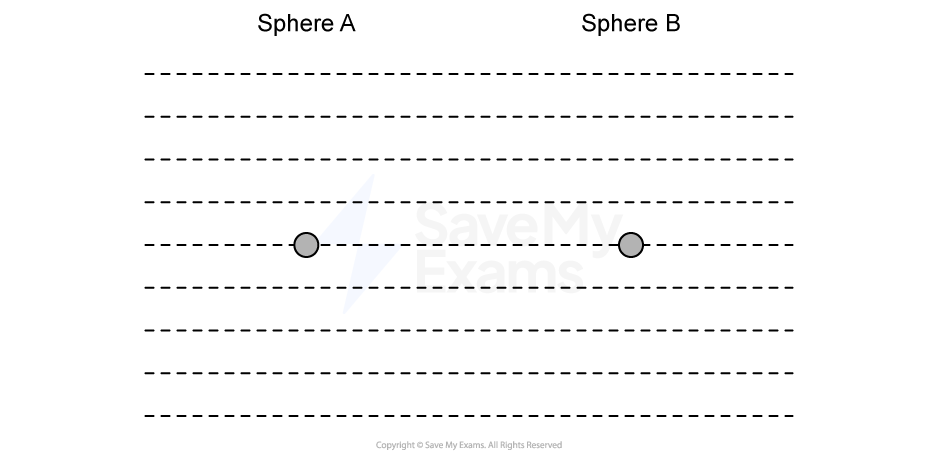
The dots in Figure 2 represent Spheres A and B. Draw a free-body diagram showing and labeling the forces (not components) exerted on each sphere at time t subscript f over 2 .

Spheres, A and B, each represented by a black dot.

Figure 2

1b
Sme Calculator
2 marks

Derive an expression for the total time of flight of each sphere, in terms of H and physical constants as appropriate. Begin your derivation by writing a fundamental physics principle or an equation from the reference book.

1c
Sme Calculator
1 mark

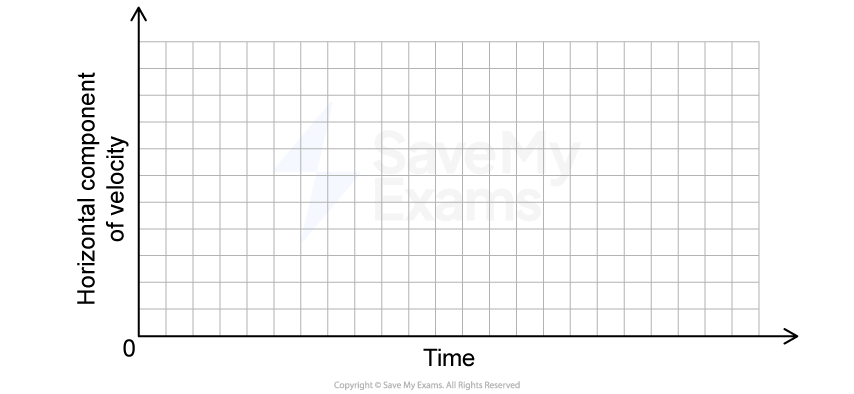
On the axes in Figure 3, sketch and label a graph of the horizontal component of the velocity of Sphere A and of Sphere B as a function of time.

Graph with horizontal axis labelled "Time" and vertical axis labelled "Horizontal Component of Velocity." Grid with dashed lines on grey background.

Figure 3

1d
Sme Calculator
4 marks

Justify whether your answers to part b) and part c) support the finding that the spheres reach the ground at the same time, even though they travel different distances.

2
Sme Calculator
3 marks
A ball launched at angle φ with initial velocity v0 towards a pendulum. The pendulum hangs from length L and swings up by angle θ after the collision with the ball.

Figure 1

A clay ball of mass m is launched at an angle ϕ above the horizontal with initial speed v subscript 0. At the moment it reaches the highest point in its trajectory and is moving horizontally, it collides with and sticks to a wooden block of mass M, as shown in Figure 1. The block is suspended from a light string of length L. The block and the clay then swing up to a maximum height h subscript 0 above the block’s initial position and make an angle theta with the vertical.

On the axes provided in Figure 2 sketch and label graphs of the horizontal and vertical components of the velocity of the clay ball as a function of time from the time the ball is launched to the time it strikes the block.

Two blank graphs axes; left is horizontal component of velocity as a function of time, right is vertical component of velocity as a function of time.

Figure 2

1
Sme Calculator
5 marks

A projectile is fired from level ground with speed v subscript 0 at an angle theta space greater than space 45 degree to the ground. The projectile is fired from a few centimeters before position x subscript 1, reaches its maximum height at position x subscript 2, and lands on the ground at position x subscript 3. end subscript.

i) Derive an expression for the maximum height of the projectile in terms of v subscript 0, g, theta and physical constants as appropriate. Begin your derivation by writing a fundamental physics principle or an equation from the reference book.

ii) Determine an expression for the mass of the projectile in terms of maximum gravitational potential energy U subscript g m a x end subscript, v subscript 0, theta and physical constants as appropriate.

2a
Sme Calculator
5 marks
Stunt motorcyclist jumps over five cars, launching from a ramp with initial height \(H_0\) and angle \(\theta_0\), covering horizontal distance \(X_0\).

Figure 1

A stunt cyclist builds a ramp that will allow the cyclist to coast down the ramp and jump over several parked cars, as shown above. To test the ramp, the cyclist starts from rest at the top of the ramp, then leaves the ramp, jumps over six cars, and lands on a second ramp.

Figure 1 shows the vertical distance between the top of the first ramp and the launch point, H_{0}, and the angle of the ramp at the launch point, \theta_{0}, as measured from the horizontal. The cyclist travels a horizontal distance of X_{0} whilst the cyclist and bicycle are in the air. The combined mass of the stunt cyclist and bicycle is m_{0}.

i) Starting with conservation of energy, determine an expression for the speed of the cyclist as they leave the ramp in terms of H_{0} and physical constants as appropriate.

ii) Starting with a kinematic equation, derive an expression for the distance travelled, X_{0} in terms of H_{0}, \theta_{0}, and physical constants as appropriate. Begin your derivation by writing a fundamental physics principle or an equation from the reference booklet.

2b
Sme Calculator
3 marks

In experiment 2, the ramp is modified so that the cyclist now starts from a height of 2 H_{0}.

Indicate whether the horizontal distance covered by the stunt cyclist in experiment 2, X_{n e w}, will be less than, equal to, or greater than X_{0} by writing one of the following:

  • X_{n e w} < X_{0}

  • X_{n e w} = X_{0}

  • X_{n e w} > X_{0}

Justify your reasoning. In your justification, include qualitative reasoning beyond mathematical derivations or expressions.