Angular Momentum & Angular Impulse (College Board AP® Physics 1: Algebra-Based): Exam Questions

43 mins20 questions
1
Sme Calculator
1 point

Identical net torques act for the same duration on two solid disks of different rotational inertia.

Which of the following correctly describes the change in angular momentum of the disks?

  • The change in angular momentum will be greater for the disk with the smaller rotational inertia.

  • The change in angular momentum will be greater for the disk with the larger rotational inertia.

  • The change in angular momentum will be equal for both disks.

  • The change in angular momentum will be zero for both disks.

2
Sme Calculator
1 point
A wheel with a force F0 applied downwards to a point on its rim directly to the left of its center.

A wheel initially rotates about its center with a constant angular speed in the clockwise direction. A constant force F0 is exerted on the wheel, as shown in the figure.

Which of the following correctly describes the angular impulse on the wheel at the moment the force is applied?

  • The angular impulse is zero.

  • The angular impulse is in the clockwise direction.

  • The angular impulse is in the counterclockwise direction.

  • The direction of the angular impulse cannot be determined.

3
Sme Calculator
1 point
Graph showing torque in newton meters (N m) increasing linearly over time in seconds (s), from 2 N m at 0 s to 10 N m at 4 s.

The graph shows the torque exerted on an object as a function of time. The object is initially at rest and has a rotational inertia of 2.0 kg·m2.

Which of the following is most nearly the angular speed of the object at t = 4 s?

  • 4 rad/s

  • 8 rad/s

  • 12 rad/s

  • 14 rad/s

4
Sme Calculator
1 point

A solid disk of rotational inertia 0.5 kg·m2 spins with an angular momentum of 4 kg·m2/s. The disk experiences an angular impulse for a duration of 8 seconds which reduces its angular speed by half.

Which of the following is most nearly the net torque applied to the disk?

  • 0.25 N·m

  • 0.5 N·m

  • 1.0 N·m

  • 1.25 N·m

5
Sme Calculator
1 point
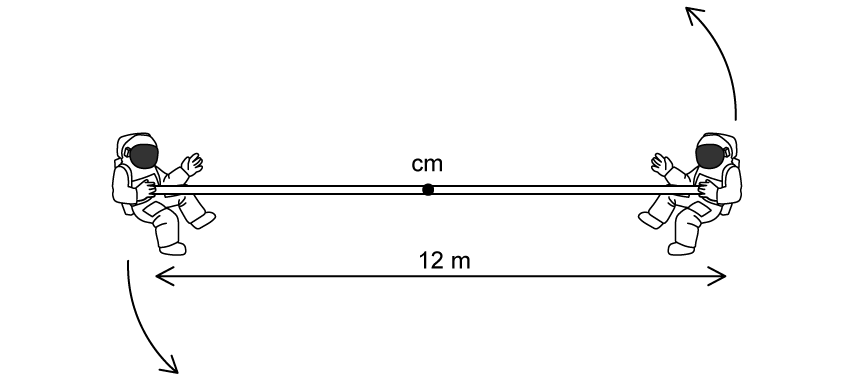
Diagram depicting two figures at the ends of a 12-meter rod, rotating around its center marked CM, with arrows indicating rotational direction.

Two astronauts each of mass 70 kg are connected by a 12 m rope of negligible mass. They are isolated in space, orbiting their center of mass at a speed of 4.0 m/s, as shown in the figure.

Which of the following is most nearly the magnitude of the angular momentum of the system?

  • 0

  • 1700 kg·m2/s

  • 3400 kg·m2/s

  • 6800 kg·m2/s

1
Sme Calculator
1 point
Diagram showing two green rectangular beams, labeled X and Y, rotating around vertical axes. The beam X has an inertia of 1/12 ML^2, and Y has 1/3 ML^2.

Two identical rods, X and Y, each of length L and mass M, are each made to rotate about different vertical axes, so they have different values of rotational inertia, as shown in the figure.

Which of the following expressions correctly relates the angular speeds of X and Y if they have equal angular momenta?

  • ωX = 14ωY

  • ωX = 12ωY

  • ωX = 2ωY

  • ωX = 4ωY

2
Sme Calculator
1 point
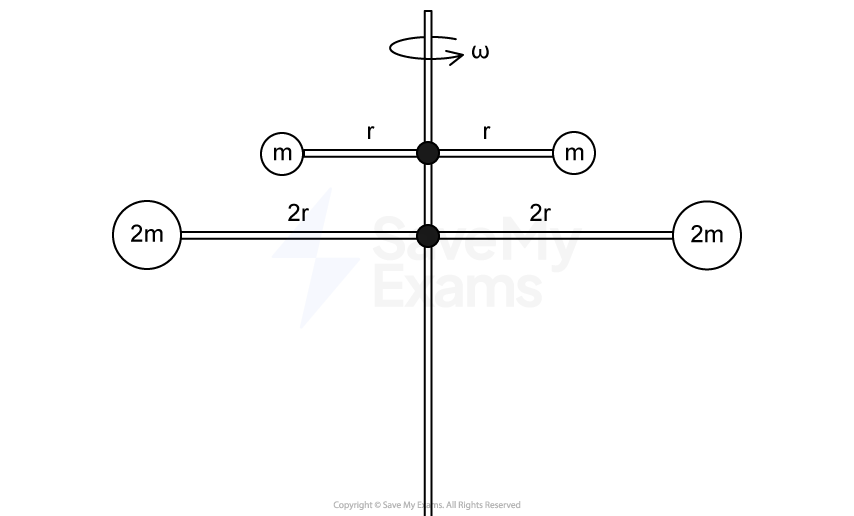
Diagram of a rotating system with four masses connected by rods. Two arms of length L with mass m at ends, and two perpendicular arms of length 2L with mass 2m at ends.

A rigid body consists of a vertical support post and two horizontal rods of negligible mass. Masses are attached to the ends of the horizontal rods, as shown in the figure. The body rotates about a vertical axis along the support post with constant angular speed ω.

What is the ratio of the angular momentum of the two upper spheres to that of the two lower spheres?

  • 18

  • 14

  • 12

  • 2

3
Sme Calculator
1 point

A constant force of 250 N is applied tangentially to the outer edge of a playground merry-go-round of radius 2.0 m to rotate it from rest. A frictional force of 50 N is exerted tangentially at a distance of 25 cm from the axis of rotation. The rotational inertia of the merry-go-round is 1500 kg·m2.

Which of the following is most nearly the angular speed of the merry-go-round if the force is applied for 5 seconds?

  • 0.17 rad/s

  • 0.33 rad/s

  • 1.3 rad/s

  • 1.6 rad/s

4
Sme Calculator
1 point
Graph showing torque (τ) in Newton-meters (N·m) versus time (t) in seconds (s). The torque rises linearly to 3 N·m from 0 to 2s, stays constant until 4s, then drops linearly to 0 by 5s.

A disk with a rotational inertia of 0.11 kg·m2 is mounted on a frictionless horizontal axle. The graph shows the torque applied to the outer rim of the disk as a function of time.

If the disk is initially at rest, what is the minimum time it takes for the disk to spin at a rate of 10 revolutions per second?

  • t = 2 s

  • t = 3 s

  • t = 4 s

  • t = 5 s

5
Sme Calculator
1 point
Graph showing angular momentum over time for two disks. Disk X (dashed line) increases from 0 to 20 kgm2/s in 10 seconds; Disk Y (solid lines) increases from 0 to 40 kgm2/s in 10 seconds.

Two disks, X and Y, each experience a net external torque that varies over an interval of 10 seconds. Disk Y has a rotational inertia that is twice that of Disk X. The graph shown represents the angular momentum L of the two disks as functions of time t between t = 0 and t = 10 s. The average magnitudes of the net torques exerted on disks X and Y from t = 0 to t = 10 s are τX and τY, respectively. At t = 10 s, the angular speeds of disks X and Y are ωX and ωY, respectively.

Which of the following expressions correctly relates the magnitudes of the average torques and the magnitudes of the final angular speeds?

Average Torques

Final Angular Speeds

A

τY = 12τX

ωX = ωY

B

τY = 12τX

ωX = 14ωY

C

τY = 2τX

ωX = ωY

D

τY = 2τX

ωX = 14ωY

    1
    Sme Calculator
    1 point
    Two torque-time graphs. Disk A: starts at 0, peaks at (τ0, t0/2), finishes at t0. Disk B: starts at 0, peaks at (2τ0, t0/4), finishes at t0/2.

    Two disks, A and B, rotate in opposite directions about fixed axles at their centers. The rotational inertia of Disk B is four times that of Disk A. Initially, Disk A has an angular velocity of ω0 and Disk B has an angular velocity of +ω0. At time t = 0 the disks experience net torques of varying magnitude. The graphs represent the net torques τ exerted on the two disks as functions of time t. From t = 0 to t = t02, the change in angular momenta of the disks are LA and LB, respectively. At t = t02, the angular speeds of disks A and B are ωA and ωB, respectively.

    If the final angular speed of Disk A is 3ω0, which of the following is true about the change in angular momenta of the disks and their final angular velocities at t = t02?

    • LA > LB and ωA < ωB

    • LA < LB and ωA > ωB

    • LA = LB and ωA = ωB

    • LA < LB and ωA = ωB

    2
    Sme Calculator
    1 point
    A horizontal rod of length L, pivoted at L/4 from the left end, with a string attached to the right end, extending vertically to a fixed point.

    A uniform rod of mass M = 2 kg and length L = 1 m is free to rotate about a frictionless pivot which is positioned L4 from its left end and held horizontally by a string of negligible mass at its right end, as shown in the figure. The rotational inertia of a rod about its center is 112ML2. The string is cut and releases the rod, allowing it to rotate about the pivot and swing down from the horizontal position.

    Which of the following is most nearly the angular momentum of the rod when it reaches a vertical position?

    • 0.6 kg·m2/s

    • 1.3 kg·m2/s

    • 1.7 kg·m2/s

    • 6.4 kg·m2/s

    3
    Sme Calculator
    1 point
    A pulley system consisting of a wheel with two perpendicular rods of length L through its center and a hanging mass M.

    A mass M is attached to a light cord wrapped around a wheel which is mounted to a frictionless axle at its center, as shown in the figure. The wheel consists of two uniform rods, each of length L and mass M, which are attached to a thin hoop of mass M. The rotational inertia of a rod about its center is 112ML2 and the rotational inertia of a thin hoop of radius R is MR2. The mass is released from rest.

    Which of the following expressions represents the angular momentum of the mass-wheel system after the wheel has turned through one revolution?

    • ML43πgL

    • 43MLπgL

    • ML83πgL

    • 83MLπgL

    4
    Sme Calculator
    1 point
    Graph showing braking torque versus angular position. Torque decreases linearly from 0 to -40 Nm at 20 rad, then remains constant -40 Nm until 60 rad, and increases linearly to 0 at 80 rad.

    A car wheel of rotational inertia 12mr2 = 1.5 kg·m2 is brought to rest by applying the brakes, which exert a frictional torque about the wheel's central axle. The graph shows the braking torque on the wheel as a function of angular position.

    Assuming the wheel does not slip, which of the following is most nearly the change in angular momentum of the wheel?

    • 40 kg·m2/s

    • 50 kg·m2/s

    • 60 kg·m2/s

    • 70 kg·m2/s

    5
    Sme Calculator
    1 point
    Diagram of two masses, 2m and m, connected by a rod of length L which rotates about an off-center axis with angular velocity ω0.

    A system consists of two objects, of masses mand 2m, connected by a rod of length L which has a negligible mass. The system is free to rotate about an axis twice as far away from mass m as it is from mass 2m, as shown in the figure. The system rotates with initial counterclockwise angular velocity ω0 and eventually comes to rest due to a frictional force between the objects and the surface, where the coefficient of friction is μ.

    Which of the following expressions represents the time taken for the system to come to rest?

    • 2ω0L5μg

    • ω0L2μg

    • 2ω0L3μg

    • 4ω0L3μg