Rolling (College Board AP® Physics 1: Algebra-Based): Study Guide

Total kinetic energy
The total kinetic energy of a system is the sum of translational and rotational kinetic energies:
total kinetic energy = translational kinetic energy + rotational kinetic energy
Where:
= mass of the object, in
= linear velocity, in
= rotational inertia, in
= angular velocity, in
When considering the mechanical energy of a system, the kinetic energy can be broken down into its translational and rotational components
Two special cases involving rotational kinetic energy are
rolling motion without slipping
rolling motion while slipping
Rolling without slipping
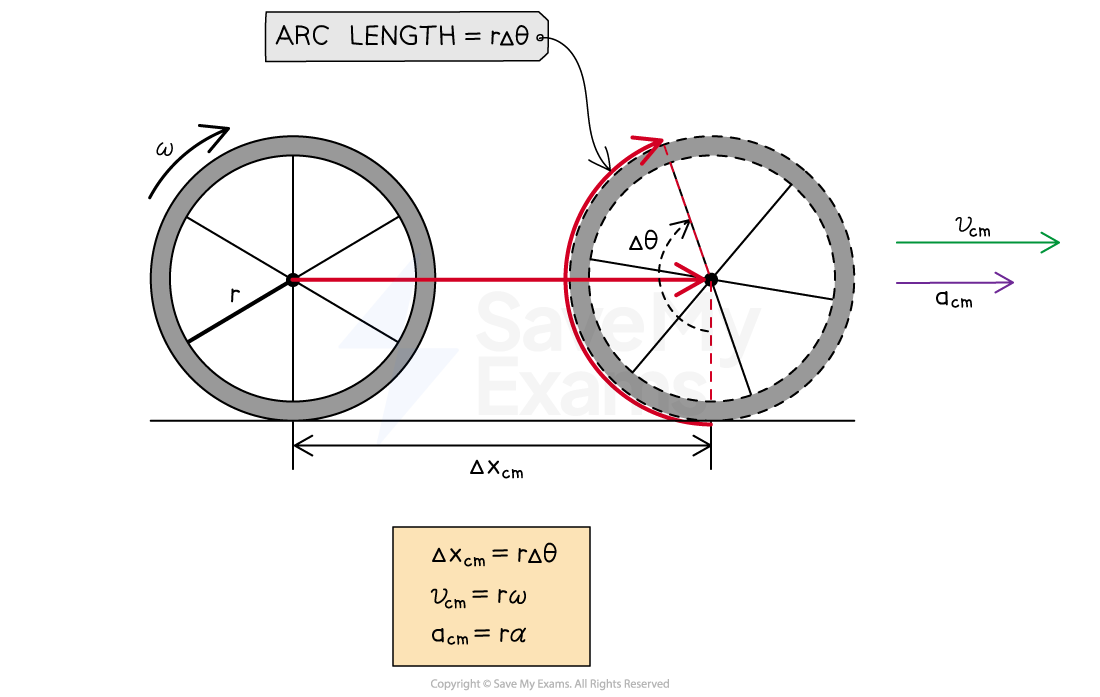
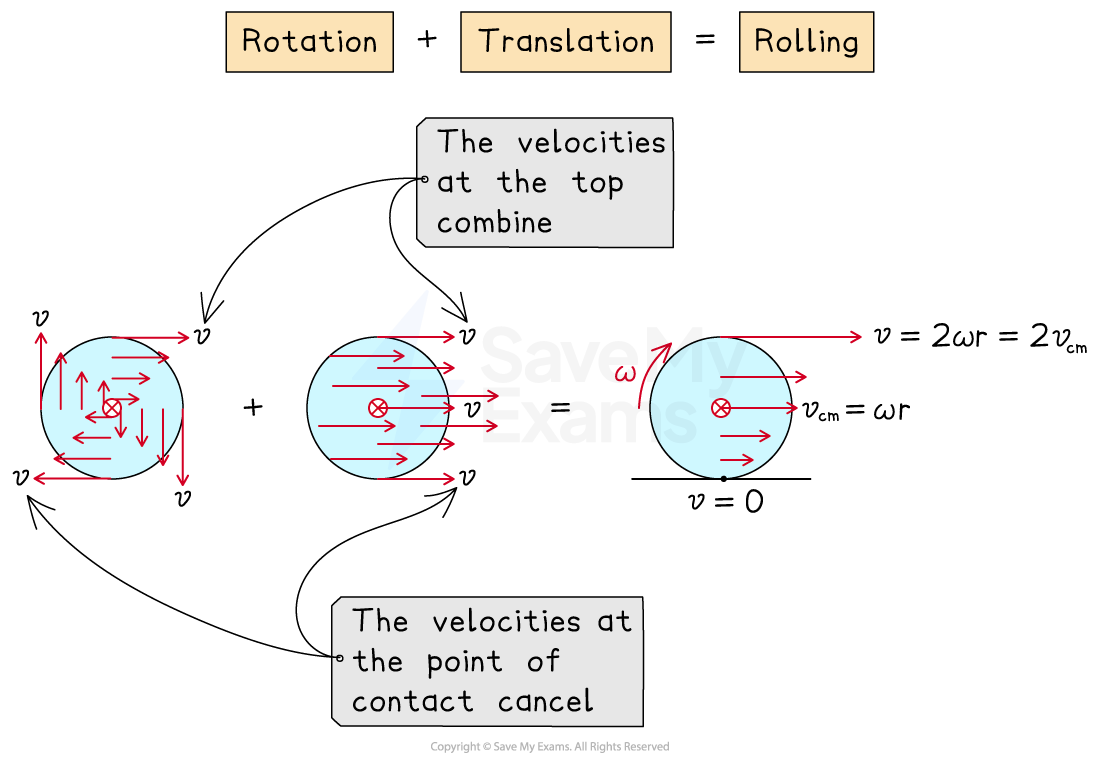
Rolling motion is a combination of rotating and sliding (translational) motion
When a circular rigid body (e.g. a ball, wheel, or cylinder) of radius rolls without slipping:
the translational motion of the system's center of mass is directly related to its rotational motion
the point of contact between the rotating body and the surface is at rest
The distance traveled by the system's center of mass is:
Where:
= translational distance moved by the object's center of mass, in
= angular displacement of the rolling object, in
The linear velocity of the system's center of mass is:
Where:
= translational velocity of the object's center of mass, in
= angular speed of the rolling object, in
The linear acceleration of the system's center of mass is:
Where:
= translational acceleration of the object's center of mass, in
= angular acceleration of the rolling object, in
These equations appear to be identical to the equations for fixed-axis rotation, but there are some key differences
For fixed axis rotation: , , and refer to the tangential quantities at a point on the object
For a rolling object: , , and refer to the translational quantities of the object's center of mass
Translational and rotational components of a rotating wheel
The role of friction in rolling without slipping
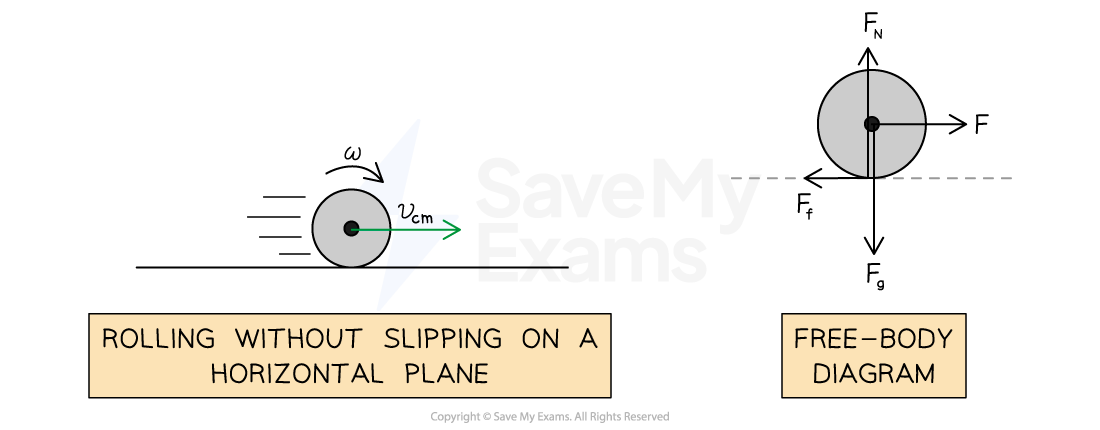
When an object rolls without slipping, static friction causes the rotation about the center of mass
This happens when there is no relative motion between the surface and the point of contact
The direction of the frictional force always acts to oppose the potential slipping motion
Static friction causing rolling on a horizontal plane
Static friction causing rolling on an inclined plane
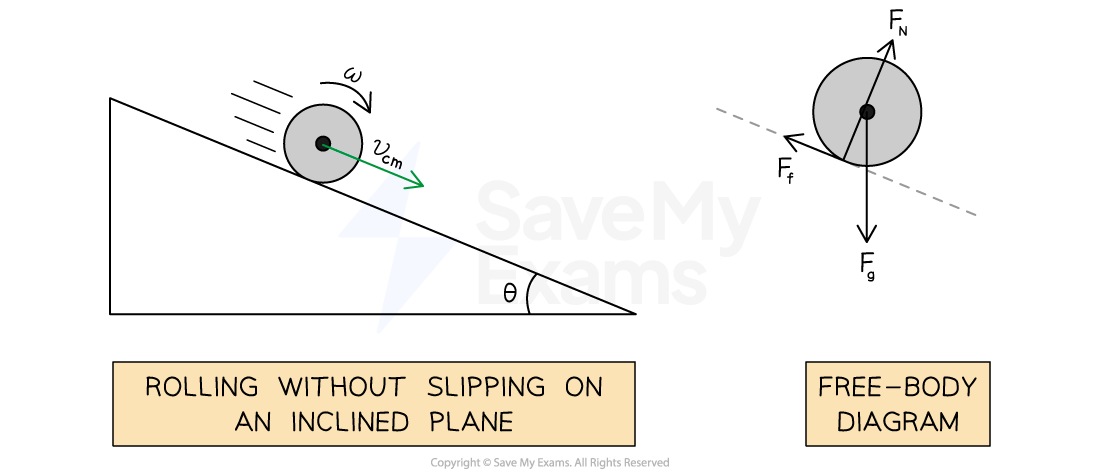
In the case of rolling motion without slipping:
no kinetic friction is present
only static friction is present
Since no work is done by static friction, no energy is dissipated when a system rolls without slipping
Rolling on a horizontal surface without slipping
When a disk rotates on a horizontal surface:
all points on the disk have a constant angular speed
each point on the disc has a different linear velocity depending on its distance from the center
the linear speed is the same at all points on the circumference
When a disk slips or slides on a horizontal surface:
there is not enough static friction present to allow the object to roll
all points on the disk have the same linear velocity
the angular velocity is zero
So, when a disk rolls without slipping:
there is enough static friction present to initiate rotational motion allowing the object to roll
the point in contact with the surface has a velocity of
the center of mass has a velocity of
the top point has a velocity of , or
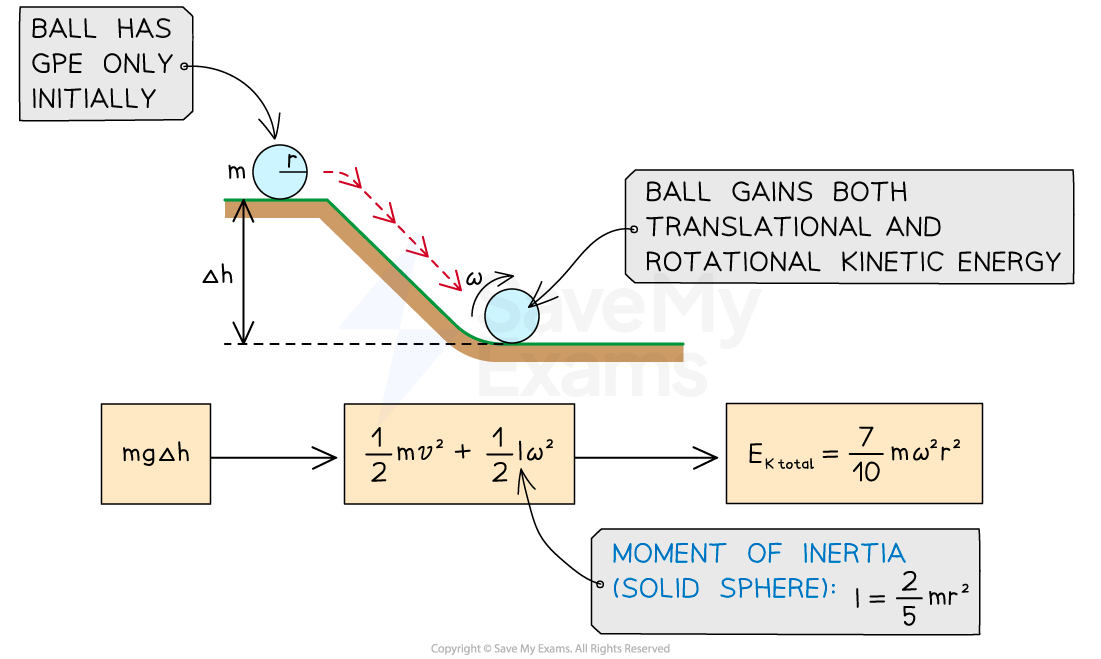
Rolling on an inclined plane without slipping
Another common scenario is a circular rigid body rolling on an inclined plane without slipping
Since the object rolls without slipping, no work is done by frictional forces
Therefore, the total mechanical energy of the system is conserved
At the top of the slope, the object has gravitational potential energy only (assuming it is initially at rest)
As the object rolls down the slope, the gravitational potential energy is transferred to kinetic energy
At the bottom of the slope, the object has both translational and rotational kinetic energy
The linear or angular velocity can then be determined by:
applying energy conservation laws
using the equation for the rotational inertia of the object
using the relationship between linear and angular velocity
Worked Example
A solid sphere of mass , radius , and rotational inertia is released from rest at the top of a ramp of height which makes an angle of with the horizontal. Throughout its motion, the sphere rolls without slipping.
(A) Derive an expression for the linear velocity of the center of mass of the sphere at the bottom of the inclined plane in terms of , , , and physical constants as appropriate.
(B) Derive an expression for the linear acceleration of the center of mass of the sphere in terms of , , , and physical constants as appropriate.
Answer:
Part (A)
Step 1: Analyse the scenario
When an object rolls down the ramp without slipping:
no work is done by kinetic friction
the total mechanical energy of the system is conserved
Therefore, the sphere's gravitational potential energy at the top of the ramp is completely transferred into kinetic energy at the bottom
The rolling motion indicates the total kinetic energy of the sphere consists of both translational and rotational components
Step 2: Apply energy conservation laws to the scenario
The total mechanical energy of the system is equal to:
Since , , and :
Step 3: Write expressions for and
At the top of the ramp, the gravitational potential energy of the stationary sphere is equal to:
At the bottom of the ramp, the total kinetic energy of the sphere is equal to:
Equate the expressions for and :
Substitute the expressions for rotational inertia and angular velocity into the equation:
Step 4: Write the final expression for
Part (B)
Step 1: Analyze the scenario
The forces acting on the sphere during its motion are:
the force of gravity acting directly downwards
the normal force acting up and perpendicular to the ramp
the force of static friction acting up and parallel to the ramp

The net torque exerted on the sphere's center of mass is due to the force of static friction only
This is because it is the only force which does not act directly through the sphere's center of mass
The net force exerted on the sphere's center of mass is proportional to its linear acceleration
Step 2: Write an expression for the frictional force acting on the sphere
Newton's second law in rotational form is given by:
The torque due to the frictional force is:
Substitute the expressions for rotational inertia and angular acceleration into the equation:
Therefore, the frictional force acting on the sphere is:
Step 3: Write an expression for the net force exerted on the sphere
The net force, and therefore, the linear acceleration of the sphere act down and parallel to the ramp
Newton's second law is given by:
Two forces act parallel to the ramp, in opposite directions, these are:
a component of the gravitational force (weight):
the frictional force
The net force on the sphere is therefore equal to:
Step 4: Write the final expression for
Examiner Tips and Tricks
The equation for translational displacement is given on your equation sheet, but the equations for and are not.
However, the equations for and have the same form as their tangential forms, and these are given on the equation sheet. Furthermore, both can easily be derived by dividing the equation by time. Similarly, dividing the equation for by time gives the equation for .
Rolling while slipping
When a rigid body rolls while slipping, the translational motion of the system's center of mass cannot be directly related to its rotational motion
This is because the point of contact between the rotating body and the surface is not at rest
In the case of rolling motion while slipping:
there is not enough static friction to cause the rotation about the system's center of mass
only kinetic friction is present as there is relative motion between the surface and the point of contact
As with the no-slipping case, the direction of the frictional force acts to oppose the slipping motion
Since work is done by kinetic friction, energy is dissipated from the system when slipping occurs
The amount of energy dissipation (work done) depends on
the coefficient of kinetic friction
the distance over which slipping occurs
Examiner Tips and Tricks
You will not be expected to quantitively explain the relationships between linear and angular quantities for an object rolling while slipping, as these are beyond the scope of both AP Physics 1 and 2.
However, you may be expected to qualitatively explain the changes to linear and angular quantities for a rigid body rolling while slipping.
You may also come across questions where a rigid body is released from the top of a frictionless slope, be aware that this results in slipping, but neither static nor kinetic frictional forces are acting in this scenario, so this results in purely translational motion.
You may come across the term 'rolling friction' in your studies, but rest assured this is beyond the scope of AP Physics 1 and will not be tested.

Unlock more, it's free!
Join the 100,000+ Students that ❤️ Save My Exams
the (exam) results speak for themselves:

Was this revision note helpful?
Build on this topic
