Elastic & Inelastic Collisions (College Board AP® Physics 1: Algebra-Based): Study Guide

Elastic collisions
In all collisions and explosions, momentum and energy are always conserved
However, kinetic energy might not always be
An elastic collision is one in which the kinetic energy is conserved, which means
initial kinetic energy of the system = final kinetic energy of the system
However, the final kinetic energy of individual objects in the system may be different from its initial kinetic energy
Some examples of elastic collisions include:
two hard spheres (e.g. billiard balls) colliding
bouncing a rubber ball on a surface
Worked Example
A mass with initial velocity collides elastically with a stationary mass .
(A) Derive expressions for and , the final velocities of and respectively, in terms of , and .
(B) For the final velocities of the two masses to be in the same direction, indicate whether must be greater than, less than, or equal to . Justify your reasoning.
(C) For the final velocities of the two masses to be in opposite directions, indicate whether must be greater than, less than, or equal to . Justify your reasoning.
Answer:
Part (A)
Step 1: Analyze the scenario
Before the collision, only mass is moving, so it will provide the total momentum of the system
After the collision, mass will be given a velocity and the velocity of mass will decrease from to
Without knowing the relative sizes of the masses, the direction of is unknown

In an elastic collision, both momentum and kinetic energy are conserved
Therefore, we can write expressions for
total momentum before = total momentum after
total kinetic energy before = total kinetic energy after
Step 2: Write expressions for the momentum and kinetic energy of the system
The momentum of the system is
The kinetic energy of the system is
Step 3: Rearrange each expression to collect the mass terms and make or the subject
The momentum expression can be arranged to give
equation 1:
The kinetic energy expression can be arranged to give
equation 2:
Step 4: Determine the relationship between the velocities
Divide equation 2 by equation 1, and simplify:
Now we have an expression relating the velocities, we can use this along with equation 1 to
eliminate , giving an expression for in terms of , and
eliminate , giving an expression for in terms of , and
Step 5: Write an expression for the final velocity
Substitute the expression for back into equation 1:
Expand and collect the velocity terms:
Step 6: Write an expression for the final velocity
Substitute the expression for into the expression for :
Combine the fractions, then expand and simplify:
Part (B)
Step 1: Analyze the scenario
The expression for indicates that it will always have a positive value, as it does not contain any minus signs
The expression for indicates it can have a positive or negative value as it does contain a minus sign
Therefore, the final velocities of the two masses will be in the same direction for positive values of
Step 2: Deduce and justify the relationship
For to be in the same direction as , must be greater than
Justification:
From the equation, , positive values of are possible when
This is only possible when
Part (C)
Step 1: Analyze the scenario
The final velocities of the two masses will be in opposite directions for negative values of
Step 2: Deduce and justify the relationship
For to be in the opposite direction to , must be less than
Justification:
From the equation, , negative values of are possible when
This is only possible when
Examiner Tips and Tricks
Every AP Physics exam you take will include a question asking you to "derive an expression". Derivations are a key problem-solving skill in physics and serve as a powerful tool for determining relationships and making reliable predictions for numerous scenarios.
If you are finding it tricky to master derivations, try these steps:
Analyze the scenario to identify exactly what is being asked in the derivation and come up with a rough plan for where you want to end up
In the example above, we needed two expressions, one for and one for in terms of the three quantities given in the question , so it was clear we had to relate the two velocities to each other, and then use algebra to write separate equations for each one.
Begin your solution by identifying one or more fundamental equations from the AP Physics Exam equation sheet
In the example above, we started by applying the fundamental equations for momentum and kinetic energy to each object which gave us two equations as a basis for the rest of the derivation.
Obtain a final expression using the algebraic manipulation skills you know, such as factorizing, expanding, and simplifying variables
In the example above, once we set up the equations containing the required terms, all we had left to do was to rearrange, manipulate, and simplify the expressions algebraically to get them into the required forms
This process should help you to apply a structure to derivations that exam markers can easily follow to ensure you receive maximum credit, but more importantly, you must practice as many of these types of questions as you can to improve your confidence with them.
Inelastic collisions
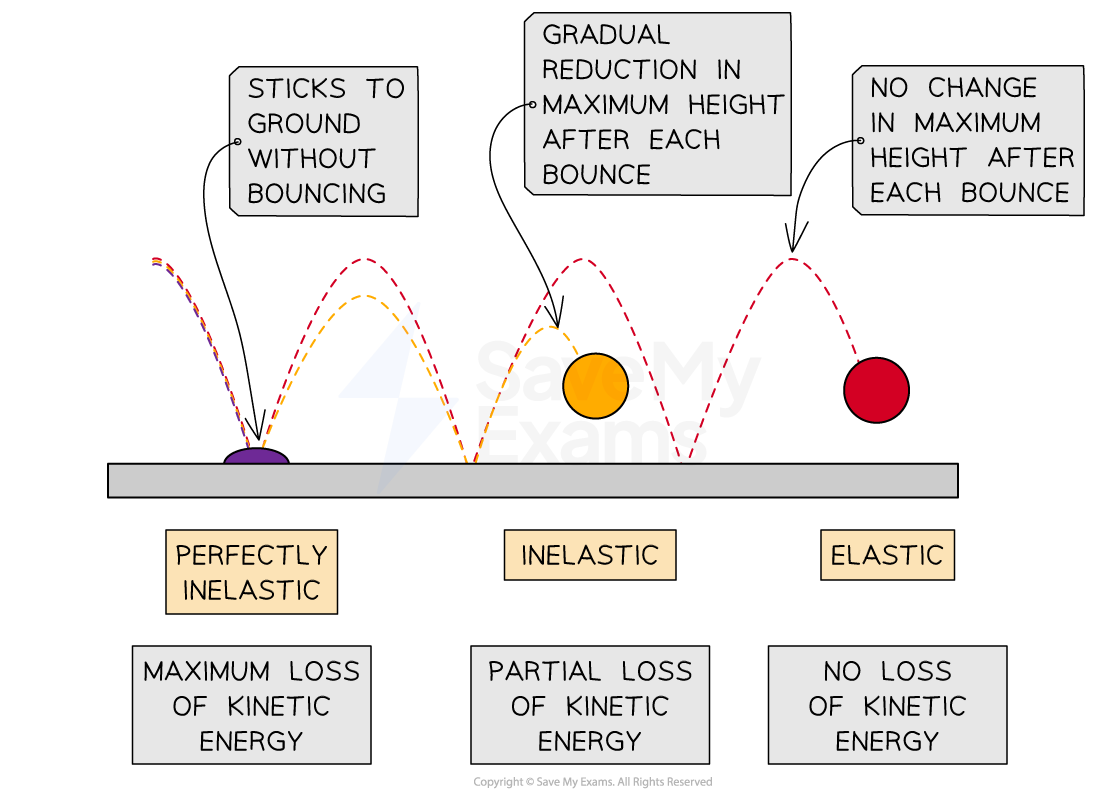
An inelastic collision is one in which the kinetic energy is not conserved, which means
initial kinetic energy of the system > final kinetic energy of the system
In other words, the total kinetic energy of the system decreases
This is because some of the initial kinetic energy is transformed into other forms of energy by nonconservative forces
Some examples of inelastic collisions include:
a bouncing ball which decreases in height with each bounce
a collision between a car and another object
Perfectly inelastic collisions
A perfectly inelastic collision is a special case in which:
the maximum amount of kinetic energy is lost to other forms
the objects stick together and move with the same velocity after the collision
Some examples of perfectly inelastic collisions include:
two lumps of clay sticking together after colliding
a ballistic pendulum i.e. a bullet becoming embedded in a wooden block
Comparison of elastic and inelastic collisions
Worked Example
A car of mass , traveling with a velocity , strikes a stationary vehicle of mass in a head-on inelastic collision and the bumpers lock together.
What fraction of the initial kinetic energy is lost in this collision?
A
B
C
D
The correct answer is D
Answer:
Step 1: Analyze the scenario
Before the collision, only the car of mass is moving, so it will provide the total momentum of the system
After the collision, the cars become one object of total mass and velocity
This is an example of a perfectly inelastic collision

Step 2: Use conservation of momentum to relate the velocities
Conservation of momentum: the total momentum before the collision is equal to the total momentum after
Step 3: Determine the initial and final kinetic energies
The initial kinetic energy of the system is:
The final kinetic energy of the system is:
Step 4: Determine the fraction of kinetic energy lost
The kinetic energy lost is equal to:
The fraction of kinetic energy lost is therefore:
Therefore, the correct option is D
Examiner Tips and Tricks
It can be helpful to think about collisions and explosions as if there are four types rather than two:
elastic - kinetic energy conserved
perfectly elastic - kinetic energy conserved and no energy transferred between objects
inelastic - kinetic energy not conserved
perfectly inelastic - kinetic energy not conserved and maximum energy transferred to surroundings
However, in AP Physics 1, be aware that the 'perfectly elastic' collision type will not be tested.

Unlock more, it's free!
Join the 100,000+ Students that ❤️ Save My Exams
the (exam) results speak for themselves:

Was this revision note helpful?
Build on this topic