Circular Motion Examples (College Board AP® Physics 1: Algebra-Based): Study Guide

Banked surface
A banked surface, normally a road or track is a curved surface where the outer edge is raised higher than the inner edge
The purpose of this is to make it safer for objects to travel on the curved road at a reasonable speed without skidding
The steeper the banked curve the greater the speed an object can travel around the curve without sliding up or down
Banked surface with friction
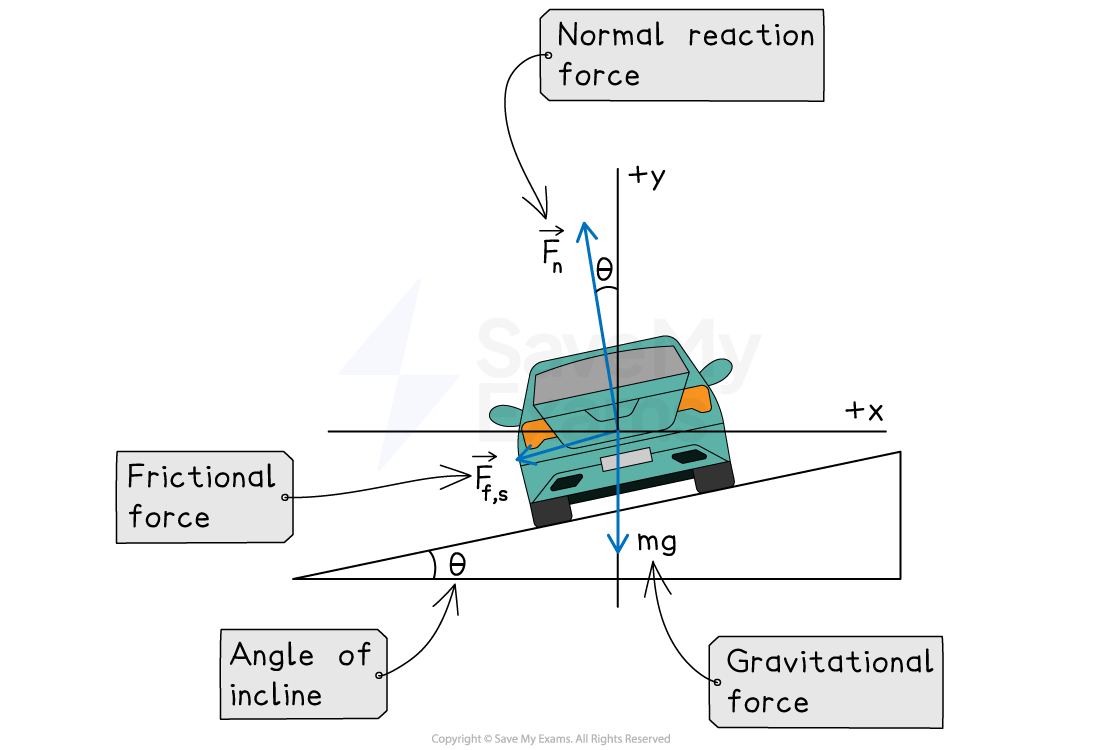
For an object moving on a banked surface with friction:
gravitational force acts vertically downwards
normal reaction force acts perpendicular to the surface
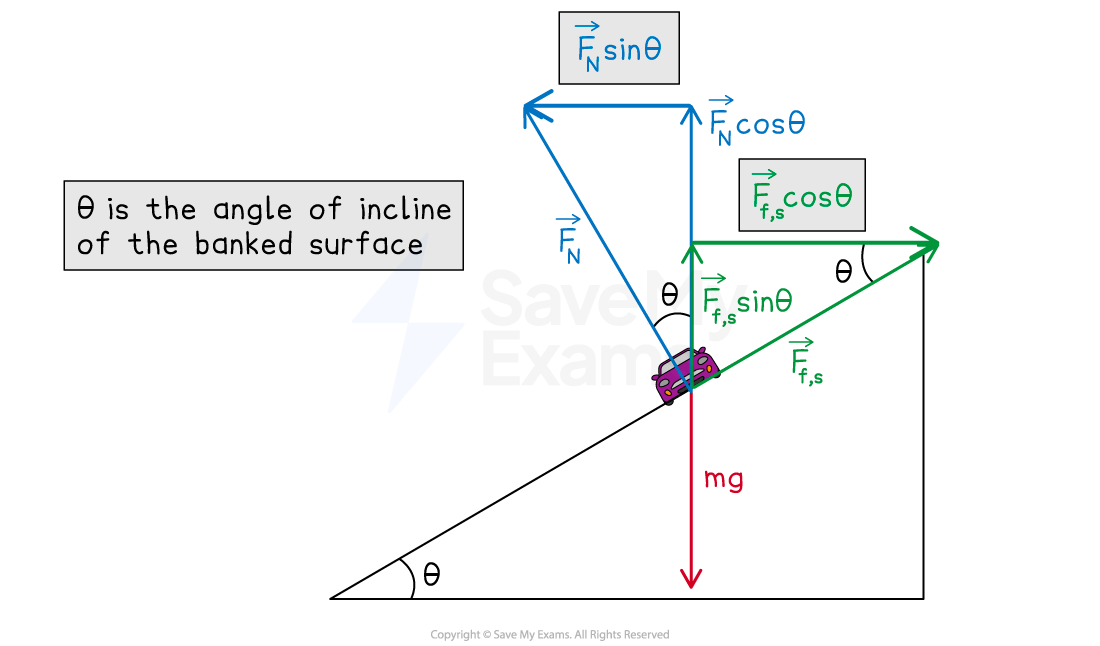
frictional force acts parallel to the surface, either up or down the slope depending on the situation
centripetal force is the net force acting horizontally towards the center of the circle
Forces acting on an object on a banked surface
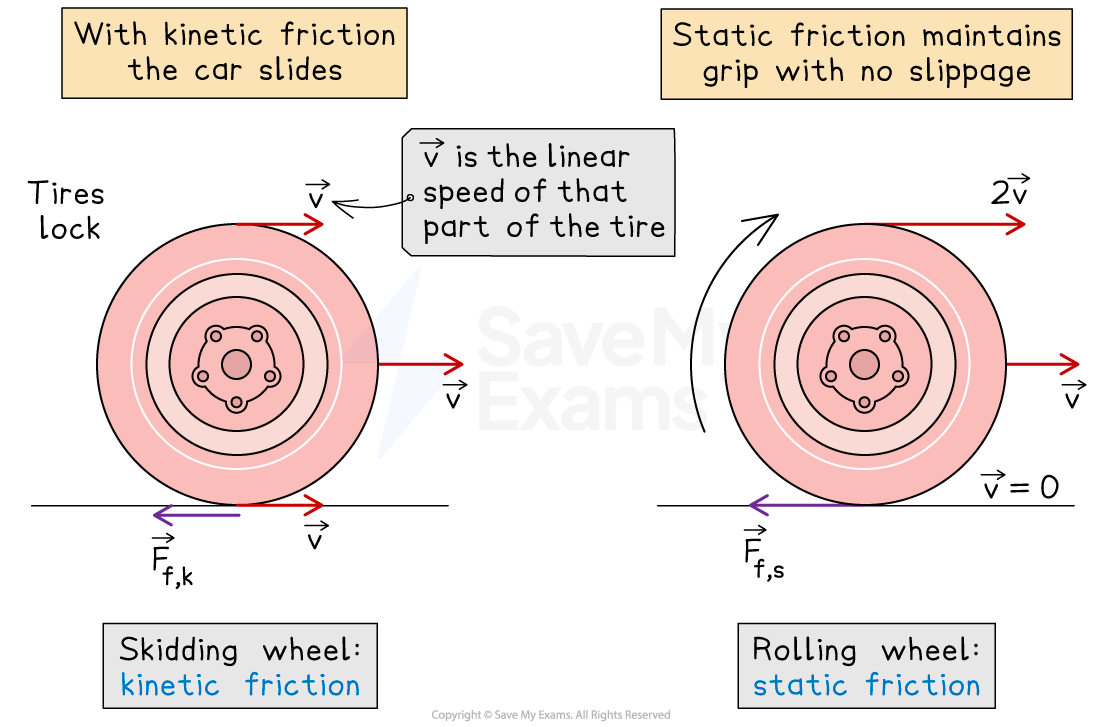
There are two types of friction to consider
static friction prevents the car from skidding
kinetic friction acts if the car starts skidding
If an object remains at the same position up the slope of the banked surface while undergoing uniform circular motion then only static friction is present
Kinetic vs static friction on a tire
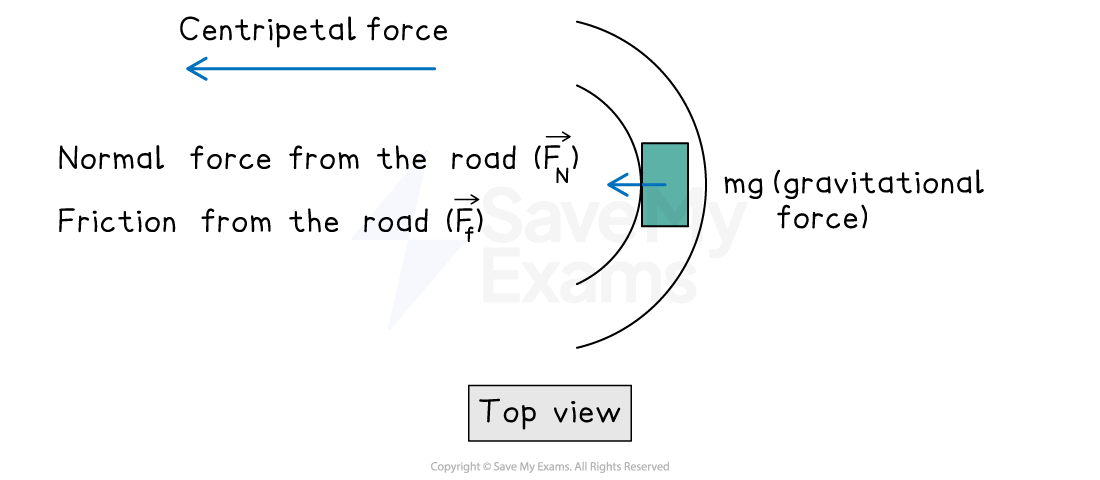
Components of the static friction force and the normal force can contribute to the net centripetal force producing the centripetal acceleration of an object traveling in a circle on a banked surface
The net centripetal force acts horizontally towards the center of the circle
An object travelling at its ideal speed is travelling at the maximum speed possible before it starts slipping or sliding on the banked surface, and kinetic friction is applied to keep the car in its lane
Net centripetal force
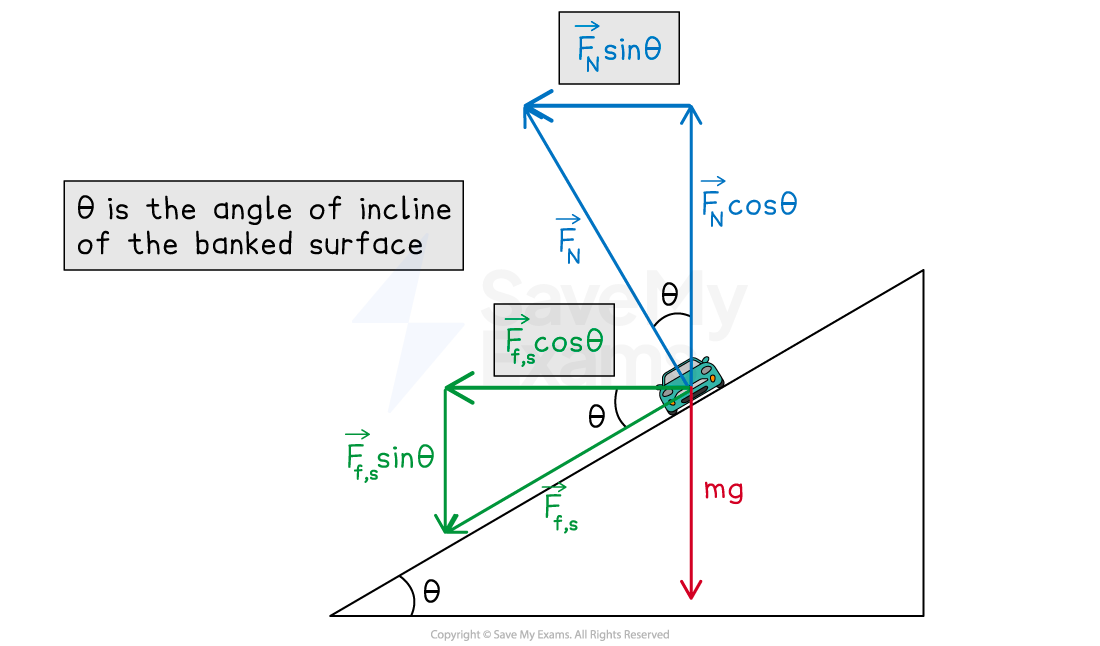
Faster than ideal speed
When the object is moving faster than the ideal speed, static friction acts down the banked surface
The static friction prevents the object from skidding upward
The net centripetal force is given by the equation
Where:
net centripetal force, measured in
normal reaction force, measured in
angle of incline of banked surface, measured in
static friction, measured in
Components of forces at faster than ideal speed
Slower than ideal speed
When the object is moving slower than the ideal speed static friction acts up the banked surface in the opposite direction to the centripetal force
The static friction prevents the object from skidding downwards
The net centripetal force is given by the equation
Components of forces at slower than ideal speed
Ideally banked surfaces
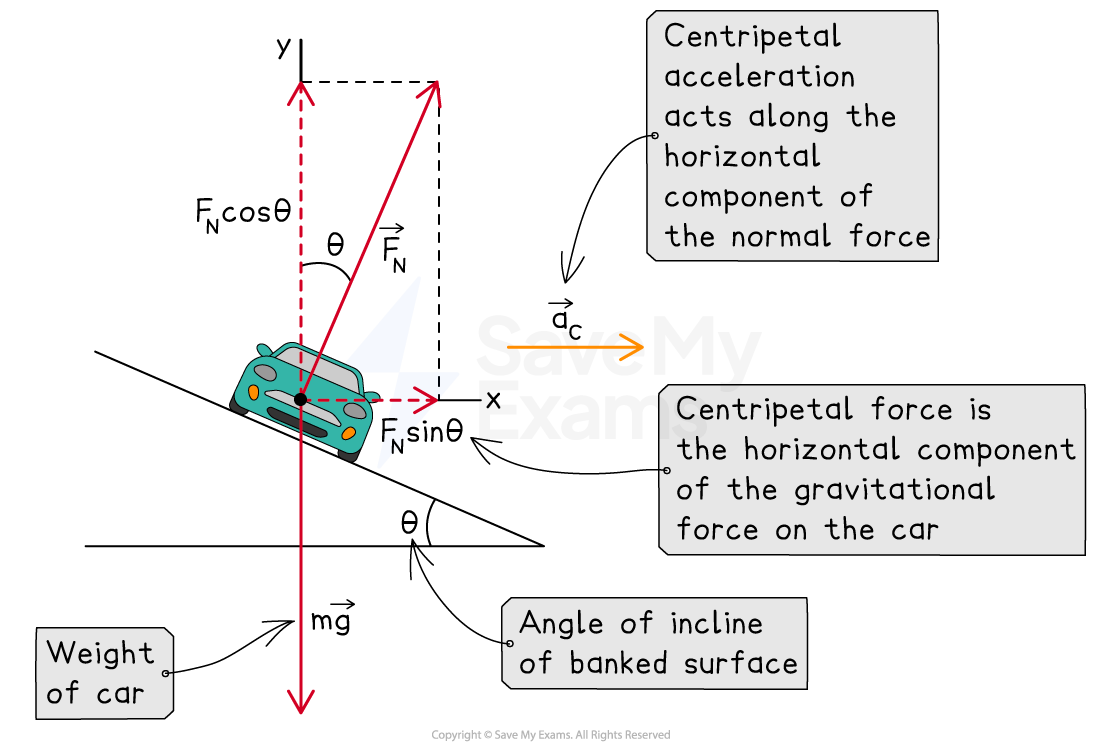
An ideally banked surface has an angle of incline so an object can negotiate the curve at a certain speed without the need for friction
For an object moving on an ideally banked surface without friction
gravitational force acts vertically downwards
normal reaction force acts perpendicular to the surface
centripetal force is the net force acting horizontally towards the center of the circle
The net centripetal force is given by the equation
Components of the normal force on an ideally banked surface
Worked Example
What is the minimum angle of an ideally banked road so a car can travel at and safely negotiate a curve of radius ?
A
B
C
D
The correct answer is D
Answer:
Step 1: Analyze the scenario
The car is on an ideally banked road, so there is negligible friction
Therefore, the centripetal force acting towards the center of the curve must be equal to the horizontal component of the normal reaction force of the car
Step 2: List the known quantities
Tangential speed of car,
Radius of curve,
Acceleration due to gravity at Earth's surface,
Step 3: Determine an expression for the centripetal force as the horizontal component of the normal force
eq (1)
Step 4: Determine an expression for the net zero vertical normal force
eq (2)
Step 5: Combine equations (1) and (2) to obtain an expression in terms of without the normal force,
Step 6: Substitute in the known quantities to obtain the minimum angle of the ideally banked road
The answer is therefore D
Examiner Tips and Tricks
The value of is not equal to the gravitational force, , of the car so it cannot be calculated without the angle of the incline.
Conical pendulum
A conical pendulum consists of a mass set in horizontal circular motion suspended on the end of a light inextensible string fixed from a central point above
For example, a fairground ride or a ball suspended on a string
Conical pendulum example
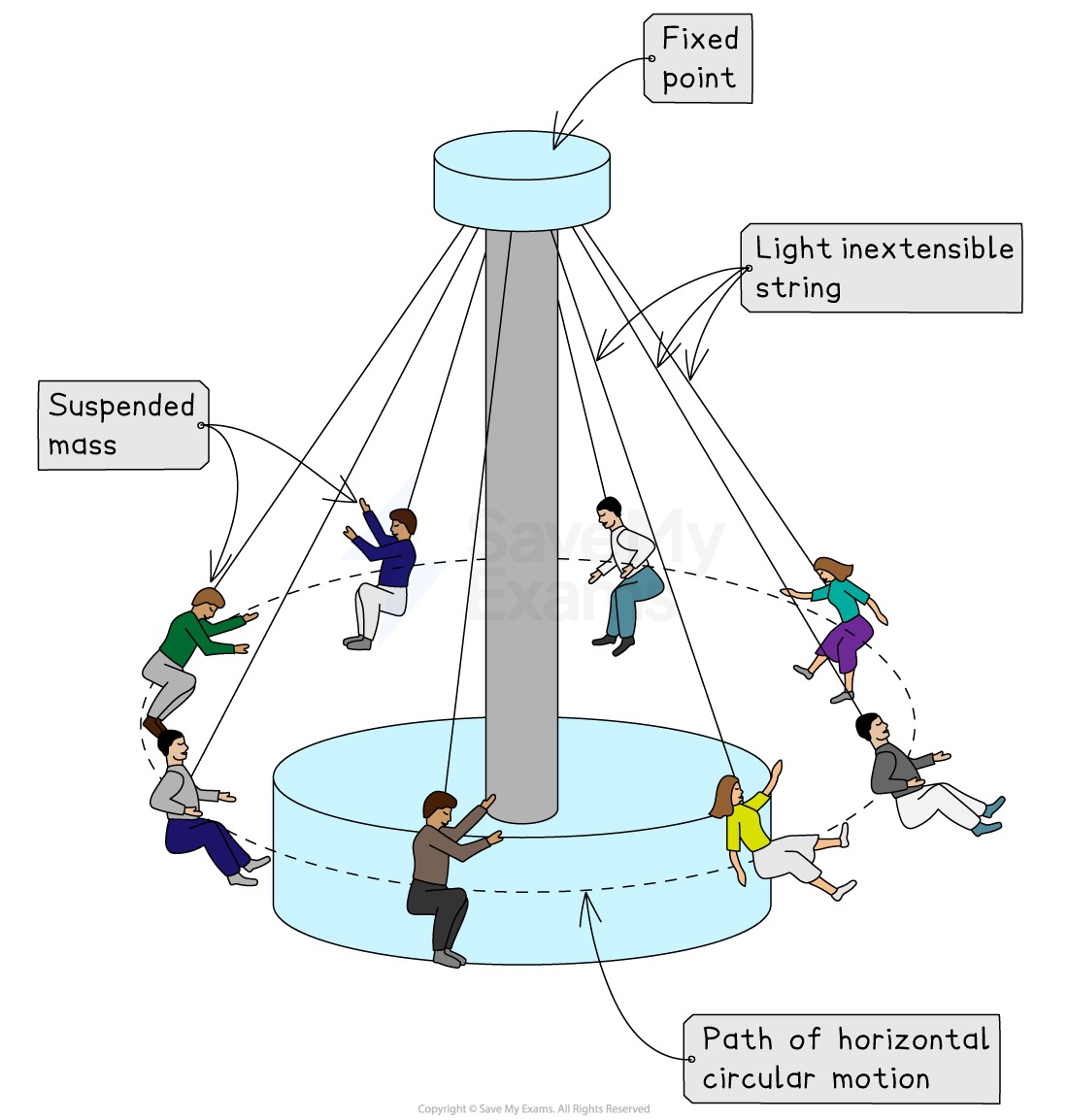
It is assumed that:
the string is massless
the string cannot be stretched
air resistance is negligible
The behavior of a conical pendulum is similar to that of an object on an ideally banked surface where there is no friction
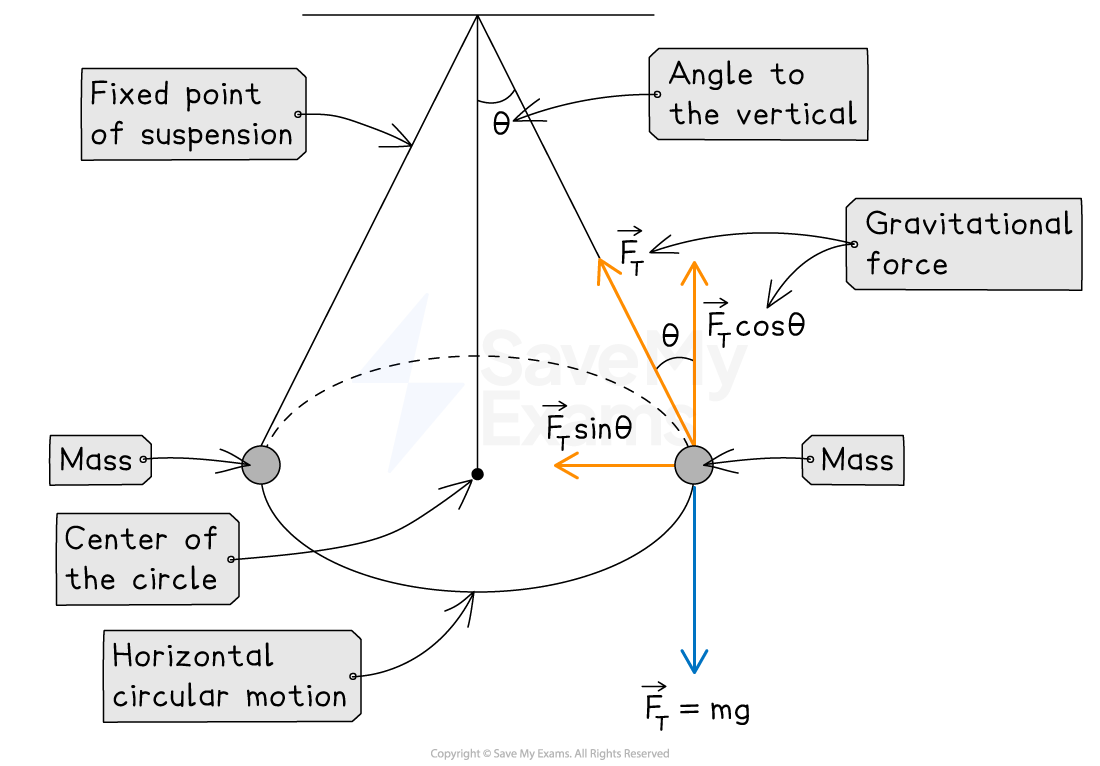
The normal reaction force of the banked surface on the object is equivalent to the tension in the string
A component of tension contributes to the net force producing centripetal acceleration experienced by a conical pendulum
The tension in the string and the gravitational force on the mass are not equal, so the mass is not in equilibrium, hence there is centripetal acceleration
A conical pendulum experiences the following forces:
gravitational force acting vertically downwards
tension force acting along the line of the string at an angle to the vertical
centripetal force is the net force acting horizontally towards the center of the circle
The horizontal net centripetal force is given by the equation:
The vertical component of the tension in the string is equal to the gravitational force acting on the mass
Components of the tension force on a conical pendulum
Worked Example
A conical pendulum has a mass suspended from a height by a light inextensible string with tension at an angle of to the vertical. It moves in uniform circular motion of radius, with tangential velocity, .

Verify that the time period of the oscillation of the conical pendulum is given by the equation
Answer:
Step 1: Analyze the scenario and determine the required equations
The following forces are present on a conical pendulum system
The gravitational force acting on the mass is
The vertical component of tension in the string is
The horizontal component of the tension in the string is
The centripetal force is given by the equation
The time period is calculated using
Step 2: Determine an expression for the centripetal force as the horizontal component of the tension force
eq (1)
Step 3: Determine an expression for the net zero vertical tension force
eq (2)
Step 5: Combine equations (1) and (2) to obtain an expression in terms of without the tension force,
Step 6: Determine an expression for in terms of and
Step 7: Combine the equations to obtain an expression for in terms of , and
Step 8: Substitute the expression for into the time period equation
as required

Unlock more, it's free!
Join the 100,000+ Students that ❤️ Save My Exams
the (exam) results speak for themselves:

Was this revision note helpful?
Build on this topic