Motion of Orbiting Satellites (College Board AP® Physics 1: Algebra-Based): Study Guide

Motion of orbiting satellites
When a system consists only of a satellite orbiting a massive central object:
the mass of the orbiting satellite is considered negligible (compared to the mass of the central object)
both bodies orbit around a single center of mass, but the central object is considered stationary
Satellites can be categorized as natural satellites or artificial satellites
Examples of satellite-central-object systems include:
planets or comets orbiting the Sun
moons or spacecraft orbiting a planet
Gravitational potential energy of a system
Gravitational potential energy is the energy possessed by an object due to its position in a gravitational field
The gravitational potential energy of a system is defined as:
The work done to assemble the system from infinite separation of the components of the system
Gravitational potential energy is calculated using the following equation:
Where:
= gravitational potential energy of the system, in
= universal gravitational constant
= mass of the central body, in
= mass of the orbiting satellite, in
= distance between the centers of the masses, in
For a satellite-central-object system:
potential energy is defined as zero when the satellite is an infinite distance from the central object
potential energy increases when the distance of the satellite from the central object increases
potential energy decreases when the distance of the satellite from the central object decreases
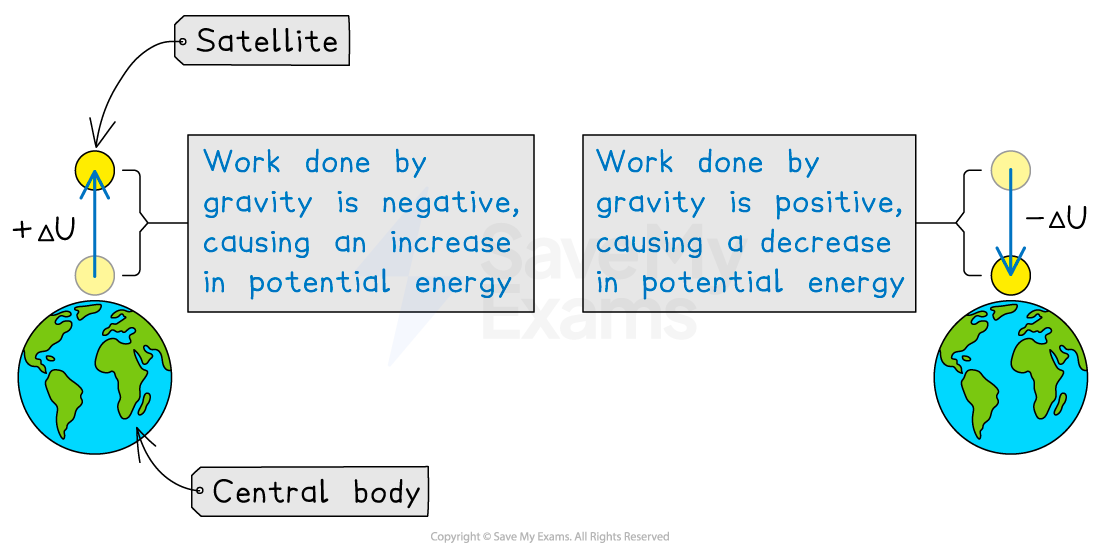
Energy of an orbiting satellite
Gravity is a conservative force, therefore, the total energy of a satellite-central-object system is constant
The total mechanical energy is equal to the sum of the system's kinetic and potential energies:
Total mechanical energy = kinetic energy + gravitational potential energy
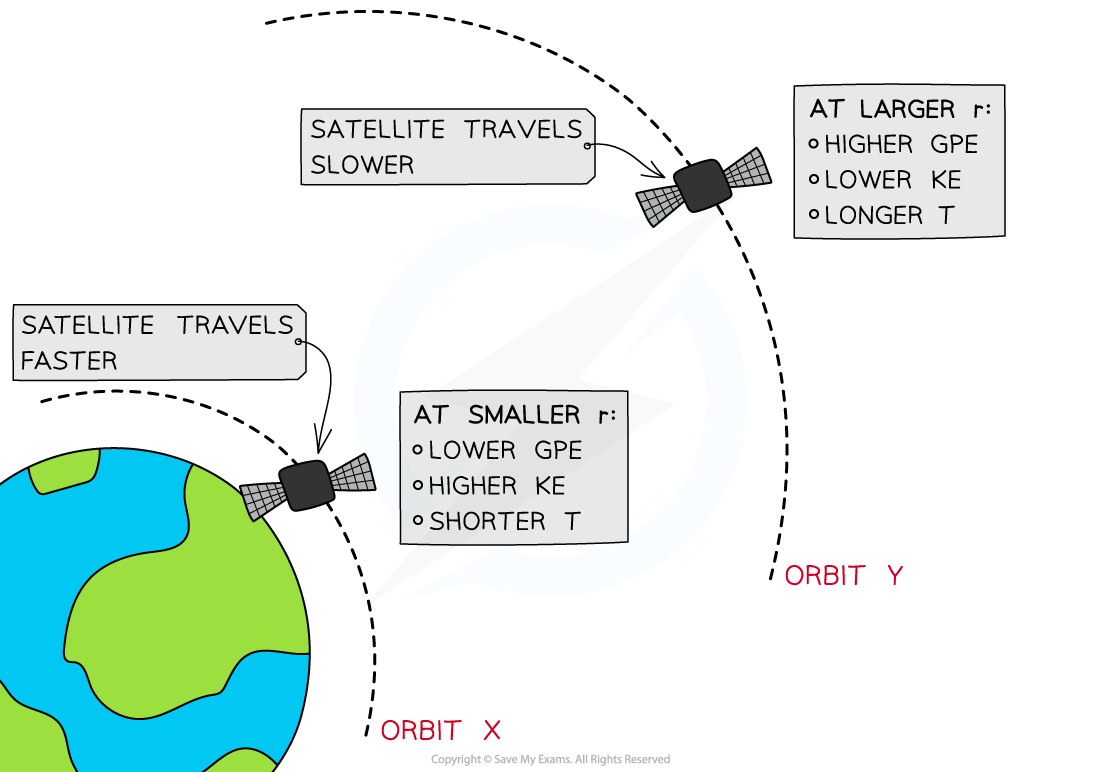
A satellite moving in a circular orbit of fixed orbital radius has a constant orbital speed
Therefore, the satellite's kinetic and potential energies are also constant for a particular orbital radius
To change the orbital radius of a satellite, work must be done, which means that:
if the orbital radius of the satellite decreases then decreases, increases, and decreases
if the orbital radius of the satellite increases then increases, decreases, and increases
Variation of energy with orbital radius
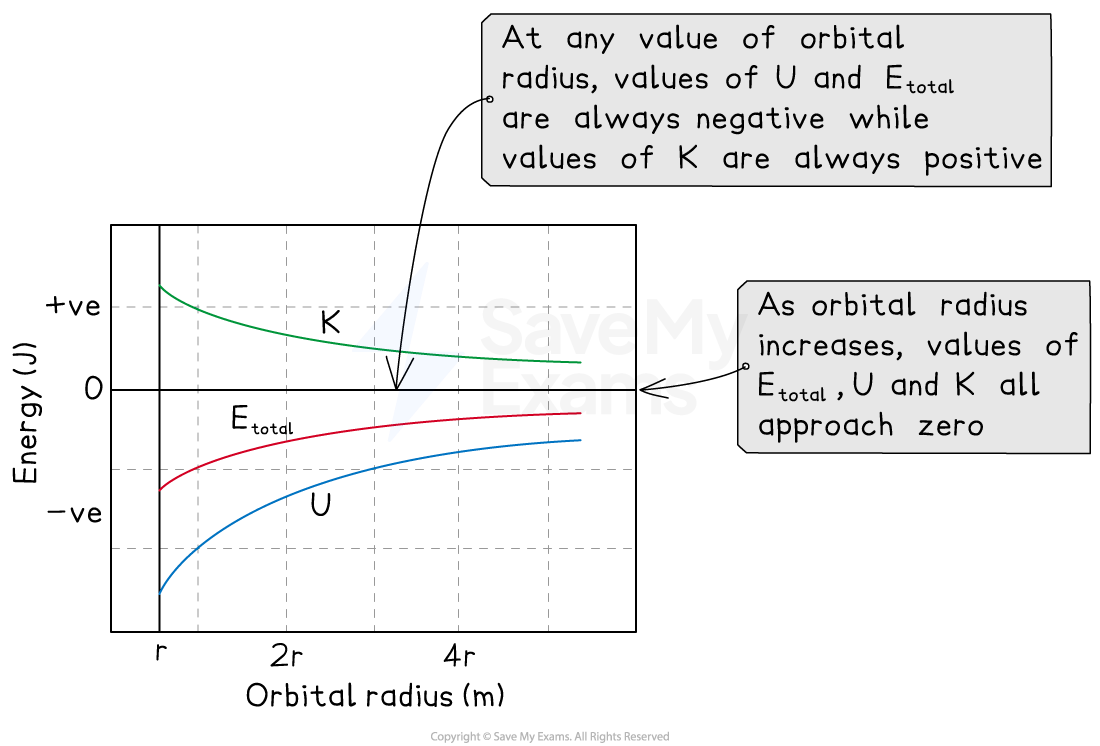
Comparing energies of satellites in different orbits
Circular and elliptical orbits
The path of an orbiting satellite around a central object may be circular or elliptical
In both types of orbit, the total energy and the total angular momentum of the system are constant throughout the satellite's motion
Analyzing circular orbits
In a circular orbit, the satellite's speed and radius are constant, which means:
the system's total mechanical energy and the gravitational potential energy are constant
the satellite's angular momentum, kinetic energy, and speed are constant
Satellite in a circular orbit
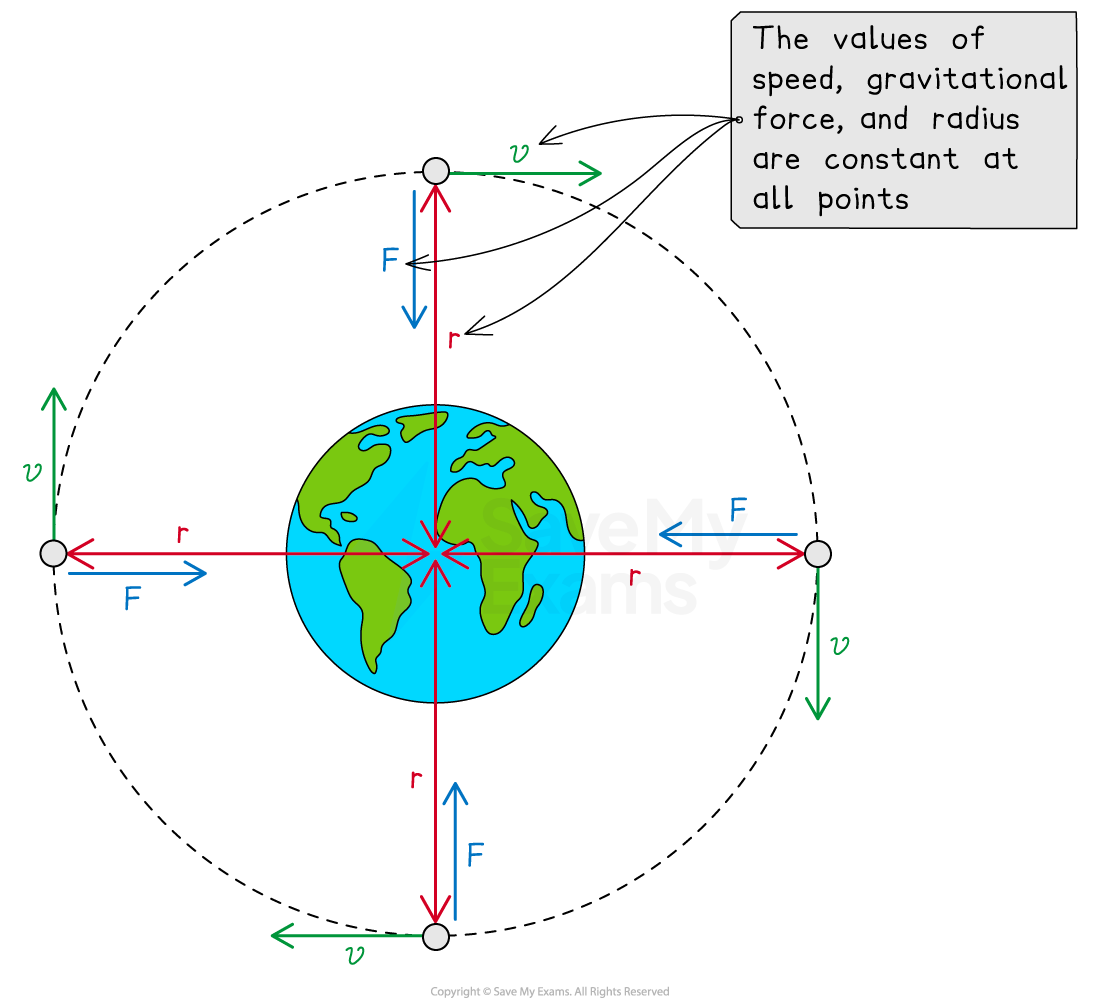
Orbital speed of a satellite
A satellite’s orbit is maintained by the force of gravitational attraction, , between the satellite and the central object
In a circular orbit, this force acts towards the center of the circular path as a centripetal force,
Where:
= universal gravitational constant
= mass of the central body, in
= mass of the orbiting satellite, in
= orbital speed of the satellite, in
= distance between the centers of the masses, in
Therefore, the orbital speed of a satellite is:
This means that all satellites, regardless of their mass, will travel at the same speed in a circular orbit of radius
Angular momentum of a satellite
When traveling in a circular path, the radius and the velocity of the satellite are always perpendicular to each other
The angular momentum of the orbiting satellite is:
This means that the angular momentum of a satellite traveling in a circular orbit of radius is constant
Total energy of a circular orbit
The total mechanical energy of the system is the sum of kinetic and potential energies:
Substituting the equation for orbital speed:
Therefore, for a circular orbit, the following apply at all points:
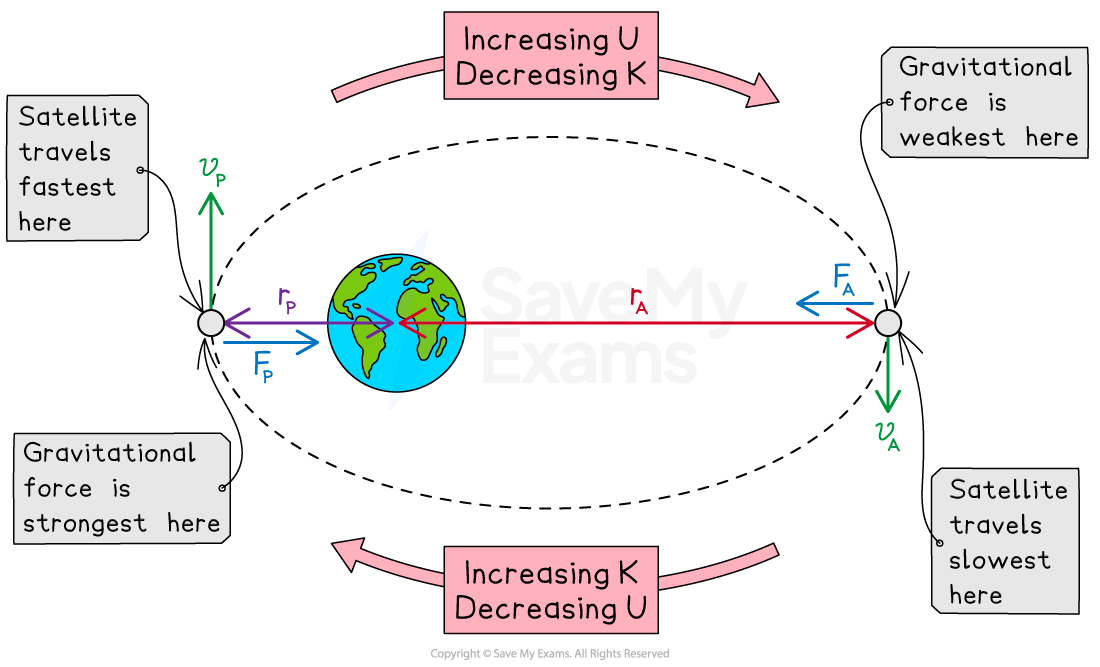
Analyzing elliptical orbits
In an elliptical orbit, the satellite's speed and radius are not constant, which means:
the system’s total mechanical energy and the satellite’s angular momentum are constant
the system’s gravitational potential energy and the satellite’s kinetic energy change throughout the satellite's motion
Satellite in an elliptical orbit
Angular momentum of a satellite
When traveling in an elliptical path, the angle between the radius and the velocity of the satellite changes
The angular momentum of the orbiting satellite is:
Where:
= angle between the radius and the velocity of the satellite, in
As with a circular orbit, the gravitational attraction between the satellite and the central object is the only force that acts on the system
This force acts towards the focus of the ellipse where the central body is located
Since this force always acts in the same direction as the radius, it can never cause a torque
Therefore, the angular momentum of the satellite is constant as no net external torque acts on the satellite-central-object system
Orbital speed of a satellite
To conserve angular momentum, the satellite reaches maximum and minimum values of radius and velocity at the two extreme points
At the point closest to the central object:
the radial distance is the shortest
the satellite has the highest speed
At the point farthest from the central object:
the radial distance is the greatest
the satellite has the lowest speed
Total energy of an elliptical orbit
To conserve mechanical energy, the satellite reaches maximum and minimum values of kinetic energy and gravitational potential energy at the two extreme points
At the point closest to the central object:
the satellite has the highest kinetic energy
the system has the lowest (most negative) gravitational potential energy
At the point farthest from the central object:
the satellite has the lowest kinetic energy
the system has the highest (least negative) gravitational potential energy
Worked Example
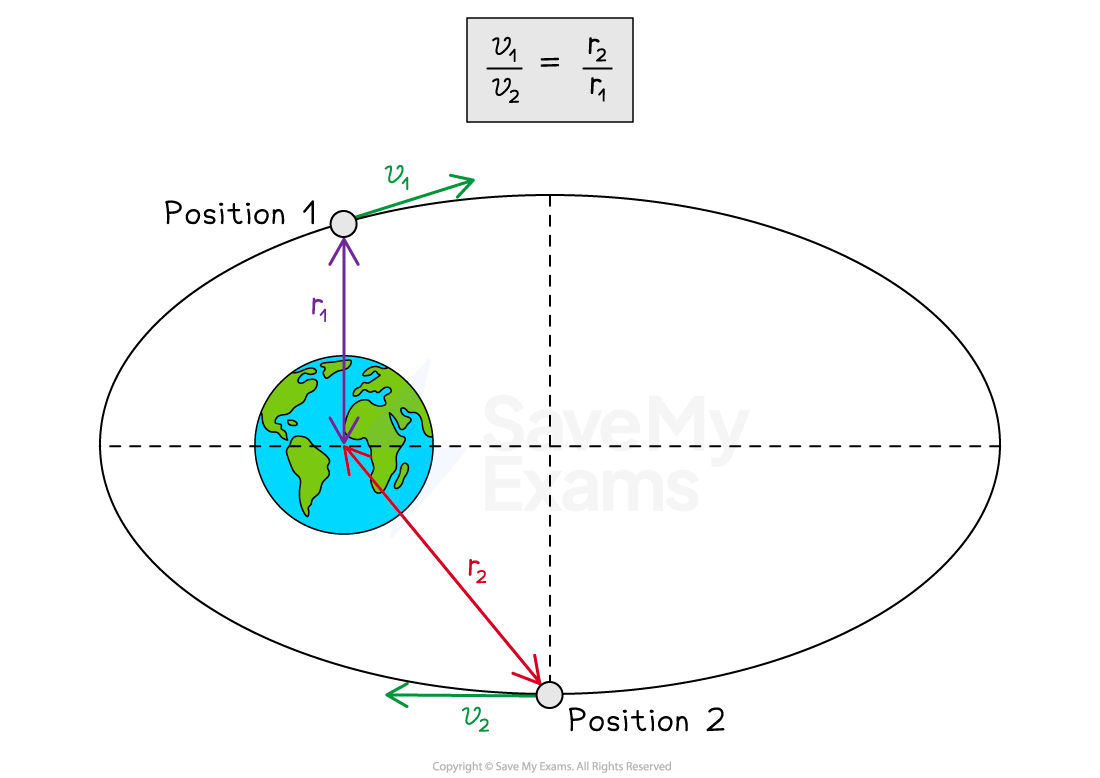
A satellite in an elliptical orbit around a planet has speed at its closest distance from the center of the planet and speed at its farthest distance from the center of the planet .

Which of the following expressions correctly represents ?
A
B
C
D
The correct answer is A
Answer:
Step 1: Determine the angular momentum of the satellite at the two extreme points
The angular momentum of the orbiting satellite is:
At its closest distance to the planet, the angular momentum is
At its farthest distance from the planet, the angular momentum is
Step 2: Apply conservation of angular momentum
The satellite's angular momentum is constant at all points in its orbit, so:
Step 3: Write an expression for the speed of the satellite at the furthest point
Note: This relationship between speed and radial distance can be applied at any point in the orbit

Unlock more, it's free!
Join the 100,000+ Students that ❤️ Save My Exams
the (exam) results speak for themselves:

Was this revision note helpful?
Build on this topic
