Hooke's Law (College Board AP® Physics 1: Algebra-Based): Study Guide

Ideal spring
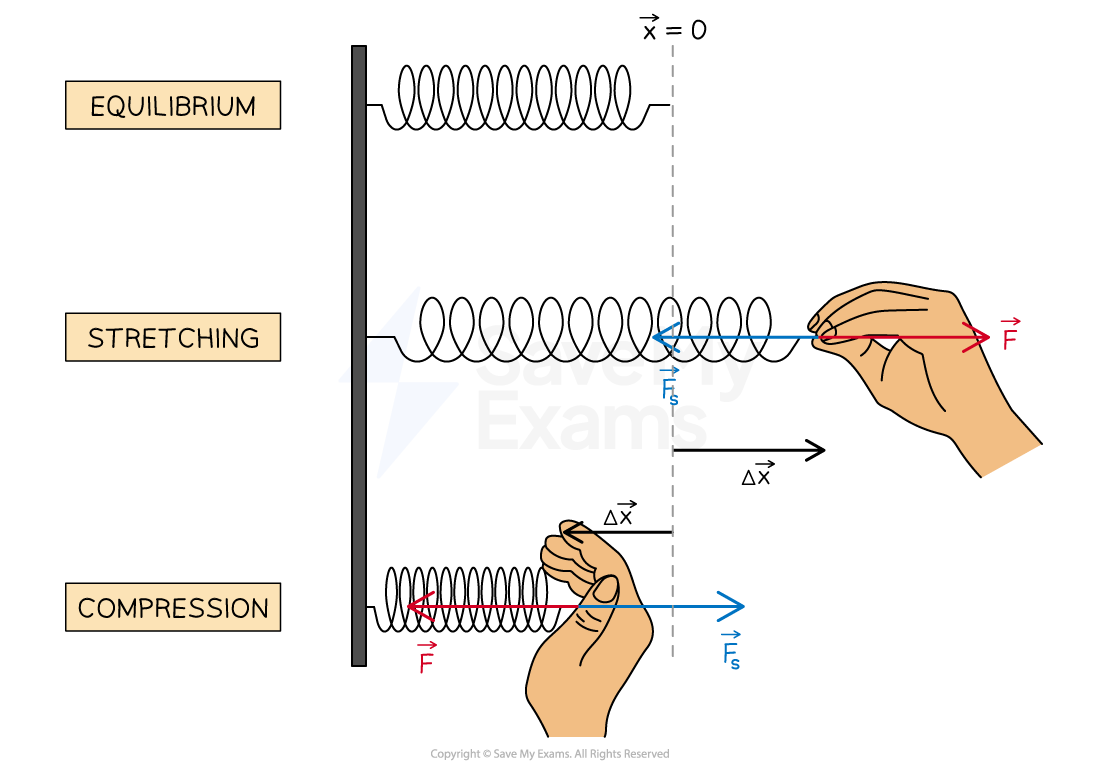
When a spring is neither stretched nor compressed, it is said to be in equilibrium
The net force on the spring is zero
Its length at its equilibrium position is known as the relaxed length
When a spring is stretched or compressed, its change in length (extension or compression), , is the displacement from its equilibrium position
The spring will exert a force, , towards its equilibrium position
Force exerted by a spring
An ideal spring can be defined as:
A spring that has negligible mass and exerts a force that is proportional to the change in its length as measured from its relaxed length
This can be expressed as:
Where:
= force exerted by a spring, in
= change in length of the spring, in
The minus sign shows that the force exerted by a spring is a restoring force as it acts toward the equilibrium position
Hooke's law
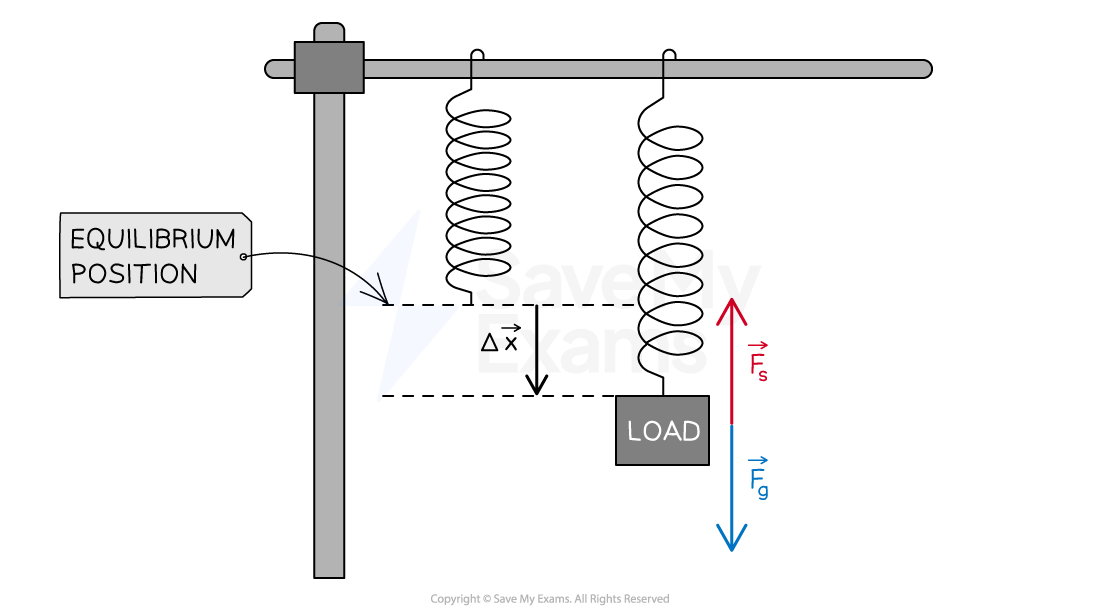
When an object is placed on an ideal spring, the spring will exert a force on the object
For an ideal spring:
Where:
= force exerted by a spring, in
= change in length of the spring, in
This can be re-written using a proportionality constant, called the spring constant, to show the magnitude of this force
This equation is known as Hooke's law:
Where:
= force exerted by a spring, in
= spring constant, in
= change in length, in
The force that is exerted by an ideal spring on an object is a restoring force
Hooke's law applies to both extensions and compressions:
The extension of an object is determined by how much it has increased in length
The compression of an object is determined by how much it has decreased in length
The extension, , is the difference between the relaxed and stretched length
Force exerted on an object by an ideal spring
Force-versus-extension graphs
The relationship between force and the change in length from its relaxed length is shown on a force-versus-extension graph
For an ideal spring, this is a linear relationship shown as a straight-line graph which passes through the origin
Calculating the spring constant from a force-versus-extension graph
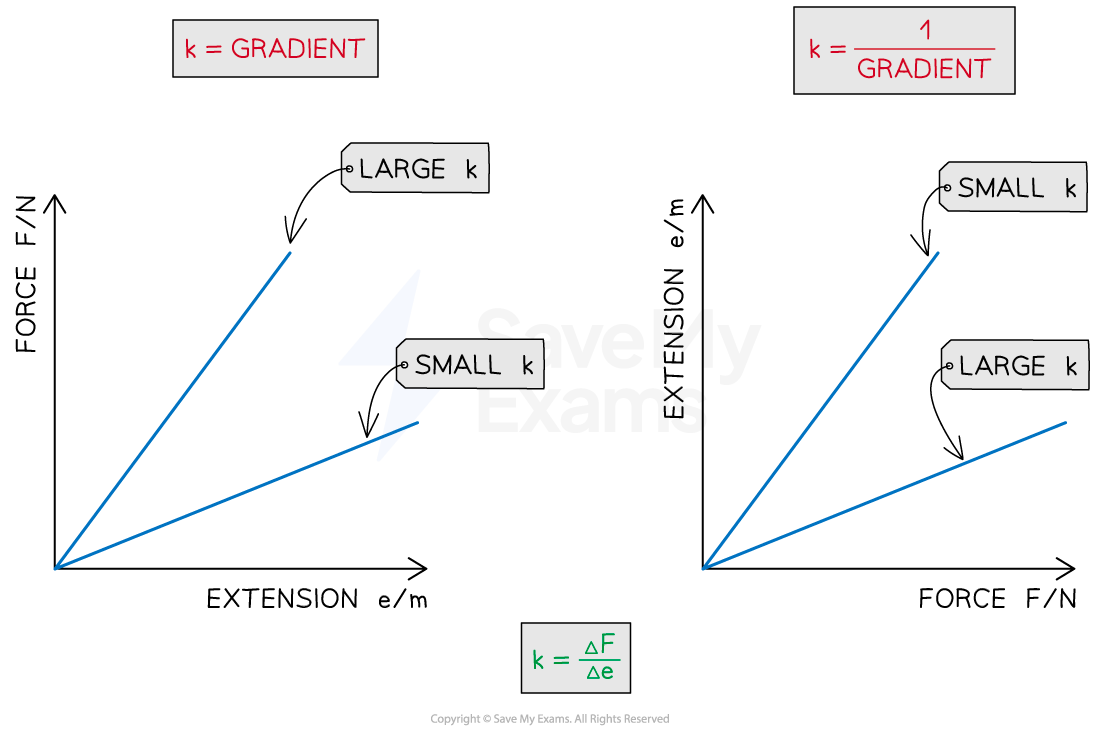
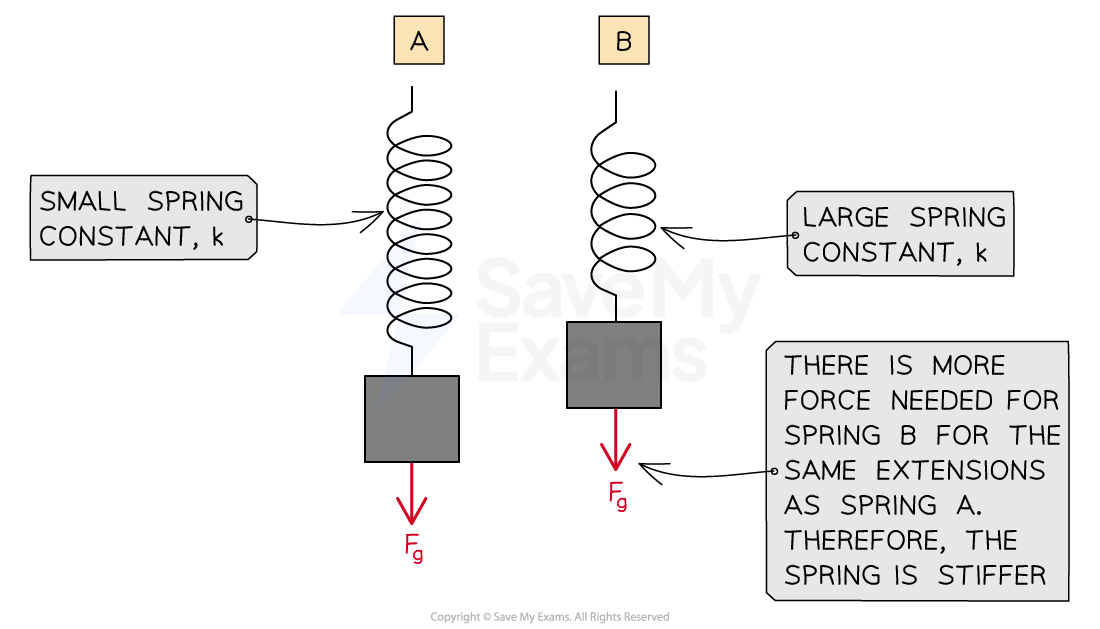
The stiffer the spring, the greater the spring constant and vice versa
This means that more force is required per meter of extension compared to a less stiff spring
When force is plotted against extension, the steeper the slope of the line, the larger the spring constant and the stiffer the spring
Combination of springs
Springs can be combined in different ways:
In series (end-to-end)
In parallel (side-by-side)
The effective spring constant, , is a measure of how much force the combination of springs exerts per unit of extension or compression
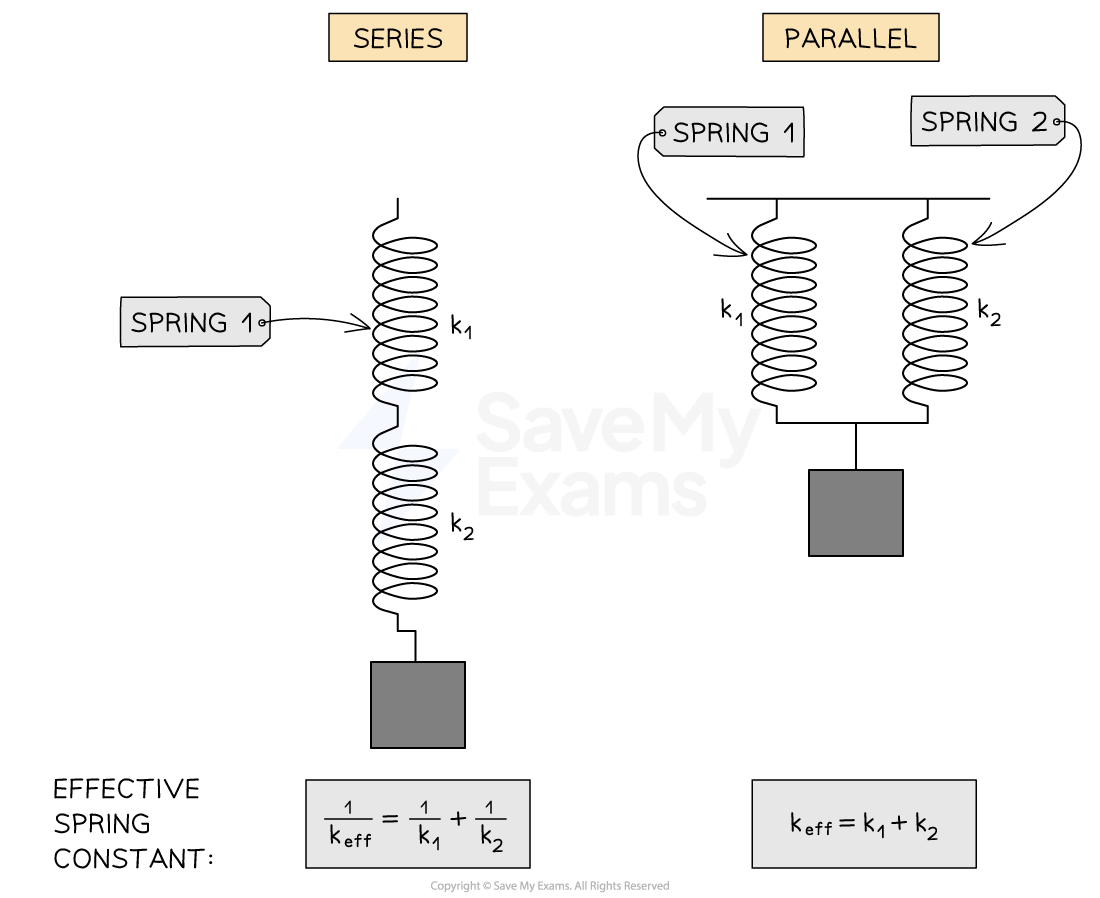
Springs in parallel
For springs in parallel, the extension from the equilibrium position, , is the same for both springs
The net force exerted by the two springs, , is:
Using Hooke's law, the force exerted by spring 1 is:
The force exerted by spring 2 is:
Substituting:
Therefore, the effective spring constant for springs in parallel, , is:
Springs in series
For springs in series, the total extension, is:
Where:
is the extension of spring 1, measured in
is the extension of spring 2, measured in
The force is evenly distributed, so the force, , exerted by each spring is equal
The extensions can be written in terms of force and spring constants using Hooke's law:
Therefore
Rearranging this in the format of Hooke's law for a single spring:
Therefore, the effective spring constant, , is:
Worked Example
Four springs are arranged vertically as shown in the figure.

Springs P, Q and O are identical and each has a spring constant . Spring R has a spring constant of . What is the magnitude of the increase in the overall length of the arrangement when a force, is applied as shown in the figure?
A
B
C
D
The correct answer is C
Answer:
Step 1: Analyze the scenario
Springs O, P and Q are in parallel and act like a single spring with an effective spring constant,
The three springs O, P and Q act like a single spring with a spring constant which is in series with spring R
The effective spring constant of the arrangement,
Step 2: Identify the equation to calculate the overall increase in length of the arrangement
Rearranging Hooke's law gives the equation for the overall increase of the arrangement:
Step 3: Calculate the effective spring constant
The effective spring constant from parallel springs O, P and Q
The springs O, P and Q are in series with spring R, so the effective spring constant of the arrangement can be calculated by:
Step 3: Substitute back into the equation for the equation for the overall increase in length of the arrangement
The negative sign indicates that the direction of the increase is in the opposite direction to the force exerted by the spring
Examiner Tips and Tricks
The effective spring constant equations for combined springs work for any number of springs e.g. if there are 3 springs in parallel , and the effective spring constant would be .

Unlock more, it's free!
Join the 100,000+ Students that ❤️ Save My Exams
the (exam) results speak for themselves:

Was this revision note helpful?
Build on this topic