Combining Vectors (College Board AP® Physics 1: Algebra-Based): Study Guide

Combining vectors
Vector sums in one dimension
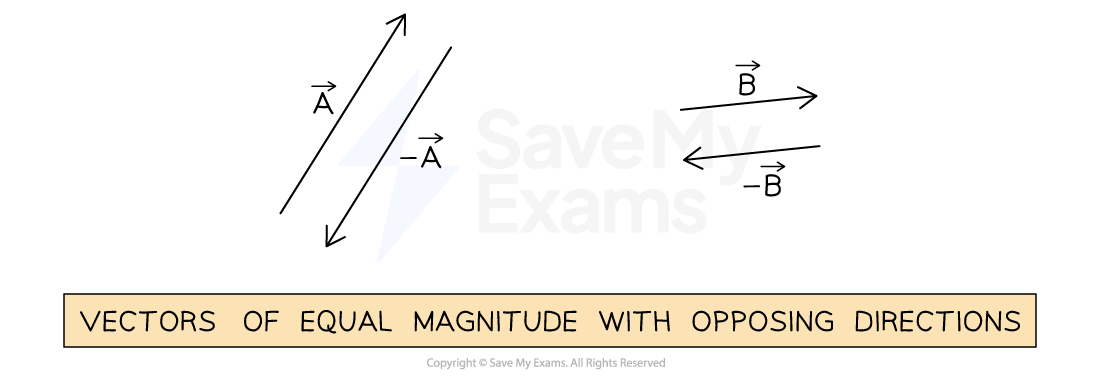
In one-dimensional coordinate systems, vectors of opposing directions are represented as positive and negative
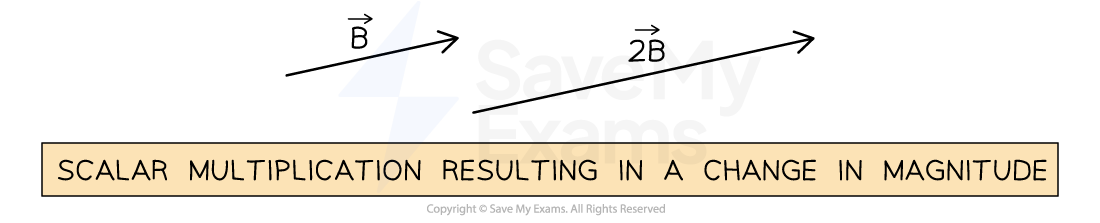
Scalar multiplication
Vectors can be multiplied by a scalar
The effect is either a change in magnitude or a reversal of the direction
For example, vector is multiplied by
is the vector
is the scalar
The resultant vector is
The magnitude of the vector has doubled
The direction has not changed
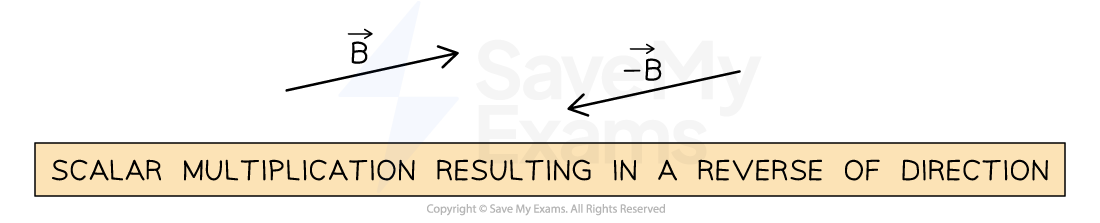
When vector is multiplied by
is the vector
is the scalar
The resultant vector is
The magnitude of the vector has not changed
The direction has reversed
Vector addition
Vectors can be added together using a vector sum
The effect is a resultant vector that describes the combined effect of both vectors
For example, vector is added to vector
The resultant vector is
There are two methods to adding vectors graphically:
The tip-to-tail method
The parallelogram method
Tip-to-tail method of adding vectors
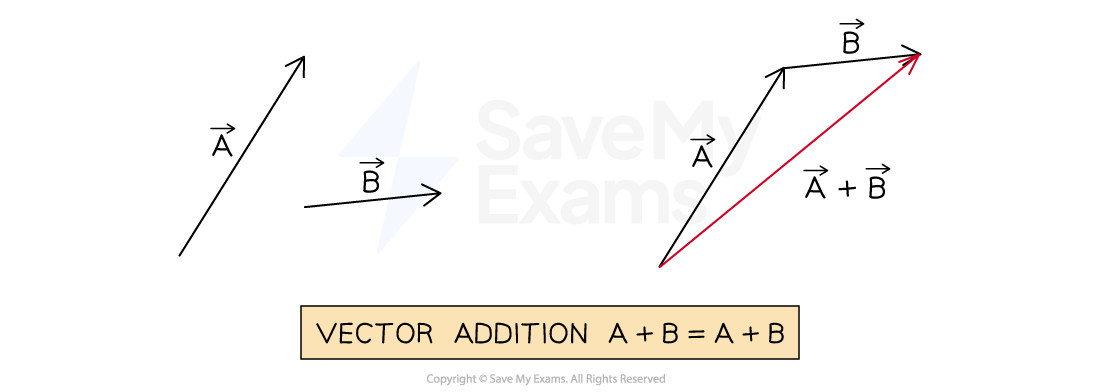
The tip-to-tail method places the vector arrows tip-to-tail to find the resultant vector
Parallelogram method of adding vectors
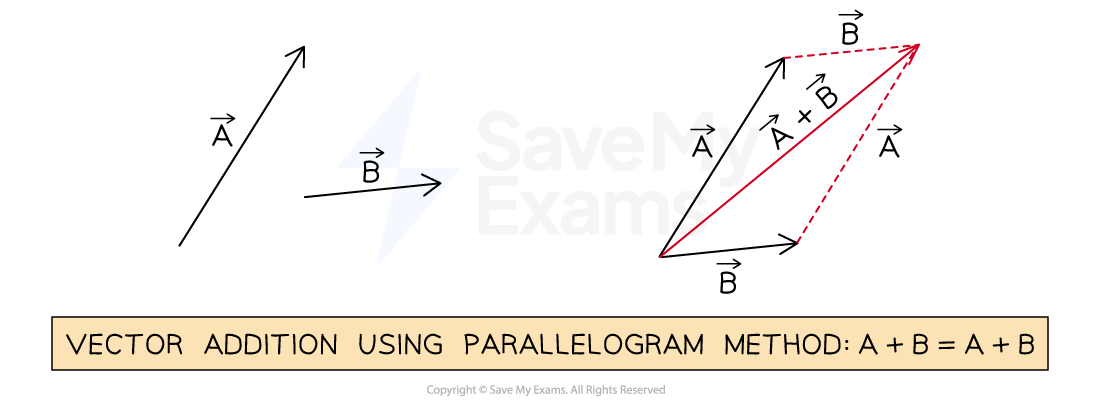
The parallelogram method places the vectors tail-to-tail to find the resultant vector
Vector subtraction
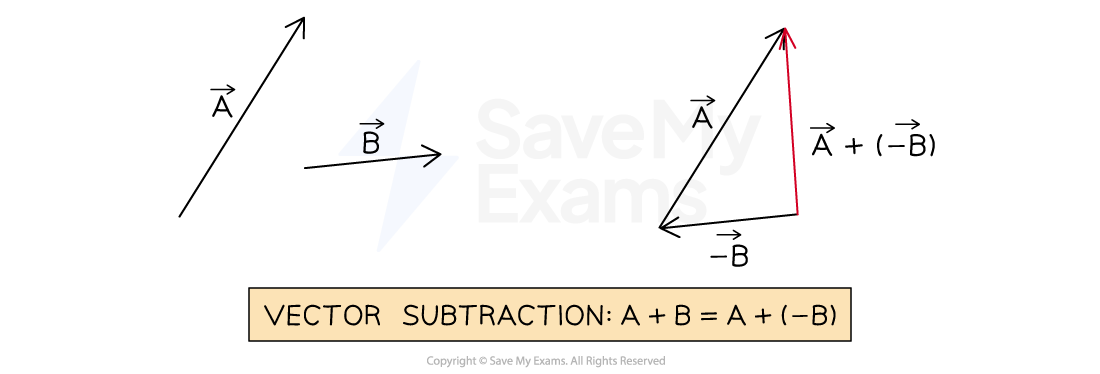
Vectors can also be subtracted using a vector sum and scalar multiplication
For example, vector is subtracted from vector
Vector is first multiplied by the scalar
This reverses the direction of vector to give
The vectors are then added by placing them tip to tail
The resultant vector is
Vectors in one and two dimensions
A one-dimensional vector has magnitude and direction along a single straight line
This can be along the -axis or -axis in a coordinate system
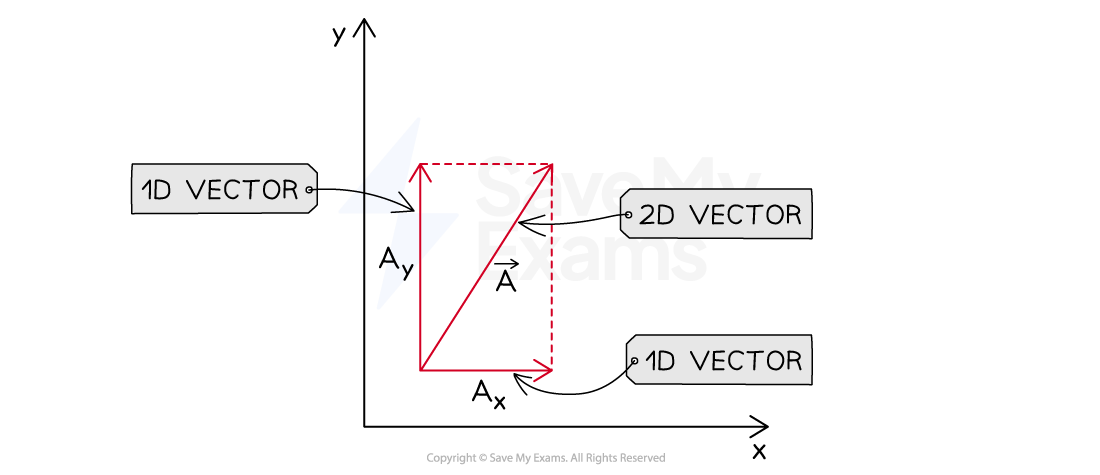
A two-dimensional vector has magnitude and direction in a plane
This means it has two component vectors: one along the -axis and one along the -axis
Resolving vectors in two dimensions
Two-dimensional vectors can be resolved into two perpendicular one-dimensional vectors
The vector along the horizontal -axis
The vector along the vertical -axis
These are called component vectors
Finding the magnitude of the vector
The magnitude of a two-dimensional vector can be found using Pythagoras' theorem
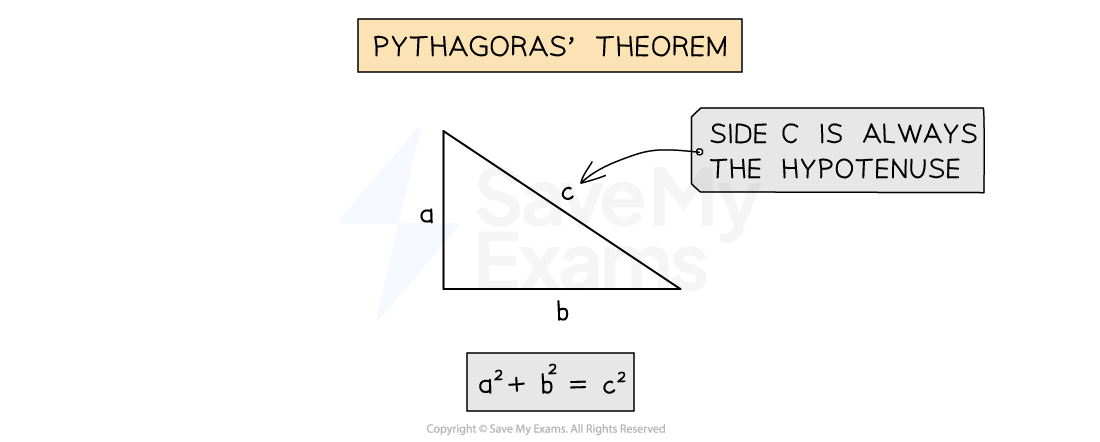
The two-dimensional vector is the hypotenuse of the triangle, therefore:
Finding the direction of the vector
The direction of the vector can be described with respect to an axis
This is usually the horizontal -axis, unless otherwise directed
The symbol theta is used for an unknown angle
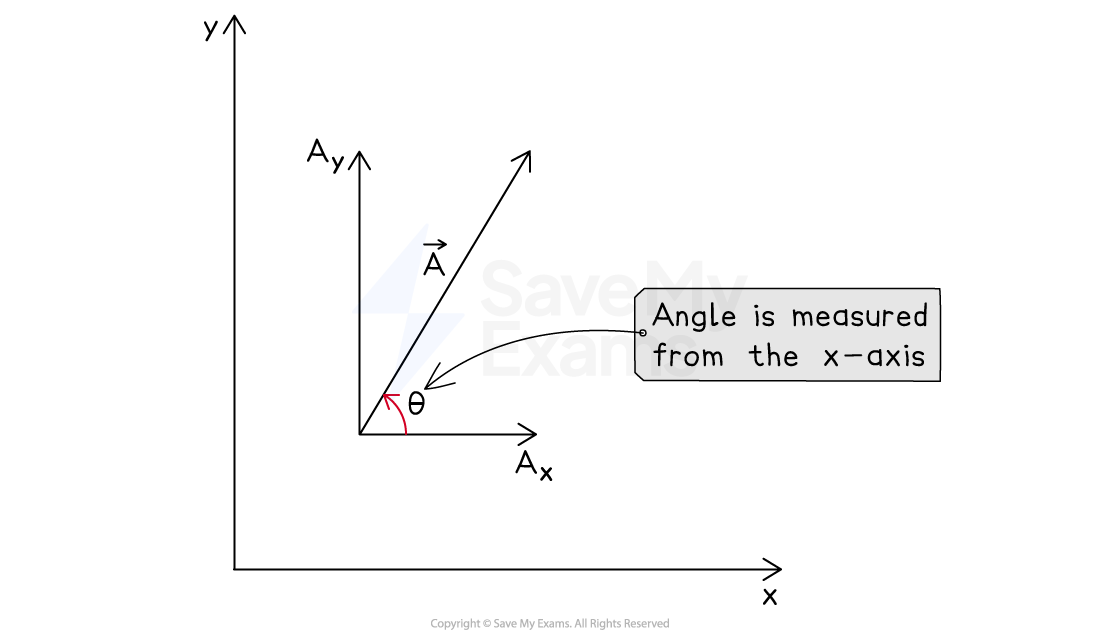
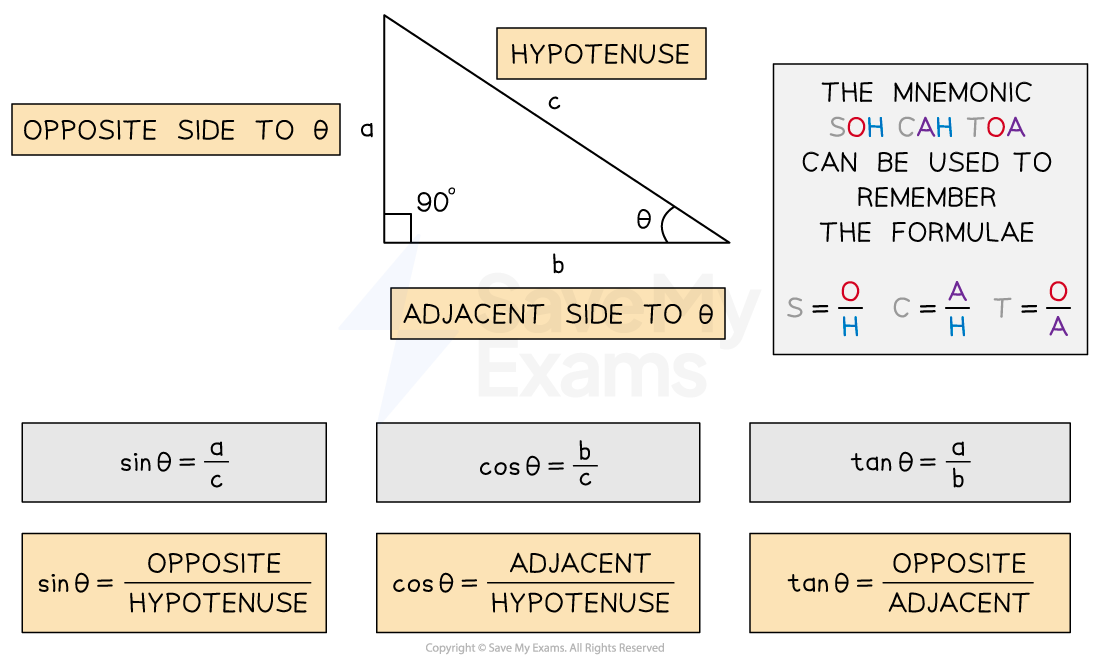
Trigonometry can then be used to find:
the angle, if the magnitude of the vectors are known
the magnitude of a vector, if the angle and the magnitude of one vector are known
Worked Example
A kayaker rows from the north bank to the south bank of a river flowing due east at speed . The kayaker knows they can maintain an average speed of when rowing in still water.
(a) State an equation relating the velocities and .
(b) Give an expression for the direction of the kayaker as they cross the river in terms of and .
(c) Before the kayaker sets off, the river flow slows to half its initial speed. Derive an equation for the new velocity that the kayaker needs to cross the river.
Answer:
Analyze the scenario
Sketch a diagram to help visualize the situation
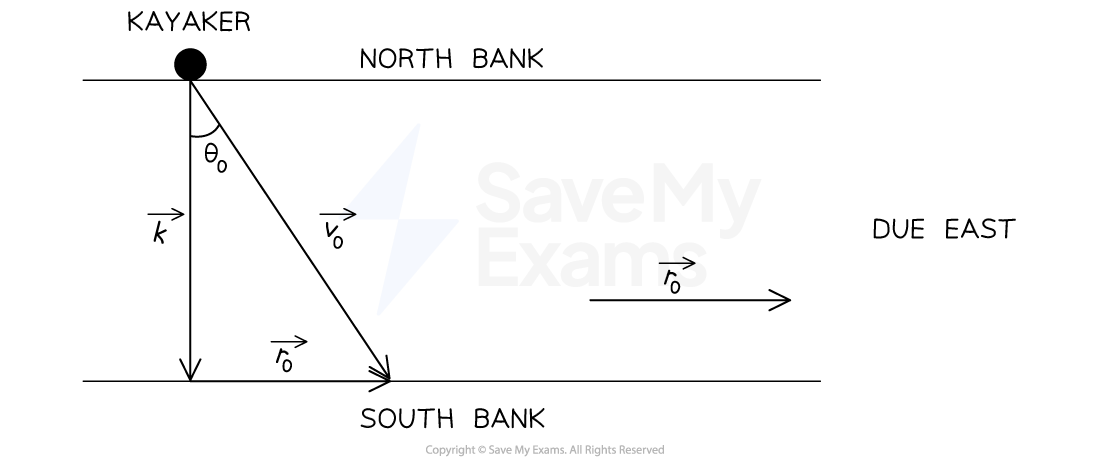
The kayaker travels from the north bank to the south bank, therefore:
The kayaker is positioned on the north bank
The kayaker travels south across the river
The kayaker can maintain a speed of in still water, therefore:
The kayaker's velocity in still water can be written as to the south
The river flows due east at an initial speed of , therefore:
The initial velocity of the river can be written as to the east
The kayaker will be pulled to the east by the current, therefore:
The initial resultant velocity of the kayaker can be written as at angle east from south
Part (a)
State an equation relating the velocities and
Step 1: Identify the relevant fundamental principle
The initial velocity vectors and are the components of vector
Therefore, the relevant fundamental principle is vector addition
Step 2: Apply the fundamental principle to the scenario
The sum of vectors and is equal to the resultant vector
Part (b)
Give an expression for the direction of the kayaker as they cross the river in terms of and
Step 1: Identify the direction of the resultant vector
The direction of a resultant vector is described by an angle
The value of the initial angle is unknown, so it can be written as
Step 2: Determine the trigonometric ratio for the resultant vector
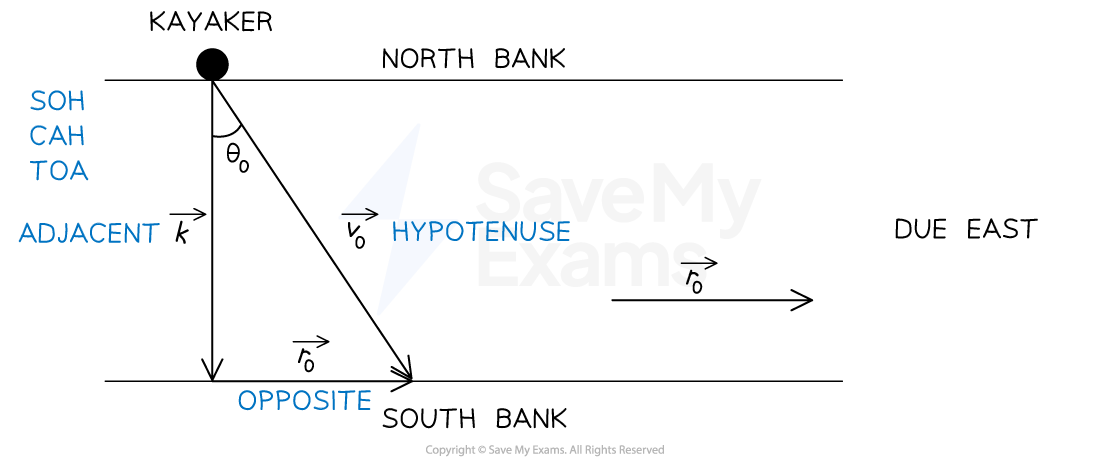
Use the mnemonic SOH CAH TOA to recall the trigonometric ratios
Choose the ratio that includes the terms of and
is the side adjacent to the angle
is the side opposite to the angle
Therefore, the correct trigonometric ratio is tangent
Part (c)
Before the kayaker sets off, the river flow slows to half its initial speed. Derive an equation for the new velocity that the kayaker needs to cross the river
Step 1: Add the information to the sketch
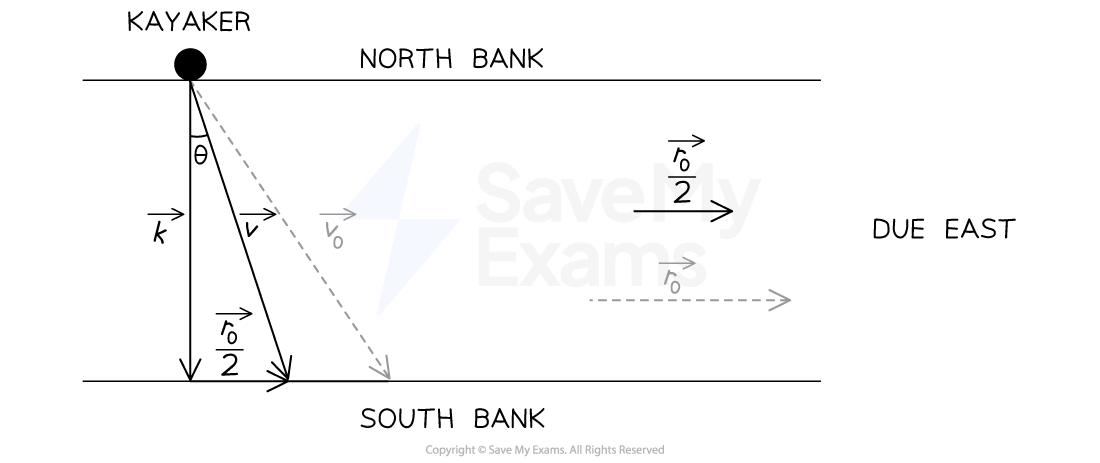
Step 2: Determine an expression for the new river speed vector
The initial velocity vector for river speed is east
The new river speed is half of the initial speed
Therefore, the new velocity of the river can be written as
Step 3: Determine the magnitude of the new resultant vector
The new resultant velocity vector can be written as
The magnitude of this vector is the sum of the vectors and
Step 4: Determine the direction of the new resultant vector
The direction of the new resultant vector is the new angle, which can be written as
The expression for the initial direction from part (B) can be applied to the new situation
Step 5: State the magnitude and direction of the new resultant vector
at an angle east from south
Examiner Tips and Tricks
The problem above is an example of the Qualitative/Quantitative Translation style of free-response question. This is where you are expected to make and justify a claim about a scenario, derive an equation related to the scenario, and then use consistent reasoning to formulate your answer.
You are expected to use algebra as a mode of communication, but it is always a good idea to also use worded statements to show the examiner your thought process. The examiner can only award marks where your logic is clear enough for them to follow. For this reason, it is always a good idea to read through your answer and check for clarity, adding in any notes that you think it needs.

Unlock more, it's free!
Join the 100,000+ Students that ❤️ Save My Exams
the (exam) results speak for themselves:

Was this revision note helpful?
Build on this topic