Figure 2
In a later experiment, Cart 2 is placed next to a wall. When the switch is pressed, the spring expands and the plunger pushes on the wall, causing Cart 2 to move towards Cart 1, as shown in Figure 2. Cart 1 is initially at rest. After the collision, the two carts stick together and move along the track with speed . Blocks of identical, known mass can be attached to Cart 1 and Cart 2, as long as the total mass of the system remains constant. The spring constant of the spring in Cart 2 is unknown. When the spring is contained within the cart, it is compressed by a fixed distance from its equilibrium position.
The students are asked to determine the value of the spring constant of the spring. The students measure the combined mass of Cart 1 and the blocks, the combined mass of Cart 2 and the blocks, and the final speed of the two-cart-block system.
The students measure the fixed value . The students repeat the experiment using different numbers of blocks on each cart and collect the data shown in Table 1.
Table 1
Combined mass of Cart 1 and blocks, (kg) | Combined mass of Cart 2 and blocks, (kg) | Final speed of the two-cart-block system, (m/s) |
|---|
1.750 | 0.500 | 0.410 |
1.500 | 0.750 | 0.505 |
1.250 | 1.000 | 0.585 |
1.000 | 1.250 | 0.650 |
0.750 | 1.500 | 0.720 |
0.500 | 1.750 | 0.775 |
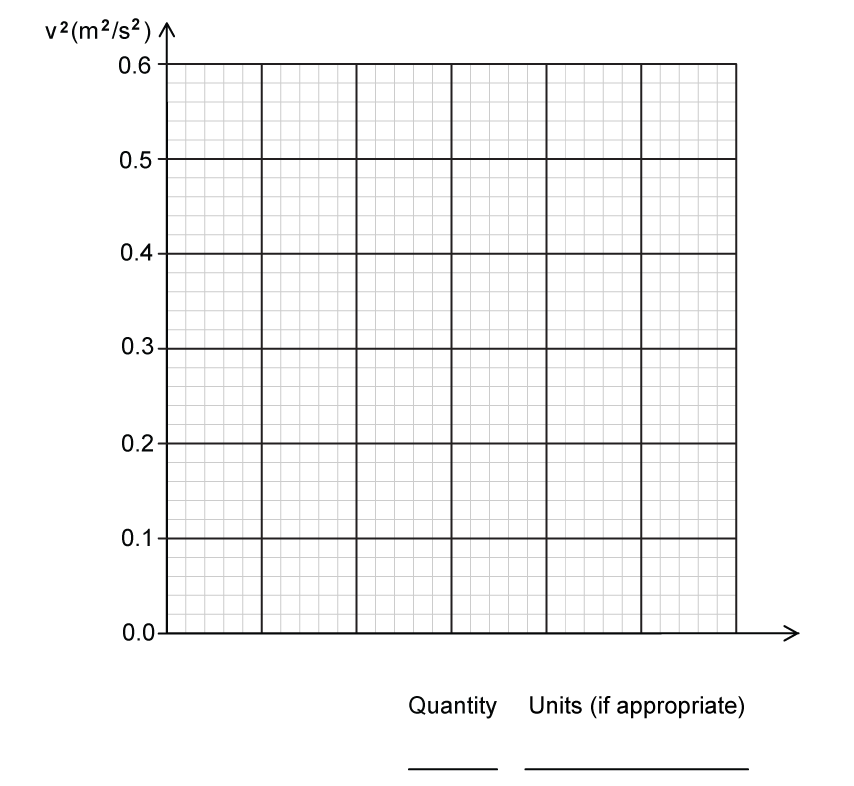
The students create a graph with plotted on the vertical axis.
i) Label the horizontal axis of Figure 3 with a measured or calculated quantity. Include units, as appropriate. The graphed quantities should yield a linear graph that can be used to determine the spring constant of the spring.
ii) On the grid provided in Figure 3, create a graph of the quantities indicated in part c)i).
Clearly label the horizontal axis with a numerical scale
Plot the corresponding data points on the grid
Any columns added to Table 1 for scratch work will not be scored
Figure 3
iii) Draw a best-fit line to the data graphed in part c)ii).