Economic effects (DP IB History: SL): Revision Note

Summary
Stalin's economic policies transformed the Soviet Union from a largely agricultural country into a major industrial power
Rapid industrialisation created new jobs and expanded education but often came at the cost of poor working conditions, shortages and low living standards
Forced collectivisation fundamentally changed rural life, causing widespread disruption, famine and the destruction of traditional peasant communities
The Five-Year Plans increased production of heavy industry but consumer goods and housing remained limited
Industrialisation
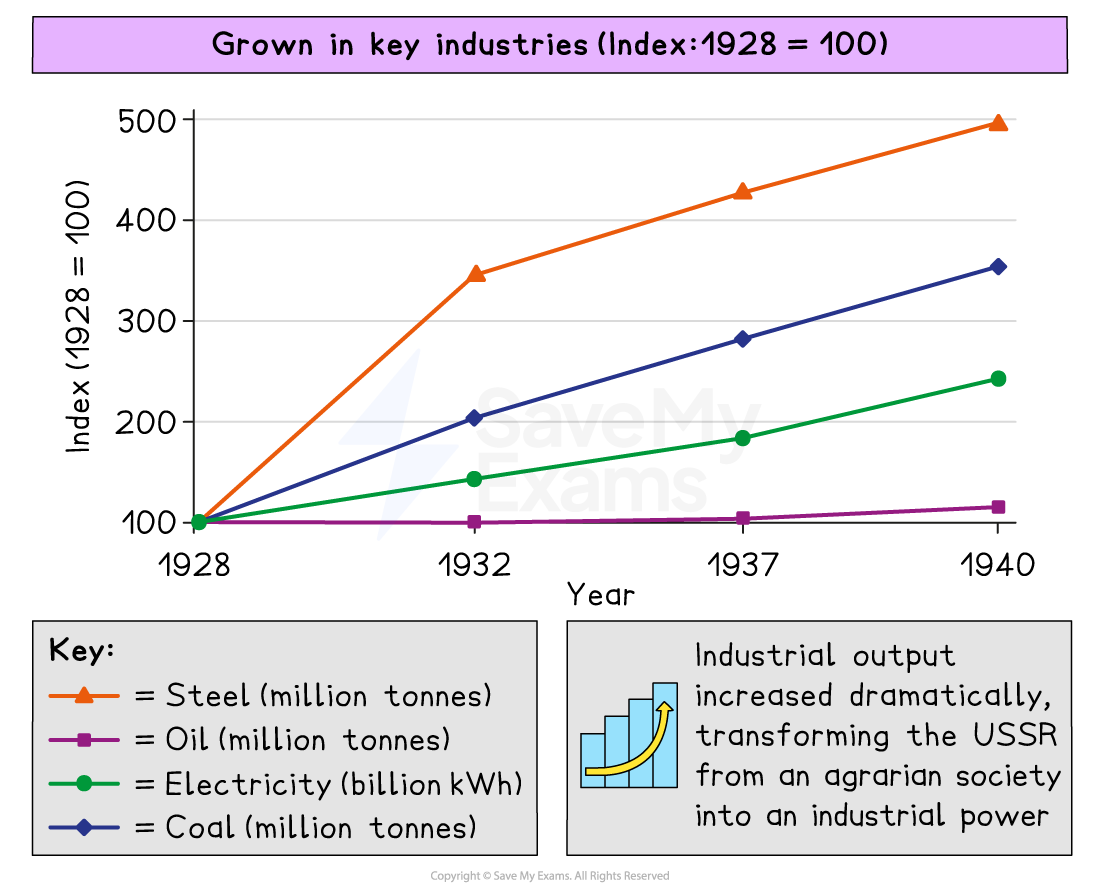
The Five-Year Plans (1928–41) transformed the Soviet economy through rapid industrial growth
Heavy industries such as coal, steel, iron and electricity expanded significantly
New industrial centres, including Magnitogorsk, were developed to support economic growth
Industrialisation created millions of new jobs as factories, mines and construction projects expanded across the Soviet Union
Many workers migrated from rural areas to rapidly growing industrial cities in search of employment
However, factory workers often worked long shifts, faced dangerous conditions and had limited health and safety protections, leading to frequent accidents
Strict labour discipline was enforced through production targets, with absenteeism, lateness and poor performance punished by fines, dismissal or even criminal prosecution
Despite these hardships, industrialisation provided many citizens with stable employment and opportunities for promotion, particularly for skilled workers and loyal Communist Party members
Living standards
Living standards improved unevenly under Stalin, with benefits concentrated in urban and skilled workers
Industrialisation created jobs and largely eliminated unemployment
However, real wages often remained low due to rising prices and shortages
Consumer goods were scarce because the regime prioritised heavy industry over light industry
Rapid urbanisation led to overcrowded housing, poor sanitation and inadequate living conditions in many industrial cities
Access to education and literacy improved significantly, creating greater opportunities for social mobility
Despite these advances, many Soviet citizens continued to experience a relatively poor standard of living
Forced collectivisation
Forced collectivisation transformed agriculture by replacing private farms with collective farms (kolkhozy) and state farms (sovkhozy)
Millions of peasants lost ownership of their land, livestock and farming equipment
Dekulakisation targeted wealthier peasants through confiscation of property, deportation and execution
State grain requisitioning, maintained despite falling harvests, caused the Soviet Famine (1932–33), including the Holodomor in Ukraine.
Traditional village life was permanently changed as the state gained greater control over agricultural production
Employment and social mobility
Industrial expansion created millions of new jobs in factories, construction and government administration
Increased access to education produced more engineers, technicians and skilled workers
Promotion increasingly depended on education, technical skills and loyalty to the Communist Party
Women entered the industrial workforce in greater numbers, expanding employment opportunities
Many workers experienced improved career prospects despite difficult working conditions
Peasants
Peasants experienced some of the greatest economic changes under Stalin
Collectivisation removed private ownership and increased state control over agriculture
Grain requisitioning reduced the amount of food available for farming communities
Many peasants resisted collectivisation by slaughtering livestock or destroying crops
Rural communities experienced famine, displacement and declining living standards during the early 1930s
Examiner Tips and Tricks
In your exam answers on this topic, try to balance economic successes with economic hardships.
Make sure to distinguish between industrial workers and peasants, as their experiences differed significantly.
Support answers with specific evidence such as the Five-Year Plans, collectivisation, Magnitogorsk, the Holodomor and the Stakhanovite Movement (add link to the propaganda and popular support page)
Historiography
Orthodox interpretation
Robert Conquest argues that Stalin's economic policies achieved industrial growth but imposed enormous human suffering through collectivisation and famine.
Revisionist interpretation
Sheila Fitzpatrick argues that industrialisation created genuine opportunities for social mobility and improved education, benefiting many Soviet citizens despite its costs.
Post-revisionist interpretation
Stephen Kotkin argues that Stalin's economic transformation modernised the Soviet Union but depended on coercion and sacrifice, producing both significant achievements and severe hardship.

Unlock more, it's free!
Join the 100,000+ Students that ❤️ Save My Exams
the (exam) results speak for themselves:

Was this revision note helpful?
