Role of ideas (DP IB History: SL): Revision Note

Summary
Stalin used ideology to strengthen his claim to leadership after Lenin's death in 1924
His idea of "Socialism in One Country" appealed to party members who wanted stability and national security
He presented himself as Lenin's true successor and portrayed rivals as ideological deviants
Although ideas helped Stalin gain support, they were mainly a tool to strengthen his political position rather than the main reason for his rise to power
Marxism-Leninism
Following Lenin's death on the 21st January 1924, Stalin portrayed himself as the defender of Marxism-Leninism and vowed to preserve the achievements of the October Revolution
He used communist ideology to justify one-party rule and suppression of opposition
Stalin argued that the Communist Party represented the “vanguard of the proletariat”
Meaning that only the Communist Party understood the historical direction of socialism and therefore had the right to rule without opposition
Stalin publicly pledged loyalty to Lenin
This helped create the image of him as "Lenin's faithful disciple"
Stalin selectively interpreted Lenin’s writings to support his own policies
This created the impression that Stalin’s leadership was the natural evolution of Marxist-Leninist doctrine
He also claimed that rivals who disagreed with him were deviating from Leninist principles and posed a threat to socialism
This allowed political opposition to be reframed as ideological betrayal rather than legitimate disagreement, strengthening the legitimacy of repression within the party
As a result, Marxism–Leninism functioned as a framework of legitimacy
This allowed Stalin to justify centralised authority, ideological conformity, and suppression of opposition as necessary for the survival of socialism
Lenin
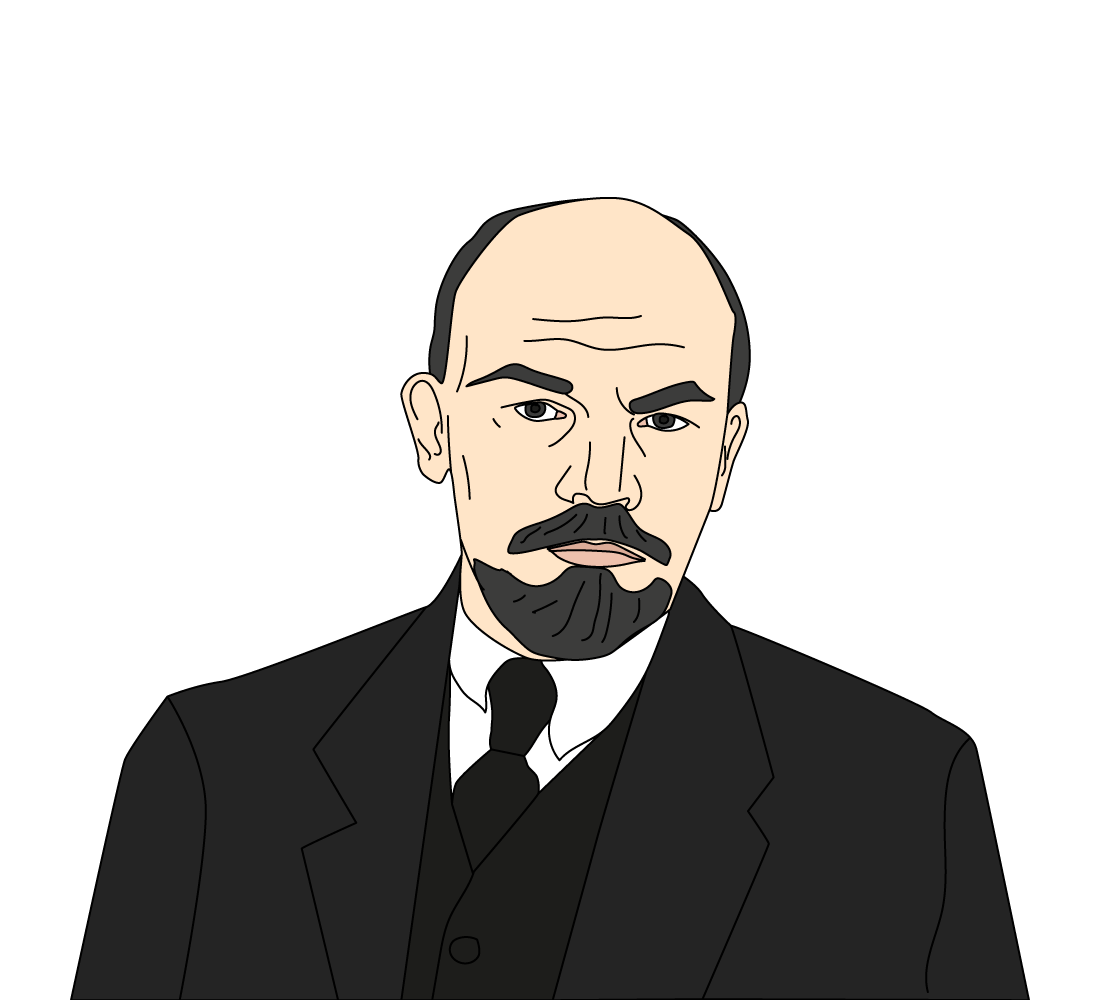
Leader of the Bolsheviks
Lenin led the Bolshevik faction of the Russian Social Democratic Labour Party
He became leader of the October Revolution in 1917
Creator of the Soviet State
Lenin established the world's first communist state and introduced one party rule under the Communist Party
Key policies
Civil War Communism (1918-21)
New Economic Policy (1921)
Beliefs
A committed Marxist who believed in a vanguard party, democratic centralism and the eventual creation of a classless society
Leadership style
A pragmatic and flexible leader who was willing to compromise to achieve long term communist goals
Death and legacy
Lenin died on 21 January 1924
His death triggered the struggle for power
Key point
Lenin built the foundations of the Soviet state and the Communist Party. His death created a power vacuum leading to a struggle for succession which Stalin won.
Socialism in One Country
"Socialism in One Country" was a policy introduced by Stalin in 1924
He argued that socialism could be built successfully in the USSR without relying on worldwide revolution
This directly opposed Trotsky’s theory of permanent revolution
Trotsky argued that socialism could only survive through continuous international expansion
The idea of 'Socialism in One Country' appealed strongly to party members after years of instability caused by :
World War I (1914–18)
The Russian Civil War (1918–21)
Economic crisis
It promised stability, economic development and national strength rather than ongoing international conflict
The idea became increasingly accepted within the Communist Party by 1925, giving Stalin ideological authority over rivals
It also helped Stalin appear practical and patriotic, contrasting with more radical revolutionary visions
Stalin's position was strengthened among newer party members, particularly those admitted during the Lenin Enrolment (1924–25)
This significantly expanded Communist Party membership
Lenin’s legacy
A key ideological tool in Stalin’s rise was the use of Lenin’s legacy as a source of political legitimacy
Lenin was elevated to a near-sacred ideological authority
This meant that claiming to represent “true Leninism” became essential for political survival within the Communist Party
Stalin positioned himself as the only leader capable of correctly interpreting Lenin’s ideas
This reinforced the image of ideological continuity between Lenin and Stalin
Opponents such as Trotsky were portrayed as “anti-Leninist”, even though they had played central roles in the revolution
Stalin selectively quoted Lenin’s writings, often removing context, to support his own political positions and policy choices
This created an ideological environment where loyalty to Lenin’s interpreted legacy mattered more than original ideological debate
As a result, Leninism became a flexible ideological tool, used to legitimise Stalin’s authority and delegitimise rivals
Examiner Tips and Tricks
For high marks in your essays, constantly show ideology doing ONE of these:
Legitimising authority (Stalin = Lenin’s heir)
Delegitimising rivals (Trotsky = anti-Leninist)
Defining political truth (Stalin decides orthodoxy)
If a paragraph doesn’t do one of these, it’s too descriptive
[INSERT IMAGE OF STALIN POSTER HERE]
Significance of ideology
Marxism–Leninism functioned as a flexible system of justification rather than a fixed doctrine
It allowed Stalin to:
Legitimise his authority as historically necessary
Delegitimise rivals as ideological deviants
Reframe political conflict as ideological struggle
Present policy shifts as doctrinal correctness
In this sense, ideology did not directly create Stalin’s power, but it defined the language through which power was understood, justified, and accepted within the Communist Party
Historiography
Orthodox interpretation
Orthodox historians argue that ideology was central to Stalin’s rise, particularly his use of Marxism–Leninism and “Socialism in One Country” to defeat rivals and legitimise his authority as Lenin’s true successor
Revisionist interpretation
Revisionist historians argue that ideology was mainly a tool used to justify Stalin’s victory, with real power coming from party control, patronage, and political manoeuvring rather than ideological debate
Post-revisionist interpretation
Post-revisionist historians argue that ideology and political power worked together, with Stalin using ideological arguments to legitimise and strengthen his control within the Communist Party

Unlock more, it's free!
Join the 100,000+ Students that ❤️ Save My Exams
the (exam) results speak for themselves:

Was this revision note helpful?
