Economic factors (DP IB History: SL): Revision Note

Summary
Economic difficulties following the Russian Civil War and War Communism increased demand for stability and effective leadership within the Communist Party
The New Economic Policy (NEP) divided party leaders
This allowed Stalin to position himself between rival factions and strengthen his leadership
Economic uncertainty encouraged many party members to support Stalin's policies
Although economic factors shaped the succession struggle, they mainly created opportunities that Stalin exploited through political skill
Economic legacy of War Communism
War Communism (1918–21) left the Soviet economy devastated, with industrial production falling to around 20% of its 1913 level
Agricultural production collapsed, contributing to widespread famine, including the Russian Famine of 1921–22, which killed an estimated 5 million people
Economic hardship increased pressure on the Communist Party to restore stability and improve living standards
Many party members prioritised practical economic recovery over ideological disputes, creating favourable conditions for Stalin's moderate image
Case Study
War Communism (1918-1921)
War Communism was the economic system introduced by the Bolsheviks during the Russian Civil War (1918–21)
Its aim was to ensure that the Red Army and cities received sufficient food and resources
It involved:
State control of industry
Forced grain requisitioning from peasants
Nationalisation of businesses
Banning of private trade
Rationing of food and essential goods
The policy aimed to maximise resources for the war effort and strengthen Bolshevik control over the economy
Although it helped the Bolsheviks win the Civil War, it caused:
Severe economic disruption
Falling industrial and agricultural production
Widespread famine
Growing public unrest
The failure of War Communism led Lenin to replace it with the New Economic Policy (NEP) in 1921
Examiner Tips and Tricks
Remember! War Communism is best understood as a temporary emergency wartime policy, rather than a long-term socialist economic programme. It created many of the economic problems that shaped the debates during Stalin's emergence as leader.
The New Economic Policy (NEP)
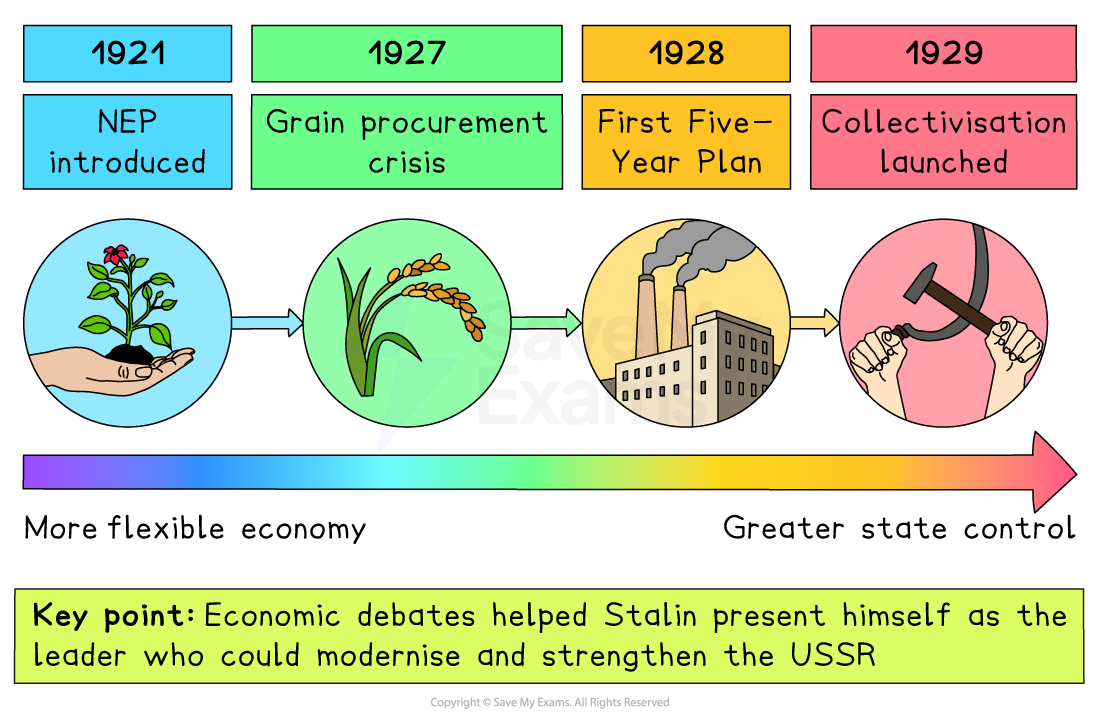
Lenin introduced the NEP in 1921, replacing grain requisitioning with a tax in kind and allowing limited private trade and small businesses
The NEP successfully restored agricultural and industrial production but created growing divisions within the Communist Party
Many Bolsheviks viewed the NEP as a temporary compromise that moved the USSR away from socialist principles
Stalin initially supported the continuation of the NEP, allowing him to build an alliance with Bukharin (link to conflict page on Bukharin) and isolate the Left Opposition
Stalin's flexible position enabled him to appear moderate while rivals became increasingly divided over economic policy
Examiner Tips and Tricks
Try to focus on economic conditions and debates, not the Five-Year Plans or collectivisation, which belong under the consolidation of Stalin's rule after 1929.
Explain how economic issues divided Stalin's rivals and created opportunities, rather than suggesting they alone caused his rise.
The grain procurement crisis (1927–28)
Grain deliveries to the state fell sharply during 1927–28
This created shortages in Soviet towns and threatened food supplies
Many party members viewed the crisis as evidence that the NEP had reached its limits
Stalin argued that stronger state intervention was necessary to secure grain and accelerate economic development
The crisis undermined support for Bukharin's defence of the NEP and strengthened Stalin's position within the party
It provided Stalin with the opportunity to abandon the NEP and justify a new economic direction
Historiography
Orthodox interpretation
Orthodox historians argue that economic debates, particularly over the NEP and industrialisation, played an important role in Stalin's emergence by exposing divisions within the Communist Party.
Revisionist interpretation
Revisionist historians argue that economic issues were secondary, with Stalin's rise depending primarily on political manoeuvring and organisational control rather than economic policy.
Post-revisionist interpretation
Post-revisionist historians argue that economic problems created opportunities for Stalin, but only became significant because he successfully exploited divisions over economic policy.

Unlock more, it's free!
Join the 100,000+ Students that ❤️ Save My Exams
the (exam) results speak for themselves:

Was this revision note helpful?
